


Online scams have become increasingly common, demanding greater attention to the links and online content we interact with daily. Cybercriminals are constantly creating new methods to deceive people for financial gain, ranging from falsified payment receipts to fake technician impersonations. In Brazil, around 71% of the population has already fallen victim to this type of crime, which shows the need for caution when clicking on links in WhatsApp messages, emails, or SMS, as well as avoiding sharing personal information with strangers. To reduce risks, it is essential to understand how these scams work, recognize their main types, learn what to do if you are targeted, and adopt preventive measures to protect your data and avoid financial losses.
This article is part of a series on digital security. You can read the other texts here.
This Content Is Only For Subscribers
To unlock this content, subscribe to INTERLIRA Reports.
WhatsApp Scams
WhatsApp is one of Brazil’s favorite apps, with over 120 million users in the country. Its popularity makes it a convenient tool for communication, payments, and even business—but it has also become a prime target for scammers. Criminals use WhatsApp to carry out social engineering attacks that can result in financial losses and personal data being stolen.
– The Most Common WhatsApp Scams
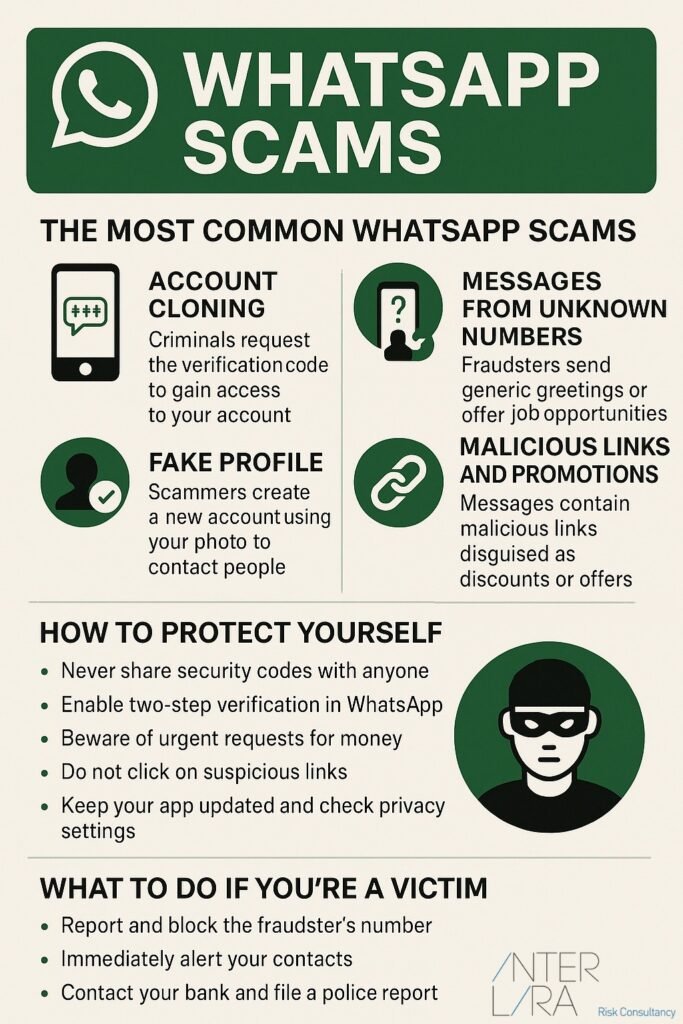
• Account Cloning (Verification Code Scam): Criminals attempt to register your WhatsApp number on another device. To complete the process, they need the six-digit verification code sent by SMS. Posing as bank staff, customer service agents, or delivery platforms, they trick victims into revealing the code. With access, scammers clone the account, read conversations, and contact friends and family requesting urgent money transfers.
• Fake Profile (“New Number” Scam): Fraudsters create a WhatsApp profile using the victim’s photo but with a different phone number. They then reach out to contacts, claiming they’ve changed their number, and invent an emergency to ask for money or bill payments.
• Messages from Unknown Numbers: Scammers send generic greetings like “hi” or pretend to be someone you know with a “new number.” In some cases, they offer fake job opportunities with promises of high pay and few working hours. These schemes often involve requests for personal data, links to malicious websites, or urgent money transfers.
• Malicious Links and Promotions: Criminals send messages with links disguised as promotions or discounts. When victims click, they are redirected to fake pages designed to steal personal data or install malware.
– How to Protect Yourself
• Never share your WhatsApp verification code or security codes with anyone.
• Enable two-step verification in WhatsApp settings to add an extra layer of protection.
• Be cautious with urgent requests for money, even from known contacts. Confirm by calling or making a video call before sending money.
• Do not click on suspicious links, even if they come from friends or family. Always check the source.
• Keep your WhatsApp updated and adjust privacy settings (such as limiting who can see your profile photo).
• Avoid posting your phone number publicly on social media.
• Log out of WhatsApp Web on shared devices.
– What to Do if You’re a Victim
• If your account is cloned or a fake profile is created with your photo, report the number within WhatsApp using the “Report and Block” option. You can also email support@whatsapp.com to notify the platform.
• Immediately alert your contacts so they don’t fall victim to money requests sent in your name.
• If someone transferred money to a scammer, advise them to contact their bank right away and file a police report with the Civil Police, including all available details about the fraudster.