


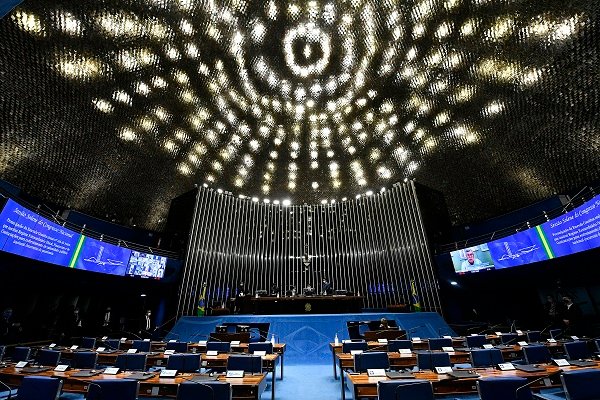
Brazil’s political landscape is entering the final stretch of the year under heightened institutional strain, with Congress, the Judiciary, and the Executive entangled in a series of sensitive and high-impact decisions. Lawmakers are pushing forward controversial legislation that could reduce sentences for those convicted of coup-related crimes linked to the January 8 attacks, a move that has reignited protests in dozens of cities and intensified public debate over accountability and democracy. At the same time, Congress is racing to clear its legislative agenda, including votes on the 2026 federal budget, amid shifting public priorities that now place health and public security at the center of national concern. High-profile developments — such as the arrest and release of the president of Rio de Janeiro’s state Chamber and the resignation of federal congresswoman Carla Zambelli following a Supreme Court order — further highlight the growing tension between political actors and institutions as Brazil closes the year in a climate of polarization and legal uncertainty.
This Content Is Only For Subscribers
To unlock this content, subscribe to INTERLIRA Reports.
National Problems
Health is cited as the main problem facing Brazil by 20% of the population, according to the most recent Datafolha survey. Public security follows closely, identified as the country’s biggest problem by 16% of respondents. Concerns about public security were more prevalent among men, reaching 18%, while health was the most frequently cited issue among women, at 26%. The findings represent a significant shift compared to the previous survey released in April, when the economy was identified as the main national problem by 22% of respondents. The current scenario, however, echoes earlier trends: in a September 2023 survey, health and public security were tied as the country’s top concerns, each cited by 17% of the population.
Sentencing Bill
The Chamber of Deputies approved on Wednesday (10/12) a bill that reduces the sentences of those convicted of coup-related acts, including the events of January 8, 2023, when supporters of former President Jair Bolsonaro (PL) invaded and vandalized the headquarters of the three branches of government in Brasília. If the bill is also approved by the Senate, Bolsonaro could see his sentence reduced and spend less time in prison. He was sentenced to 27 years and three months for allegedly leading a plan to stage a coup d’état and is currently serving his sentence at the Federal Police headquarters in Brasília. The so-called Sentencing Bill establishes that the crime of coup d’état, which carries a higher penalty of four to 12 years, should absorb the crime of violent abolition of the democratic rule of law, punishable by four to eight years. The proposal also accelerates sentence progression, allowing release from a closed regime after serving one-sixth of the sentence, instead of the current requirement of one-quarter. The bill will now be sent to the Senate.
Protests
Demonstrators took to the streets on Sunday (14/12) to protest the approval of the Sentencing Bill by the Chamber of Deputies. The proposal reduces sentences for those convicted of attempted coup-related crimes, including former President Jair Bolsonaro. Protests were recorded in at least 21 state capitals. In Rio de Janeiro and São Paulo, demonstrations began around 14:00 and drew noticeably smaller crowds than the protests held on September 21 against the Shielding Amendment, which gathered about 40,000 people in each city. According to a survey by the Political Debate Monitor and the NGO More in Common, the São Paulo protest peaked at around 13,700 participants. In Rio, the demonstration featured a strong presence of artists, which helped boost attendance, but even so, approximately 18,900 people were counted in Copacabana around 5 p.m., less than half the turnout seen in September.
End of Year
Congress is entering the final stretch of 2025 with a packed legislative agenda aimed at clearing pending votes before the end of the year. On Wednesday (17/12), the Senate’s Constitution and Justice Committee (CCJ) is expected to analyze the bill reducing sentences for those convicted of coup-related crimes, a measure that could benefit former President Jair Bolsonaro.The proposal will be the only item on the committee’s agenda and is being reported by Senator Esperidião Amin (PP-SC). In parallel, deputies and senators are expected to vote in a joint session scheduled for Thursday (18/12) on the 2026 Federal Budget. According to Senate President Davi Alcolumbre (União Brasil), the session could be brought forward to Wednesday if an agreement is reached between the two chambers. Before that, the budget text must be approved by the Joint Budget Committee (CMO).
Bacellar’s Arrest
The Legislative Assembly of Rio de Janeiro (Alerj) decided on Monday (08/12) to release state lawmaker Rodrigo Bacellar (União Brasil), president of the House. Of the 65 deputies who voted, 42 supported his release, while 21 voted to keep him detained. Bacellar had been arrested by the Federal Police on Wednesday (03/12) on suspicion of involvement in the leak of information about an operation that led to the arrest of former deputy TH Jóias in September. TH Jóias is accused of mediating the purchase and sale of drugs, weapons, and equipment for the Red Command criminal faction. Bacellar’s arrest had been ordered by Supreme Federal Court Justice Alexandre de Moraes, based on a Federal Police investigation.
Resignation
Congresswoman Carla Zambelli (PL) informed the Chamber of Deputies on Sunday (14/12) of her decision to resign from her mandate. The Speaker of the House, Hugo Motta (Republicanos), announced that Zambelli’s substitute, Adilson Barroso (PL), will be sworn in. The resignation was part of a political arrangement negotiated with House leadership after the plenary rejected a motion to expel Zambelli, who had been sentenced to prison by the Supreme Federal Court. On Friday (12/12), the Court responded by saying that the rejection was unconstitutional and ordered Motta to revoke her mandate. Lawmakers say the resignation prevents a prolonged institutional clash with the STF, as the court order effectively loses its purpose. It also allows Zambelli and her party to frame the move as a voluntary decision rather than a direct submission to judicial intervention.
Analysis:
Brazil is closing the year under an unusually high level of institutional friction, driven by overlapping disputes between Congress, the Judiciary, and the Executive. The advancement of legislation that reduces sentences for coup-related crimes places the Legislative Branch on a direct collision course with the Supreme Court’s recent jurisprudence and with a segment of public opinion that views accountability for January 8 as a democratic red line. At the same time, Congress’s rush to conclude its agenda before the recess reflects both procedural pressure and a strategic effort to settle controversial matters while political costs can still be diluted by the holiday period.
Recent episodes involving the arrest and release of Rodrigo Bacellar and the resignation of Carla Zambelli further expose the delicate balance between political self-preservation and judicial authority. In both cases, negotiated outcomes were used to contain institutional escalation rather than resolve underlying tensions. As Brazil heads into 2026, these patterns suggest a system operating through short-term accommodations, where legal certainty, political accountability, and institutional trust remain under sustained pressure.
Sources: A Folha de SP [1], [2], [3]; O Globo [1], [2]; G1 [1], [2].

