


Brazil’s political agenda is increasingly being shaped by the early race for 2026 and the pressures of an election-year Congress: while Lula and Jair Bolsonaro’s camp move to consolidate alliances in key states and street rallies adopt an openly electoral tone around Flávio Bolsonaro’s pre-candidacy, lawmakers also face contentious votes on public security and labor rules, including the PEC that would lower the age of criminal responsibility for certain crimes and the dispute over ending the 6×1 work schedule. At the same time, congressional leaders have told the Supreme Federal Court that there is little appetite to tackle “super wages” and public-sector perks before elections, arguing that any move against powerful civil-service groups carries high political costs.
This Content Is Only For Subscribers
To unlock this content, subscribe to INTERLIRA Reports.
Definitions
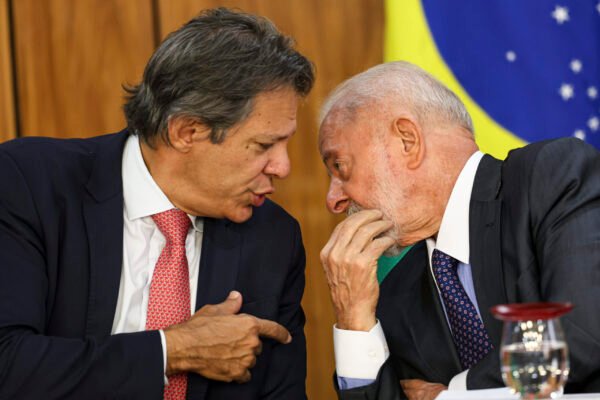
President Lula (PT) and former President Jair Bolsonaro have intensified negotiations ahead of the 2026 presidential race, holding a series of meetings to secure state-level political support, particularly in the country’s largest electoral strongholds. Lula, who plans to seek re-election, has a meeting scheduled for Tuesday (03/03) with Finance Minister Fernando Haddad and Vice President Geraldo Alckmin to shape strategy in São Paulo. Bolsonaro, imprisoned in Papudinha in Brasília after being convicted of leading a coup plot, is working to manage internal disputes within his camp over Senate candidacies. Barred from running, the former president is expected to be represented in the presidential contest by his son, Senator Flávio Bolsonaro (PL-RJ).
Demonstrations
The pro-Bolsonaro rally held Sunday afternoon (01/03) on Avenida Paulista took on an overtly electoral tone, backing Senator Flávio Bolsonaro’s (PL-RJ) pre-candidacy for president. Alongside criticism of the Lula (PT) administration, demonstrators called for former President Jair Bolsonaro’s (PL) release and the event was convened by pro-Bolsonaro federal deputy Nikolas Ferreira (PL-MG) under the slogan “Out with Lula, Moraes and Toffoli,” referencing Justices Alexandre de Moraes and Dias Toffoli, mentioned in connection with the Banco Master case. It was the first major street demonstration in which Flávio participated in the role of presidential hopeful. He arrived around 14:45 wearing a bulletproof vest and was the last speaker, repeating his father’s slogan, “Brazil above all and God above everyone.” Similar demonstrations were held simultaneously in at least 33 cities, including capitals such as Rio de Janeiro, Belo Horizonte, Brasília, and Curitiba. The event drew an estimated 20,400 people, according to the Political Debate Monitor, an initiative of Cebrap in partnership with the NGO More in Common. Among the protests already measured by the group in the same location, this one registered the second-lowest turnout.
Public Security Constitutional Amendment Proposal (PEC)
The Chamber is expected to vote this week on the Public Security Constitutional Amendment Proposal (PEC). The plan is for the special committee and the full plenary to vote on Wednesday (04/03). The rapporteur, Deputy Mendonça Filho (União Brasil), is expected to present the final version of his report on the same day, after concluding meetings scheduled through Tuesday with both government-aligned parties and the opposition. According to the lawmaker, centrist and right-leaning blocs have already converged around the text, while left-wing parties remain resistant to provisions included in the report, especially the proposal to lower the age of criminal responsibility to 16 for certain crimes, identified as the main point of disagreement.
6×1 Shift
The right wing has decided to close ranks towards ending the 6×1 work schedule. Last week, three party leaders criticized the idea of changing the law to guarantee workers two days of rest per week. Their statements reveal as much about the group’s mindset as about the substance of the proposal. União Brasil chairman Antonio Rueda called the mobilization “madness.” PL leader Valdemar Costa Neto said ending the 6×1 schedule would be “a bomb.” At a dinner in São Paulo, both politicians vowed to work hard to stop the change and acknowledged that the only certain way to block it would be to obstruct its progress. Valdemar warned that the debate in the Chamber’s Constitution and Justice Committee will be “a war.”
Super Salaries
Congressional leaders signaled to the Supreme Federal Court (STF) that they see major political obstacles to approving changes to the rules on “super wages” and public-sector perks in an election year. The meeting was convened by STF Chief Justice Edson Fachin and attended by the presidents of the Chamber of Deputies and the Senate, as well as Justices Gilmar Mendes and Flávio Dino, who issued injunctions restricting the payment of allowances that can push compensation above the constitutional salary cap. According to reports, legislative representatives—Chamber Speaker Hugo Motta and Senate President Davi Alcolumbre—argued that there is no political environment to vote on measures that directly affect organized public-service groups on the eve of elections. The view is that the issue carries a high political cost and could mobilize powerful corporations at a sensitive point in the electoral calendar.
Analysis:
Brazil’s political arena is entering a pre-electoral phase earlier than usual, with strategic positioning for 2026 already shaping institutional behavior. President Lula’s efforts to consolidate alliances in São Paulo and other major states indicate recognition that reelection will depend on broad, state-level coalitions rather than solely on national messaging. On the opposition side, Jair Bolsonaro’s imprisonment has not diminished his influence over his political base, but it has forced a transition toward proxy leadership through Senator Flávio Bolsonaro. The relatively modest turnout at the Avenida Paulista rally suggests that while the movement retains mobilization capacity, it may be struggling to reproduce the peak street momentum seen in earlier cycles.
Meanwhile, Congress is navigating an agenda loaded with ideologically charged proposals that resonate strongly with electoral narratives. Such measures tend to polarize the electorate, reinforcing law-and-order messaging while provoking constitutional and human-rights concerns. The reluctance of congressional leaders to advance reforms on super wages and public-sector perks illustrates the structural constraints of an election-year Congress. Measures that confront organized civil-service groups carry concentrated political risks, while their fiscal benefits are diffuse and long term.
Sources: O Globo [1], [2], [3], [4], [5], [6]; G1; A Folha de SP.

