


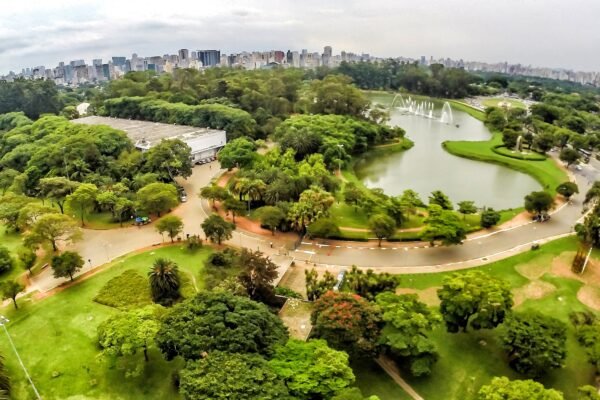
Ibirapuera Park goers have been reporting a series of attacks focused on the subtraction of small items. A series of cases of violence inside the most famous park in the capital São Paulo is scaring people that normally go there. Although crimes of this nature have declined in recent years, according to data from the Public Security Secretariat (SSP), they continue to raise concerns among park users.
This Content Is Only For Subscribers
To unlock this content, subscribe to INTERLIRA Reports.
Incident
One example took place in February. It was around 19:30 when neurosurgeon Marcelo de Lima Oliveira, 55, from Albert Einstein Hospital, decided to walk along a dirt trail inside Ibirapuera Park, in the southern zone of São Paulo, where he usually exercises a few times a week. A few minutes later, he was approached by two young men who surrounded him. He attempted to escape, but there was no clear route. He was tripped and assaulted for about five minutes while the attackers tried to take his cell phone, which was hidden in his shorts pocket. People near a parking area heard the commotion and began shouting, which caused the suspects to flee, already carrying the device.
Data
In 2024, there were 115 recorded cases of theft or robbery involving cell phones within the park. In the following year, this number dropped to 88, representing a reduction of 23.5%. Across the city of São Paulo as a whole, however, the decrease was significantly smaller, at 1.1%, with 161,666 cases recorded last year compared to 163,437 in 2024. In January of this year, the only month for which updated data is available, five incidents were reported inside the park. There is no consolidated data available on other types of thefts or robberies within the park, only on those specifically involving mobile phones.
Park Surroundings
In contrast to the decline observed inside the park, crime in the surrounding areas increased sharply, rising by 69% last year compared to the previous year. In 2025, there were 800 recorded cases of cell phone theft or robbery in the vicinity—708 classified as theft and 92 as robbery—compared to 472 incidents in 2024, when 410 thefts and 62 robberies were reported. These figures include occurrences on major avenues that border Ibirapuera Park, such as Quarto Centenário, República do Libano, and Pedro Álvares Cabral, indicating a significant shift in criminal activity toward the park’s perimeter.
User Reports
Frequent visitors report recurring incidents of theft and robbery, especially in less crowded or poorly monitored areas of the park. The crimes typically occur quickly, with suspects emerging from areas with dense vegetation and targeting individuals who appear distracted. In the case of the neurosurgeon, the assault took place on a trail near gate 4. The experience altered his routine, and he now restricts his activities to more central areas and prefers to visit the park during the morning. The sense of insecurity also affects workers in the park. A vendor who has worked at a stall for about a year and a half reports repeated break-ins at kiosks, sometimes occurring within short intervals. According to him, criminals use tools to force entry and steal products and equipment even during early morning hours, when the park is closed.
Other Reports
The area is frequently occupied by runners wearing headphones, cyclists, and visitors using their phones to record or photograph the surroundings, creating breaches for crimes of opportunity. One such case involved a woman working at a stall near Bienal Street, who noticed a teenager observing her while she was using her phone. After she put the device away, the suspect changed position and began moving near parked bicycles. A police patrol passed by, prompting her to alert the officers, but the teenager fled when approached. According to her, many vendors avoid filing police reports due to fear of retaliation. There are also reports of stalls being targeted multiple times, particularly in less busy areas such as the bamboo grove, where reduced foot traffic increases vulnerability to criminal activity.
Analysis:
The incident involving the neurosurgeon inside Ibirapuera Park illustrates a broader pattern in urban crime dynamics, where even traditionally safe and well-frequented public spaces are not immune to opportunistic violence. Although official data shows a decline in reported thefts within the park itself, the persistence of assaults—often in less monitored or more isolated areas—suggests that risk has not been eliminated but rather redistributed. Criminal behavior in such environments tends to exploit moments of low visibility, limited guardianship, and predictable user routines, particularly targeting individuals engaged in leisure activities who may be distracted or carrying easily accessible valuables.
The sharp increase in crime in the park’s spatial surroundings reinforces the hypothesis of displacement rather than a structural reduction in criminal activity. When enforcement or informal surveillance intensifies within a defined area, offenders often shift operations to adjacent zones where the perceived risk of apprehension is lower.
Sources: A Folha de SP.

