


Summary
The debate over whether Brazilian criminal factions should be classified as terrorist organizations has recently gained prominence. At the center of this debate are groups such as the First Capital Command (PCC) and the Red Command (CV), which, despite their high levels of violence and territorial control, are not legally considered terrorist organizations under Brazilian law. This distinction is rooted in the country’s legal framework, which defines terrorism based on ideological, political, or discriminatory motivations—criteria that do not align with the profit-driven nature of these groups.
The issue has been further complicated by the stance of the United States government under the Trump administration, where broader legal definitions could potentially lead to the designation of these groups as Foreign Terrorist Organizations (FTOs). Such a move has sparked significant concern regarding national sovereignty, the future of international cooperation, and potential U.S. interference in Brazil’s internal security policies.
Beyond legal classification, the debate carries significant political weight, especially in the context of the 2026 elections, where it has been used to frame competing narratives on public security. At the same time, questions remain about the practical effectiveness of such reclassification, raising fundamental concerns about the consequences and limitations of redefining organized crime as terrorism.
Conceptual boundaries between organized crime and terrorism
The Brazilian government’s position against classifying domestic criminal factions as terrorist organizations reflects the legal and conceptual framework established in national legislation. Under Brazilian law, terrorism is defined as acts of violence committed “for reasons of xenophobia, discrimination or prejudice based on race, color, ethnicity or religion, when carried out with the purpose of provoking widespread or generalized social terror,” highlighting the central role of ideological or discriminatory motivation. This definition sets a narrow legal threshold and distinguishes terrorism from other forms of violence.
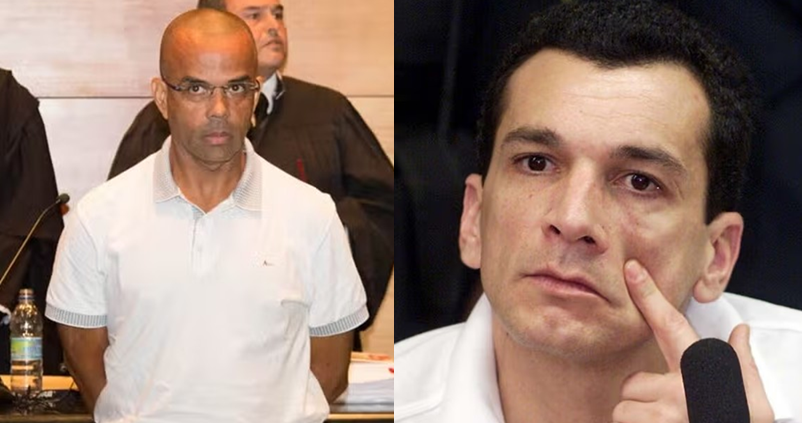
Within this framework, groups such as the PCC and the CV do not qualify as terrorist organizations. Brazilian authorities argue that these groups are primarily profit-oriented, operating through illicit activities such as drug trafficking, arms smuggling, and money laundering. As noted by a former Ministry of Justice official, these organizations “have no ideological, political, or religious orientation… their objective is to commit criminal offenses and launder money,” reinforcing that motivation is the key differentiating factor.
This distinction is further supported by legal scholarship. According to Thiago Bottino, Law professor at the Getúlio Vargas Foundation, “a terrorist act seeks to destabilize the government, whereas criminal organizations like ours do not seek to destabilize any government.” He further explains that “the more stable the environment, the better it is for their criminal activities,” underscoring how organized crime tends to depend on institutional stability rather than challenge it.
Legal, international and security impacts
The possible designation of Brazilian criminal factions as Foreign Terrorist Organizations (FTOs) by the United States would generate significant legal, financial, and diplomatic consequences, extending far beyond a symbolic change in classification. The measure would trigger a series of legal mechanisms under U.S. jurisdiction with extraterritorial effects.
One of the most immediate consequences would be the possibility to freeze the assets linked to these organizations in jurisdictions connected to the international financial system. In addition, companies and individuals — even indirectly associated with these groups — could face expanded sanctions and restrictions.
The classification would also enhance U.S. capacity for extraterritorial enforcement, including broader investigative powers and increased pressure for judicial and police cooperation by Brazilian authorities. According to experts, this could lead to more frequent requests for information sharing, joint operations, and coordinated enforcement actions, potentially reshaping bilateral security cooperation.
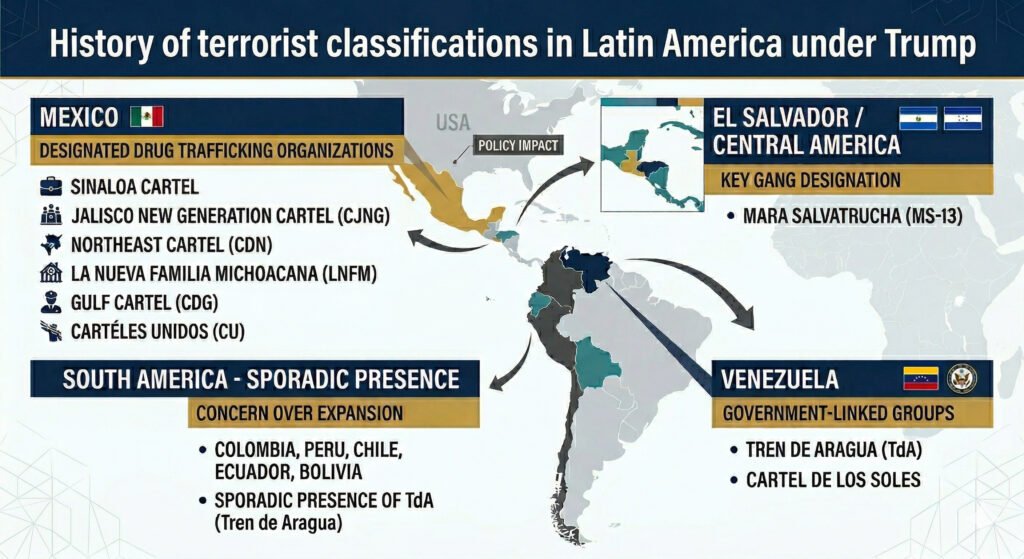
Beyond financial and legal dimensions, the measure raises concerns about sovereignty and the use of force. As noted by Jorge Lasmar, Professor of International Relations at PUC Minas, the designation could “open access to intelligence and counterterrorism tools and change the doctrine on the use of force.”
Such a shift could potentially justify unilateral actions. Examples cited in the region include U.S. operations against drug-trafficking networks in Venezuela, such as the targeting of vessels suspected of involvement in illicit activities, as well as the broader justification used in actions involving the Venezuelan government under accusations of “narco-terrorism.” Similar classifications have also been applied to groups like the Cartel de Jalisco, Tren de Aragua, and MS-13.
In terms of public security, the reclassification could shift the focus from combating transnational organized crime to a strict counterterrorism approach. This raises concerns about the militarization of security strategies, including the expanded use of armed forces in densely populated and vulnerable areas, where such approaches may increase risks to civilians.

In practice, outcomes remain uncertain. Evidence from countries such as Mexico and El Salvador suggests that this type of designation often produces limited operational impact on criminal organizations. Its most significant effects may instead fall on the economy, increasing compliance costs, creating financial uncertainty, and placing additional strain on Brazilian institutions responsible for enforcement and oversight.
It is also important to note that attempts to classify criminal factions as terrorist organizations have emerged within Brazil’s own legislative arena. Members of both the Chamber of Deputies and the Senate have proposed changes to equate organized crime with terrorism, including recent discussions surrounding the so-called “Anti-Faction Law.” Congressional committees have approved bills seeking to classify acts committed by criminal factions and militias as terrorism, particularly in cases involving territorial control, intimidation, and attacks on public services. However, these initiatives have not advanced into binding law, facing legal obstacles, and political resistance.
Ultimately, the reclassification would not only alter the legal treatment of these groups but also introduce broader political and diplomatic tensions. As noted by analysts, Brazil’s concern is not limited to legal implications, but also to the precedent it could set by allowing external influence over an issue the country defines as organized crime rather than international terrorism.
Political impacts and practical limitations
Domestically, the debate over classifying Brazilian criminal factions as terrorist organizations has become deeply embedded in the country’s political agenda, with direct implications for the 2026 presidential race. Discussions surrounding groups such as the CV and the PCC have evolved into what analysts describe as an “electoral trap,” polarizing the political landscape between hardline security approaches and more cautious institutional positions. Opposition actors have used the issue to advocate for tougher policies, reframing a technical legal debate into a politically charged narrative.
Within this environment, legal arguments are often simplified in public discourse, particularly in electoral rhetoric and social media. As a result, narratives portraying authorities as lenient or ineffective in addressing organized crime have gained traction. This dynamic reduces complex policy discussions to binary positions, limiting space for nuanced decision-making and evidence-based policymaking.
At the same time, expanding the concept of terrorism to include criminal factions raises concerns about civil liberties and potential political misuse. Experts such as Ben Saul, United Nations Special Rapporteur on counter-terrorism and human rights, and Eugenio Raúl Zaffaroni, a former judge of the Inter-American Court of Human Rights, warn that applying counterterrorism laws to non-ideological groups may enable abuses and weaken legal safeguards. In Brazil, recent legislation required presidential vetoes to avoid provisions that could affect social movements, while earlier debates on the Anti-Terrorism Law raised fears of misuse against protests. These developments illustrate how legal ambiguity can translate into risks for civil society and democratic guarantees.
Conclusion
The debate over classifying Brazilian criminal factions as terrorist organizations reflects a broader dilemma between political urgency and legal precision. While the proposal may appear to offer a stronger response to organized crime, its practical and conceptual limitations raise significant concerns. Brazil’s legal framework clearly distinguishes terrorism from organized crime based on motivation, requiring ideological or political intent—criteria that groups such as the PCC and the CV do not meet.
From a policy perspective, there is limited evidence that reclassifying such groups would significantly improve law enforcement effectiveness. International experience suggests that this type of designation often produces limited operational impact while generating legal, economic, and diplomatic side effects, including higher compliance costs, financial uncertainty, and challenges to international cooperation. Moreover, shifting toward a counterterrorism approach risks distorting security strategy and encouraging militarized responses that are poorly suited to the dynamics of organized crime.
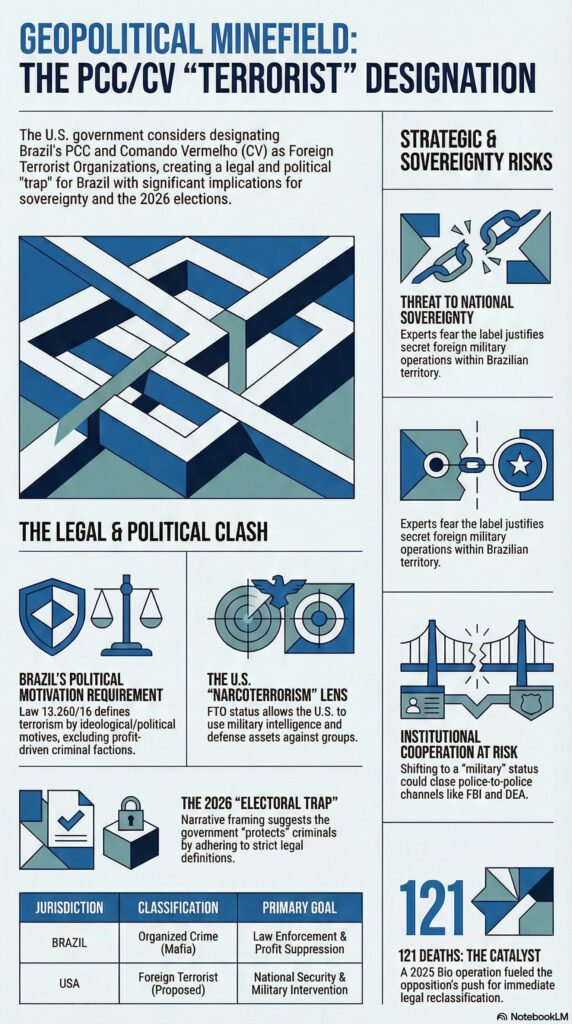
The debate over whether criminal factions should be classified as terrorist organizations exposes the high risks of politicization, particularly as legal distinctions are often simplified for electoral gain. This issue is further strained by external pressure from the Trump administration. By aligning themselves with this U.S. stance, certain political sectors, seek to demonstrate ideological allegiance to Trump while framing the current government as “soft on crime.” However, this shift toward a “narcoterrorism” lens has sparked deep concerns regarding national sovereignty, as it could invite U.S. jurisdictional overreach and allow foreign influence to dictate Brazil’s internal security and economic policies.

