


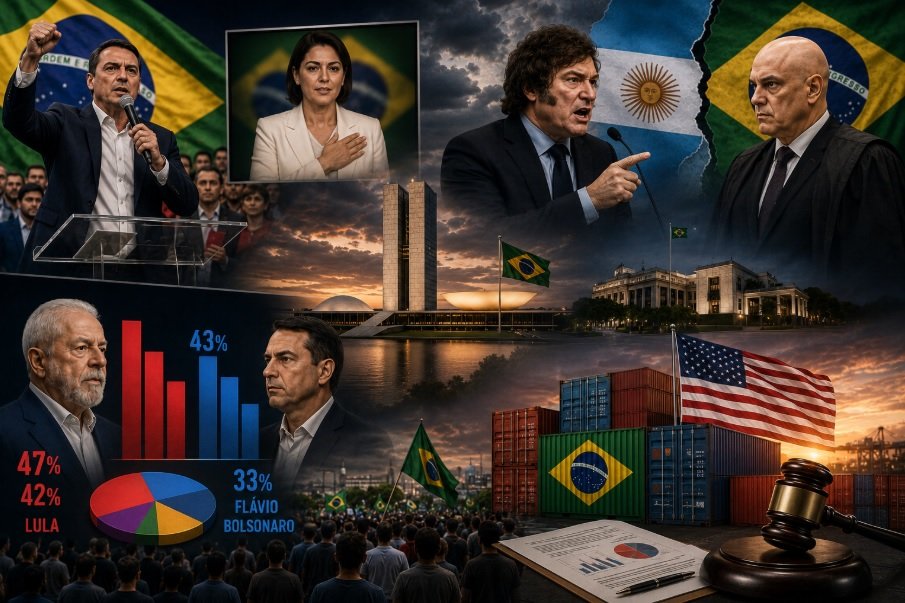
A dramatic week in Brazilian politics culminated in the official launch of Flávio Bolsonaro’s presidential campaign, overshadowed by a serious diplomatic incident and mounting trade pressures. At the PL’s national convention in São Paulo on Saturday, Flávio Bolsonaro was formally nominated as the party’s presidential candidate — without a running mate — after failing to attract major Centrão parties to his coalition, though the event was marked by a reconciliatory video appearance from Michelle Bolsonaro and derailed by Argentine President Javier Milei’s inflammatory attack on STF Justice Alexandre de Moraes, which prompted Brazil to recall its ambassador to Argentina and triggered a full diplomatic crisis. On the electoral front, the latest BTG/Nexus poll shows the race remaining stable, with Lula leading Flávio Bolsonaro 47% to 43% in a simulated runoff. At the same time, the incumbent also gained ground in first-round scenarios. The trade situation continued to deteriorate as the 25% U.S. tariff on Brazilian goods took effect on July 22. Moreover, the US has announced the imposition of an additional 12.5% tariff on Brazilian goods — tied to forced labor allegations —, which will certainly strain even more the bilateral relationship between Brasília and Washington.
This Content Is Only For Subscribers
To unlock this content, subscribe to INTERLIRA Reports.
Flávio Bolsonaro
After failing to attract Centrão parties to a coalition, Flávio Bolsonaro (PL) was officially nominated as the PL’s presidential candidate on Saturday (25/07) during the party’s national convention, although no running mate was selected. Former President Jair Bolsonaro’s son is still attempting to build political support through talks with leaders from the União Brasil-PP federation and the Republicanos party, although only the latter has shown openness to negotiations. On Tuesday, Senator Tereza Cristina (PP), a highly sought-after candidate for the position, once again formally declined the invitation. During the same convention, a video featuring former First Lady Michelle Bolsonaro was shown, in which she declared her support for Flávio Bolsonaro’s candidacy and called for unity on the right. The appearance marked Michelle’s first public show of support for her stepson’s campaign following a rift between the two, which was resolved this week after a public apology from the senator.
Attack on the Supreme Court
The Lula administration recalled Brazil’s ambassador to Argentina following President Javier Milei’s attack on Supreme Federal Court (STF) Justice Alexandre de Moraes on Saturday (25/07) in São Paulo. Ambassador Julio Bitelli is scheduled to arrive in Brazil on Monday (27). Hours after Bitelli was recalled, Argentina’s ambassador to Brazil, Daniel Raimondi, was summoned to the Foreign Ministry, known as Itamaraty. This marks a second diplomatic protest over Milei’s statements at the convention. Argentine President Javier Milei was the main guest at the PL party convention held on Saturday in São Paulo, where Flávio Bolsonaro was officially nominated as the party’s presidential candidate. During his speech, Milei called STF Justice Alexandre de Moraes “bald trash” for denying him permission to visit former President Jair Bolsonaro (PL), who is imprisoned for an attempted coup d’état.
New Poll
President Lula (PT) holds 47% of voting intentions in a simulated runoff for the October presidential election against Senator Flávio Bolsonaro (PL), who stands at 43%, according to a new BTG/Nexus poll released on Monday (27/07). In the previous survey, conducted in mid-July, the PT candidate also registered 47%, while the son of former President Jair Bolsonaro (PL) stood at 44%. The survey was conducted by telephone between July 24 and 26, interviewing voters aged 16 and older nationwide. The margin of error is 2 percentage points, with a 95% confidence level. In a first-round scenario, the incumbent president leads with 42%, up from 40% in the previous Nexus survey. The senator follows with 33% of voting intentions, down from 34% in the previous poll. Ronaldo Caiado (PSD) registers 6%, Renan Santos (Missão) stands at 5%, and Romeu Zema (Novo) has 3%. Augusto Cury (Avante) registers 2%, while Cabo Daciolo (Mobiliza) stands at 1%.
New Tariffs
The Lula administration considers the imposition of a new 12.5% tariff on Brazilian products by the United States to be certain. Meanwhile, a 25% tariff on goods exported by Brazil to the US took effect on Wednesday (22). On Tuesday (21), US Trade Representative Jamieson Greer stated that the Donald Trump administration was expected to announce tariffs on approximately 60 countries, citing the importation of goods produced using forced labor. Brazil is among the nations being investigated by the US agency over this alleged practice. The Brazilian government believes the US intends to use the 12.5% tariff to circumvent restrictions imposed by the US Supreme Court, which struck down the 10% tariff applied to Brazil and several other countries last year.
Analysis:
Brazil’s political environment is entering a more polarized phase as the official campaign begins, but recent developments suggest that the opposition continues to face structural challenges beyond electoral polling. Although Flávio Bolsonaro’s formal nomination provides greater clarity to the conservative camp, the absence of a running mate and the failure to secure broader support from major Centrão parties demonstrate the difficulty of building a coalition capable of competing with the incumbent government’s established congressional alliances. Michelle Bolsonaro’s renewed public support may help reduce internal tensions within the Bolsonarista movement, but rebuilding unity after weeks of public disagreements will remain an important task throughout the campaign.
The diplomatic crisis involving Argentina introduces an additional layer of uncertainty to the electoral environment. Javier Milei’s remarks directed at a Supreme Federal Court justice transformed what was intended to be a partisan event into a bilateral diplomatic dispute, forcing the Brazilian government to respond through traditional diplomatic channels.
Sources: O Globo [1], [2], [3]; G1 [1], [2], [3]; A Folha de SP [1], [2], [3].

