


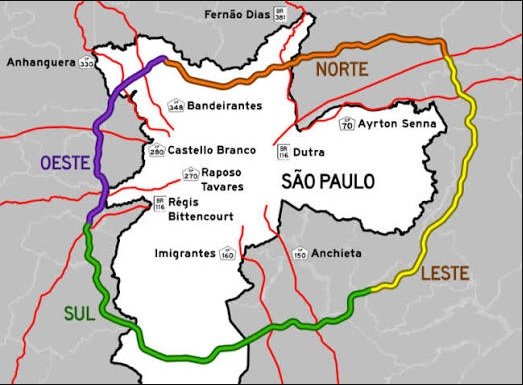
Cameras equipped with artificial intelligence and facial recognition technology will begin to be installed along the Mário Covas Ring Road, known as the Rodoanel. Sections of the highway, which surrounds the São Paulo metropolitan area and connects some of the country’s main highways, will also be enclosed by protective walls. According to Artesp, the São Paulo State Transportation Agency, the objective is to monitor the entire 174 km route in real time, given its history of assaults against motorists and cargo theft. The first phase of the detailed engineering plans is expected to be completed in December 2026, with construction scheduled to begin in January of the following year.
This Content Is Only For Subscribers
To unlock this content, subscribe to INTERLIRA Reports.
Developed by the Military Police
The system is being developed in partnership with the Highway Military Police. On the 30th, a new base for the 6th Highway Police Battalion, or BPRv, was inaugurated along the northern section of the Rodoanel. The equipment will include high-resolution imaging, license plate readers, facial recognition technology, a fiber-optic network, intrusion sensors to detect unauthorized access to the highway, and intelligent lighting. AI-powered 360-degree panoramic cameras will continuously monitor the roadway and identify pedestrians, vehicles traveling in the wrong direction, traffic congestion, smoke, fog, and other potentially hazardous situations. The units will be integrated into Muralha Paulista, a state government program that uses cameras to monitor public roads.
No Set Number Yet
The total number of cameras has not yet been determined, but the approximately 120 km section managed by the SPMar concessionaire, covering the southern and eastern stretches, will initially receive 30 units. Also in 2026, another 81 AI-equipped cameras will be installed along this section to detect drivers using mobile phones or failing to wear seatbelts. The number will increase to 127 in 2027, with the first unit having entered operation on the 1st. In addition, 56 km of walls will be built in areas considered particularly vulnerable, especially near densely populated communities. Known as “smart walls,” the structures will incorporate sensitive fiber-optic technology capable of detecting intrusion attempts in real time. When an intrusion is identified, the system will automatically activate the nearest cameras to track the individual’s movements and immediately alert the highway police control center.
Sources: A Folha de SP.

