
Summary
Brazilian cargo thieves are increasingly targeting pharmaceutical cargo. According to a Q1 2026 cargo theft report by nstech, a supply chain risk-management firm that aggregates data from risk managers BRK, Buonny, and Opentech, losses tied to robbery of medicines climbed from 1.7% to 22.3% of the national total between the first quarters of 2025 and 2026, while cigarettes — the traditional top target — fell from 34.1% to 3.7%. The same report found Rio de Janeiro concentrating 44% of national cargo theft losses, making it the epicenter of this shift. Operation Metástase, launched in July 2026 against a network accused of stealing and reselling oncology drugs, showed how these schemes combine armed violence, insider leaks inside transportation companies, and shell-company networks able to funnel stolen medicine back into legitimate — even public — supply chains. The same period saw a documented rise in armed robberies of retail pharmacies targeting weight-loss injectables, alongside a parallel surge in smuggled counterfeit medication entering through Brazil’s western border. The stakes extend well beyond financial loss: stolen and smuggled medicines that enter the market put patients, employees, and corporate health plans at real risk of ending up with counterfeit, mishandled, or expired drugs, while exposing the companies that source, distribute, insure, or reimburse those medicines to liability, regulatory scrutiny, and reputational damage. For any organization operating in or through Rio de Janeiro, this mix of public health and corporate risk deserves to be treated as a distinct, fast-evolving threat — not filed away as an ordinary cargo-theft statistic.
This Content Is Only For Subscribers
To unlock this content, subscribe to INTERLIRA Reports.
The Numbers Behind the Shift
The scale of the change is striking. According to nstech’s Q1 2026 cargo theft report, pharmaceuticals accounted for just 1.7% of the total value lost due to cargo theft nationally in the first quarter of 2025; one year later, that figure jumped to 22.3%, while cigarettes — historically the top target for cargo theft rings — fell from 34.1% to just 3.7%. This is not incidental drift; it reflects a deliberate reallocation of criminal resources toward goods that combine high resale value, strong demand, and comparatively weak traceability once they leave the legitimate supply chain.
Geographically, the risk is not evenly distributed. The Southeast region concentrated 78.2% of national cargo theft losses in the first quarter of 2026, and within it, Rio de Janeiro alone accounted for 44% of losses nationwide — up from 16.4% a year earlier. Rio has, in effect, become the epicenter of Brazil’s pharmaceutical cargo theft problem, and any company with logistics exposure in the state should treat it as a distinct risk zone rather than folding it into generic national statistics.
Operation Metástase and the Maré Connection
The clearest illustration of how this crime actually functions came on July 21, when Rio de Janeiro’s Civil Police launched Operation Metástase, targeting a network specializing in the theft and resale of oncology drugs and immunosuppressants. Investigators estimate the scheme moved more than R$33 million between 2025 and 2026, with warrants carried out not only in Rio but also in São Paulo, Goiás, and Pará.
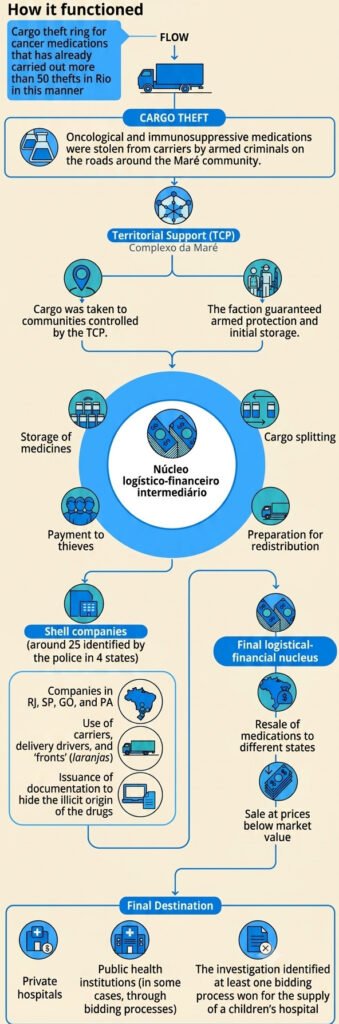
The mechanics are instructive for any security professional assessing pharmaceutical supply chain risk in Brazil. The thefts were carried out with military-grade weapons and coordinated escort vehicles — a level of sophistication well beyond opportunistic theft — and investigators identified insiders: employees of transportation companies allegedly leaked privileged information about routes and high-value shipments, a reminder that this risk is as much an insider-threat and vendor-management problem as a perimeter-security one.
According to the findings of Rio de Janeiro Civil Police’s Operation Metástase, once stolen, shipments were taken to the Maré favela complex in Rio’s North Zone, an area under the territorial control of the Third Pure Command (TCP). From there, roughly 25 shell companies reintroduced the products into the legitimate market, including into public hospital through fraudulent tenders. Stolen products, in other words, do not stay confined to the black market, and can re-enter formal distribution channels.
The Public Health Dimension
There is a dimension to this problem that goes beyond financial loss. Oncology drugs, immunosuppressants, and other high-value biologics typically require strict cold-chain management from manufacturing through to patient administration, and Federal Highway Police authorities have flagged that broken cold chains linked to stolen medication can cause loss of efficacy, severe adverse reactions, and in some cases death. A stolen shipment of chemotherapy drugs, handled outside controlled conditions and later resold — potentially to a hospital or clinic operating in good faith — carries a patient safety risk that rarely shows up in a standard loss report.
A related threat involves counterfeit or diverted GLP-1 weight-loss medications, now one of the most sought-after categories for both cargo thieves and armed robbers targeting pharmacies. Products of unknown provenance carry the risk of containing incorrect dosages or entirely different active substances than labeled, a concern regulators and medical specialists have raised with increasing urgency as demand for these drugs has surged.
Violence at the Retail Level
The same demand pressure has reshaped risk at the storefront level. Weight-loss injectables have become a magnet for armed robbery crews targeting pharmacies directly, and the consequences have, at times, been fatal — in February 2026, an employee was killed during a robbery attempt at a pharmacy in São Paulo’s Santana district, one of a string of violent incidents that pushed pharmacy chains to visibly step up security, from guards at store entrances to restricted display of injectable stock. According to figures from São Paulo’s state public security secretariat, the city of São Paulo alone recorded 162 robberies and thefts at pharmacies in just the first five months of 2026, more than one per day.

São Paulo has recorded the highest volume of these incidents, but the pattern isn’t confined to one state. Regulatory filings submitted to Anvisa place Rio de Janeiro as second nationally for theft, robbery, or loss incidents involving GLP-1 medications — an early signal that this exposure travels with wherever demand is highest, not a localized anomaly.
A Supply Problem, Not Just a Theft Problem
The financial toll is becoming clearer as industry associations quantify it. ABRADIMEX, representing Brazil’s largest specialized pharmaceutical distributors, has put industry-wide losses from cargo theft at R$283 million — a figure cited for both 2024 and, more recently, 2025, in studies produced with Deloitte and risk firm Overhaul. Individual incidents show how concentrated these losses can be: a truckload of oncology drugs bound for São Paulo’s public health system, stolen in July in Santo Antônio de Posse, was valued at R$4.6 million, and an April attack resulted in losses of roughly R$6 million. According to nstech’s Q1 2026 report, pharmaceutical shipments made up 17.9% of total national cargo theft losses within the >R$1 million segment.
Retail commerce is absorbing a parallel hit. According to the Brazilian Association of Pharmacies and Drugstores (Abrafarma), which tracks the nine largest pharmacy chains operating in São Paulo, thefts of GLP-1 injectables alone generated R$68.97 million in losses in the state in 2025, across 3,838 separate incidents involving 58,898 stolen units — an average of eleven robberies a day. The scale prompted Abrafarma, whose member networks account for more than half of all medicine sales in Brazil, to create a dedicated security working group to track losses and coordinate with law enforcement.
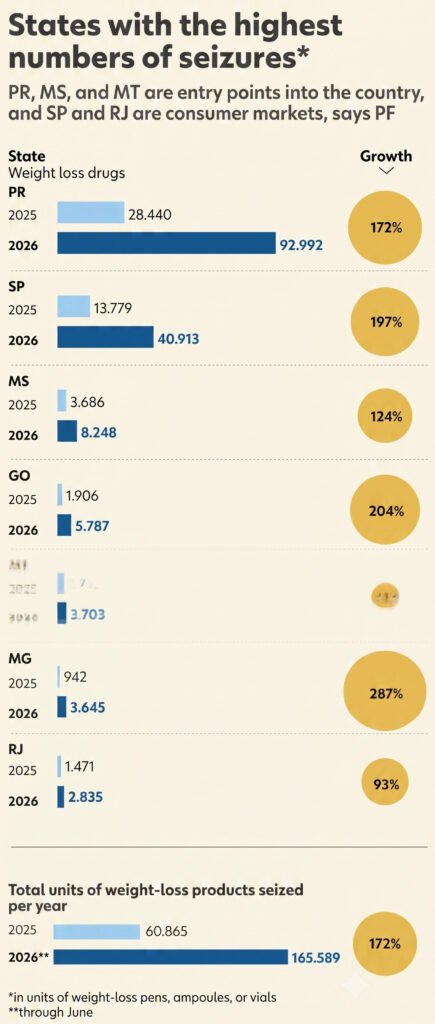
Domestic cargo theft is only one half of the equation. Federal Police data show a parallel surge in smuggling of counterfeit weight-loss medications through the Paraguay border: seizures rose from 335 incidents in 2025 to 758 in the first half of 2026, and seized units jumped from 609 in 2024 to over 60,000 in 2025, with 2026 already on pace to exceed that. Officials describe structured land smuggling through the tri-border region, distributed via highway corridors already used for narcotics trafficking into São Paulo and Rio de Janeiro. Even companies with airtight domestic cargo security may still face exposure through counterfeit product entering these parallel channels.
The pharmaceutical sector’s move into the crosshairs of organized crime in Brazil, and in Rio de Janeiro in particular, still appears to be in its early stages. It combines financial, reputational, and human safety risk in ways few other cargo categories do, and it is likely to keep evolving as criminal groups refine their methods and demand for high-value medications continues to grow. Reducing exposure will depend on progress across the whole chain — from how shipments are secured in transit to how the final product is bought and verified by those who ultimately consume it.
Recommendations for Safer Consumption
Given how much of this stolen and smuggled product eventually reaches an end consumer — a patient, a corporate wellness program, a hospital pharmacy — part of managing this risk falls on how medicine is purchased, not only on how it is transported.
- To ensure drug safety and authenticity, both organizations and individual consumers must purchase exclusively through registered, verifiable channels. Unusually low prices—particularly for high-risk products like oncology drugs, immunobiologics, and GLP-1 injectables—serve as primary warning signs of diverted, stolen, or counterfeit stock. Businesses should source strictly from distributors and pharmacies with active Anvisa registration and documented supply chains, avoiding the informal sellers and unverified online marketplaces that frequently channel stolen medicine. Likewise, individual patients should exercise extreme caution with injectables, purchasing directly from established, regulated pharmacies rather than private sellers or heavily discounted offers outside standard retail environments.
- Institutional buyers must conduct rigorous vendor due diligence. Beyond basic licensing, organizations should thoroughly evaluate prospective suppliers before entering procurement agreements or awarding bids. This includes verifying corporate registration, checking background records for legal or regulatory infractions, and auditing corporate structures to ensure the supplier is not a shell company. Where feasible, institutional buyers should conduct physical site visits—and, when possible, discreet or undercover inspections—to confirm that the vendor maintains genuine warehouse facilities, proper operational capacity, and adequate security rather than serving as a paper-only front for illicit inventory.
- Ask for proof of origin and storage conditions. For any product requiring cold-chain handling, buyers should request documentation of how it was stored and transported, including invoices (nota fiscal) and batch numbers checkable against the manufacturer. A medication with no verifiable chain of custody carries real risk regardless of how convincing its packaging looks.
- Institutional buyers should scrutinize below-market pricing. Corporate health plans, hospitals, and public procurement teams should treat unusually favorable pricing on high-demand drugs as a reason for closer scrutiny, given that stolen pharmaceuticals have already been shown to re-enter the market through shell companies bidding below standard rates.

