


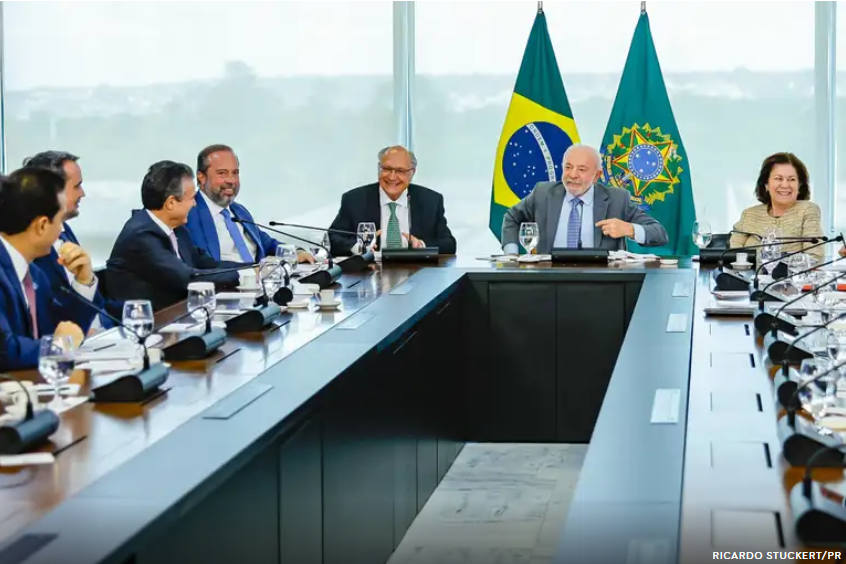
Brazil’s convention season draws to a close this week against a backdrop of strong economic indicators and a tightening presidential race. Record employment figures provided a timely boost for President Lula as he formally launched his re-election bid on Sunday at a convention in São Paulo, where he outlined a platform centered on national sovereignty, women’s rights, and a promise to challenge Congress over control of parliamentary amendment funds. Despite the favorable economic backdrop, the latest BTG/Nexus poll shows the race narrowing significantly, with Lula and Flávio Bolsonaro now in a virtual tie in a simulated runoff at 46% to 45% — a notable shift from recent surveys that had shown a more comfortable lead for the incumbent. On the institutional front, the Superior Electoral Court moved to increase accountability for Big Tech platforms ahead of the elections, requiring companies to submit formal compliance plans to combat disinformation by August 16, while the Supreme Federal Court returned from recess with a packed agenda of high-stakes trials expected to shape Brazil’s political and legal landscape in the months ahead.
This Content Is Only For Subscribers
To unlock this content, subscribe to INTERLIRA Reports.
Unemployment
Brazil’s unemployment rate declined again, reaching 5.4% in the quarter ending in June this year, down from 5.6% in May. The figure, released on Thursday (30/07) by the IBGE, was in line with market analysts’ expectations and represents the lowest rate ever recorded for the month of June. In the previous rolling quarter, which ended in March, the rate stood at 6.1%. As a result, the unemployed population fell to 5.9 million, a 10.9% decrease compared with the preceding three-month period. Compared with the same quarter last year, when 6.3 million people were unemployed, the figure declined by 6.3%, representing 392,000 fewer unemployed individuals in the labor force. Meanwhile, the employed population reached a record 103.1 million people, the highest level in the entire historical series.
Candidate for Re-election
President Lula (PT) officially launched his re-election campaign on Sunday (02/08), sending political signals regarding both his government platform and his relationship with the National Congress. The PT candidate stated that he does not want to be remembered solely for the Bolsa Família program and promised, should he secure another term, to challenge the Legislature over control of parliamentary amendment funds. Lula is 80 years old and will be participating in his seventh presidential election. During his one-hour-and-ten-minute speech at the convention in São Paulo, he also addressed national sovereignty, women’s rights, investment in defense, and other issues expected to feature prominently in his campaign. The president also praised his running mate, Geraldo Alckmin, and former minister Fernando Haddad, who is running for governor of São Paulo.
New Poll
President Lula (PT) holds 41% of voting intentions in the first round, while Senator Flávio Bolsonaro (PL-RJ) registers 37%, according to a new BTG/Nexus poll released on Monday (03/08). The gap narrowed from nine to four percentage points compared with the previous survey, conducted last week, when former President Jair Bolsonaro’s son had 33%, and the PT candidate registered 42%. The survey also places Ronaldo Caiado (PSD) at 5%, Renan Santos (Missão) at 4%, and Romeu Zema (Novo) at 3%. Augusto Cury (Avante), Cabo Daciolo (Mobiliza), and Samara Martins (UP) each register 1%. Blank and null votes account for 4%, while 3% of respondents were undecided or did not answer. A total of 2,002 voters aged 16 and older from across the country were interviewed by telephone between July 31, a Friday, and August 2, a Sunday. The margin of error is two percentage points. In a runoff scenario, Lula and Flávio Bolsonaro are technically tied, with 46% and 45% of voting intentions, respectively.
Big Tech and the Supreme Court
Under pressure from the Superior Electoral Court (TSE) to adopt a more assertive approach to combating disinformation, technology companies will be required, for the first time, to present the measures they intend to implement to address risks to the country’s electoral process. Platforms have until the 16th to submit their “compliance plans” for the 2026 election to the Court. Experts consider the requirement a significant step toward preventing electoral crimes in digital environments and improving oversight of Big Tech companies in this area. The TSE’s decision comes amid the major role played by social media in electoral campaigns since 2018, when former President Jair Bolsonaro was elected through a campaign conducted largely on digital platforms. The Supreme Federal Court (STF) resumes its activities on Monday (03/08) following the July recess, with controversial trials scheduled for August and expectations of new developments in investigations involving Banco Master, the INSS scandal, and parliamentary amendments. Another issue likely to gain prominence at the Court is the proposed advancement of discussions on a Code of Ethics for the justices, although the topic is expected to be examined in greater depth after the October elections.
Analysis:
The current pre-campaign period suggests that Brazil’s electoral debate will increasingly revolve around economic performance, institutional stability, and governance rather than solely around ideological polarization. Record employment levels provide President Lula with a strong argument in defense of his administration’s economic record, reinforcing a message centered on continuity and stability. At the same time, the latest polling indicates that favorable economic indicators alone may not be sufficient to guarantee electoral advantage, as the opposition continues to maintain a highly competitive position. The narrowing of the presidential race points to an increasingly polarized and unpredictable campaign. As the margin between the two leading candidates shrinks, campaigns are likely to intensify efforts to mobilize their core supporters while seeking to persuade undecided voters, whose preferences may prove decisive in determining the election outcome.
The Supreme Federal Court’s actions demonstrate that the electoral process will unfold under heightened judicial oversight. The requirement for digital platforms to submit compliance plans reflects growing concern over the influence of online disinformation on democratic processes.
Sources: O Globo [1], [2], [3], [4], [5], [6]; G1; A Folha de SP.

