


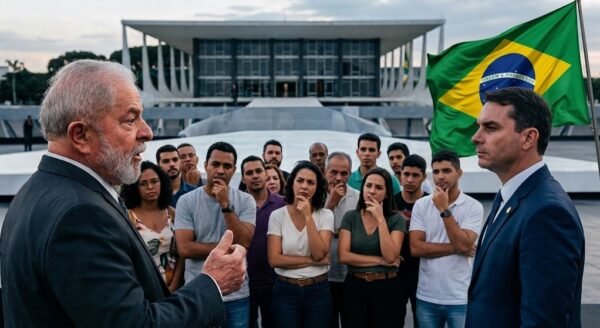
With Brazil’s presidential race locked in a statistical tie and the official election just weeks away, both campaigns are zeroing in on undecided voters in key swing states — particularly Minas Gerais, Rio de Janeiro, Rio Grande do Sul, and Paraná — where between 16% and 18% of the electorate has yet to make up its mind. President Lula, facing pressure from a narrowing poll lead and domestic scandals, has fully engaged in congressional negotiations to push through a package of popular policy proposals, with the PEC ending the 6×1 work schedule — backed by 69% of Brazilians — serving as the centerpiece of his electoral strategy. The latest BTG/Nexus poll adds a new dimension to the race with the emergence of Augusto Cury, who surged from 2% to 11% in first-round voting intentions, potentially complicating the dynamic for both frontrunners even as Lula and Flávio Bolsonaro remain statistically tied at 46% to 45% in a simulated runoff. On the economic front, the Lula administration resumed trade negotiations with Washington amid skepticism over prospects for a deal, while the Central Bank’s Focus survey pointed to slightly lower inflation and growth forecasts for 2026 alongside rising inflation projections for 2027, reflecting continued uncertainty in the economic outlook.
This Content Is Only For Subscribers
To unlock this content, subscribe to INTERLIRA Reports.
New Poll
The BTG/Nexus poll released on Monday (31/08) shows Lula (PT) and Flávio Bolsonaro (PL) continuing to lead the presidential race, although both lost ground in first-round voting intentions compared with the previous week. In the scenario including Pablo Marçal, Lula receives 37% of voting intentions, compared with 31% for Flávio Bolsonaro; in the previous poll, they had 40% and 34%, respectively. In the scenario excluding Marçal, Lula registers 39%, while Flávio receives 33%. Despite the decline in first-round support, Lula and Flávio remain statistically tied in a potential runoff, with the PT candidate receiving 46% against Flávio’s 45%, within the survey’s two-percentage-point margin of error. The main development in the poll is the rise of Augusto Cury, who climbed from 2% to 11% in the first round, emerging as a significant contender among candidates seeking space outside the polarization between Lula and Flávio. Nexus interviewed 2,005 people between August 28 and 30. The survey has a margin of error of two percentage points and a 95% confidence level.
Undecided Voters
In an election considered “tight” by allies of both Lula (PT) and Flávio Bolsonaro (PL), the four states with the highest concentrations of undecided voters—according to the latest Quaest poll released in August—have become a major focus for both campaigns. The list includes populous electoral strongholds that could prove decisive in the race, such as Minas Gerais and Rio de Janeiro, as well as Rio Grande do Sul and Paraná. In these states, between 16% and 18% of respondents had not yet decided which candidate to support. The battle for this segment of the electorate has led both sides to combine territorial strategies, including appearances at campaign events, with messages tailored to specific voter concerns. For Flávio Bolsonaro, three of these four states had already been designated as campaign priorities. Efforts to win over undecided voters include emphasizing public security and the cost of living—issues identified by internal polling as major concerns—while increasing television exposure and mobilizing local allies to promote his candidacy. Lula’s campaign also sees undecided voters as a group that can be persuaded through targeted messaging. The prevailing strategy is to contrast the current administration with that of former President Jair Bolsonaro, Flávio’s father, in an effort to secure their support.
Improved Approval Ratings
Facing pressure from a narrowing lead over Flávio Bolsonaro (PL) in the polls, as well as scrutiny over allegations involving his son Fábio Luís Lula da Silva (“Lulinha”) and former chief of staff Marco Aurélio Santana Ribeiro (“Marcola”), President Lula (PT) has, after resisting for more than three months, fully engaged in political negotiations with congressional leaders to identify new policy platforms for his re-election campaign. Seeking a political initiative capable of reversing the government’s negative approval ratings and shifting the media narrative, Lula’s congressional liaison team will work to prevent pro-Bolsonaro senators from using procedural maneuvers to block votes on a package of proposals agreed upon by Lula, Senate President Davi Alcolumbre (União Brasil), and Chamber of Deputies President Hugo Motta (Republicanos). The main priority for both the government and congressional leadership is the proposed constitutional amendment (PEC) to end the “6×1” work schedule, under which employees work six days followed by one day off. A Quaest poll conducted in July found that 69% of Brazilians support the proposed change, while 22% oppose it.
Economy
The Lula administration resumed trade negotiations with the United States on Monday (31/08), with presidential aides skeptical about the prospects of reaching an agreement with Washington. Government officials fear that the steep tariffs could become permanent if the dispute continues for an extended period. One official noted that trade barriers on steel and aluminum were first imposed in 2018, during Donald Trump’s first term, and that his successor, Joe Biden, took no action to remove them. A phone call from the Brazilian president to Trump last week helped ease tensions and prompted White House representatives to resume contact with the Planalto Palace. The conversation between Lula and Trump, which took place on Friday (21), was once again facilitated by prominent business leaders with direct access to Trump’s inner circle. Also on the economic front, economists surveyed by the Central Bank lowered their inflation and economic growth forecasts for this year while raising their inflation projections for 2027, according to the Focus survey released on Monday (31/08). The expected increase in the IPCA (Extended National Consumer Price Index) for 2026 fell to 5.01%, from 5.02% the previous week, while the forecast for 2027 rose by 0.03 percentage points to 4.28%. The GDP growth forecast for this year was revised down from 1.95% to 1.92%, while the projection for 2027 remained unchanged at 1.50%.
Analysis:
The latest polling suggests that Brazil’s presidential election is entering a highly competitive phase in which neither leading candidate can rely on a stable electoral advantage. Although Lula and Flávio Bolsonaro remain statistically tied in a potential runoff at 46% and 45%, the movement in first-round support is particularly relevant. The decline recorded by both candidates, combined with Augusto Cury’s rise from 2% to 11%, indicates that part of the electorate may be looking beyond the traditional PT versus Bolsonaro confrontation. With 16% to 18% of voters undecided in key states such as Minas Gerais, Rio de Janeiro, Rio Grande do Sul, and Paraná, the capacity to attract voters outside each candidate’s established base could become decisive.
Economic conditions will also influence how voters evaluate the competing narratives in the final weeks of the campaign. The resumption of negotiations with the United States gives Lula an opportunity to demonstrate diplomatic engagement, but skepticism within his administration regarding the possibility of a tariff agreement limits the immediate political benefits. Domestically, the slight reduction in projected 2026 inflation and GDP growth, alongside higher inflation expectations for 2027, points to an economy that remains relatively stable but vulnerable to renewed pressures.
Sources: O Globo [1], [2], [3], [4], [5]; A Folha de SP [1], [2], [3].

