


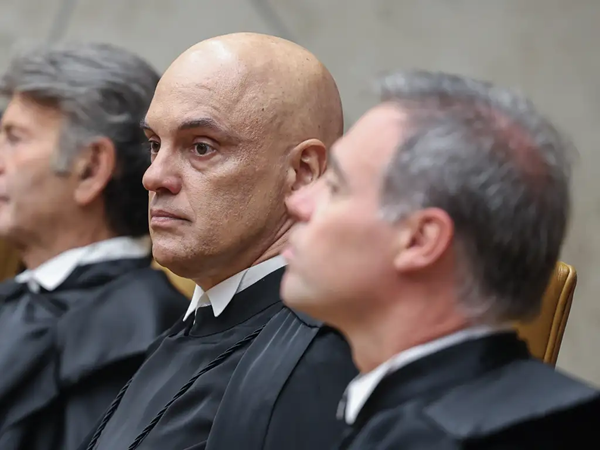
STF President Edson Fachin has taken measures to contain the escalating institutional crisis involving Justices Alexandre de Moraes and André Mendonça. He assumed control of the proceedings involving Moraes and Daniel Vorcaro and scheduled a plenary session to address the controversy. The Federal Police’s Operation Transparency 3, targeting figures linked to Mendonça, could further intensify tensions within the Court. Meanwhile, investigations involving Banco Master and the financing of the film Dark Horse have expanded the political dimension of the crisis. Growing public criticism of the STF, alongside calls for institutional reform, reflects increasing concern over the Court’s powers and internal disputes. The possibility of new U.S. sanctions against Brazilian officials adds an international dimension, increasing political and institutional uncertainty.
This Content Is Only For Subscribers
To unlock this content, subscribe to INTERLIRA Reports.
Fachin’s Response – Defusing the Crisis
To placate the crisis that has shaken the STF over the past two weeks, Justice Edson Fachin removed Alexandre de Moraes from the “fake news” inquiry, suspended conflicting rulings by André Mendonça and Flávio Dino regarding Federal Police Director-General Andrei Rodrigues, and scheduled the trial of the request to authorize an investigation into Justice Alexandre de Moraes for Tuesday (Sept. 15, 2026).
Fachin also requested Supreme Federal Court (STF) Justice André Mendonça to release part of the “Master case” records and Mendonça complied. According to Fachin, the measure was taken to prepare for the session scheduled for next Tuesday (15), when the full court is expected to review a Federal Police report identifying Justice Moraes as an interlocutor for former banker Daniel Vorcaro, the owner of Banco Master.
Moreover, Fachin ordered on Saturday (12) a change of rapporteurs in the proceedings investigating the link between Alexandre de Moraes and former banker Daniel Vorcaro. He is now taking charge of the case, replacing André Mendonça. In the same decision, he ordered the transfer of the full case files regarding the investigations into the INSS (National Social Security Institute) and Banco Master. Fachin states that the measure is being taken due to the possibility that the trial of the case could result in the judge being disqualified—that is, a situation where a magistrate is unable to adjudicate a case.
Finally, the Supreme Court President scheduled a session for September 23 to examine questions regarding Mendonça’s handling of the Master and INSS cases—details gathered in a Federal Police intelligence report sent to the Court at Moraes’s request that points to a lack of impartiality and an alleged selective targeting of investigations against political figures—such as Senate President Davi Alcolumbre (União Brasil-AP) and Moraes himself.
The Context
The crisis within the Supreme Court started after Justice André Mendonça revealed an exchange of messages between his colleague, Justice Alexandre de Moraes, and Daniel Vorcaro, the owner of Banco Master. The clash between the two justices escalated when Moraes used an internal Federal Police document—which lacked evidentiary value—to call for an investigation into his colleague for alleged abuse of authority. Mendonça ultimately removed the Federal Police Director-General, Andrei Rodrigues, from his post due to the report.
The Unprecedented Plenary
The unprecedented crisis that has engulfed the Supreme Federal Court (STF) over the “Master” case reaches the court’s plenary session ton Tuesday (15), amidst uncertainty regarding the procedure, the potential for a vote obstruction, and a barrage of maneuvers from two rival factions led by Justices Alexandre de Moraes and André Mendonça.
News on Mendonça and Vorcaro
This Monday (14), the Federal Police launched the third phase of Operation Transparency, executing search and seizure warrants in São Paulo and the Federal District. One of the key targets is Congressman Cezinha de Madureira (PL-SP). He is a friend and ally of Supreme Federal Court (STF) Justice André Mendonça and was the person who arranged a private meeting between the justice and former banker Daniel Vorcaro. According to the Federal Police, Operation Transparency 3 was launched to “investigate influence peddling involving higher courts.” The operation has the potential to further escalate the crisis within the STF, given Cezinha de Madureira’s close ties to Mendonça.
More on Dark Horse
Senator Flávio Bolsonaro (PL-RJ)—a presidential candidate for the 2026 elections—is under formal investigation in an inquiry examining the production of the film Dark Horse, which focuses on his father’s life, Jair Bolsonaro. The Federal Police have requested an investigation into “the possible commission of crimes such as money laundering, illicit capital flight, corruption, and other related offenses […] in the context of financing the production of the motion picture titled Dark Horse through Banco Master.”
Moreover, on Thursday (10), the Federal Police carried out an operation authorized by Minister Flávio Dino, of the STF, on suspicions of embezzlement of public funds for the film “Dark Horse”, which tells the life of former president Jair Bolsonaro (PL). One of the targets of the search and seizure warrants was Congressman Mario Frias (PL-SP), the film’s executive producer and the author of the parliamentary amendments under investigation. Karina Gama, of Go Up Entertainment—the production company behind the movie was also a target of the police operation. The operation showed that one of the companies identified by the Federal Police as a link in the alleged triangular flow of public funds to Go Up Entertainment—the production company behind the film Dark Horse—is a consultancy registered at an address in the Vila Hulda neighborhood of Guarulhos (Greater São Paulo) where a wedding dress shop actually operates.
Impact on the Supreme Court
The STF crisis led to a rise in pressure against the court, which has been measured through surveys. For 28% of Brazilians, Supreme Court Justice Alexandre de Moraes should face impeachment proceedings, while 34% advocate for his temporary suspension. Regarding his colleague André Mendonça, 12% and 37% hold the same views, respectively. This is the initial snapshot of the crisis within the Supreme Federal Court (STF) as measured by the latest Datafolha poll. Furthermore, 76% of Brazilians believe that STF justices hold too much power. At the same time, 71% consider the court essential to democracy.
Meanwhile, a group of about 50 business leaders, economists, legal experts, and other civil society leaders prepared a public letter in support of the President of the Supreme Federal Court (STF), Edson Fachin, who is trying to defuse the crisis. They held a meeting on Wednesday afternoon (9) to discuss proposals for reform and the institutional strengthening of the Judiciary in light of the unfolding crisis at the STF.
US Interference
The Trump administration is considering imposing new sanctions on Brazilian officials amidst the crisis at the Supreme Federal Court (STF) and has measures ready for potential implementation, according to a senior State Department official. The official told reporters that the measures have already been drafted—going beyond mere consideration—and that the Trump administration is prepared to move forward with applying the sanctions. Justice Alexandre de Moraes is among the individuals being monitored by the U.S. government, but Washington is also scrutinizing the actions of other members of the Supreme Court. For International experts, Donald Trump’s administration is attempting to interfere in the Brazilian presidential election, and Latin America’s recent history shows that this type of external pressure often succeeds. This assessment comes from Peter Birle, one of Europe’s leading experts on Brazilian affairs.
Analysis:
The STF crisis has evolved into a broader institutional confrontation involving the judiciary, Federal Police, Congress, and politically exposed individuals. Fachin’s measures may temporarily contain tensions, but the underlying dispute between rival factions within the Court remains unresolved. The Banco Master investigation and Operation Transparency increase the likelihood of further disclosures, investigations, and reputational damage for the court.
The possibility of new U.S. sanctions adds a geopolitical dimension that could affect Brazilian officials, financial institutions, and companies exposed to the U.S. financial system. Corporate-security teams should closely monitor the September 15 STF session, further developments in the Banco Master case, and possible congressional or diplomatic reactions. Companies should reinforce political-risk intelligence, third-party due diligence, PEP screening, and adverse-media monitoring. Overall, the situation warrants heightened monitoring as prolonged institutional instability could generate indirect operational, reputational, and security risks.
Sources: O Globo; A Folha de SP [1], [2], [3], [4], [5], [6], [7], [8], [9], [10], [11], [12], [13].

