


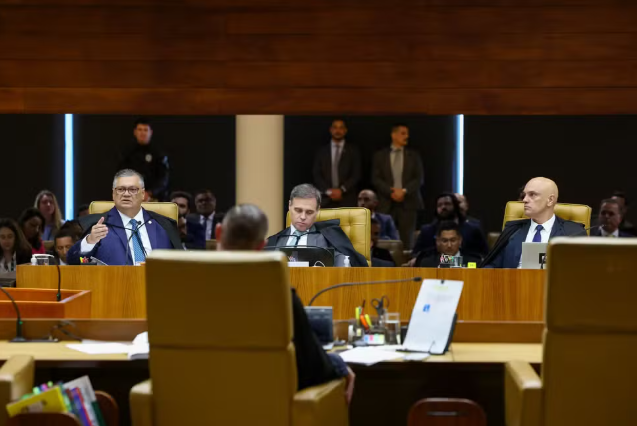
Brazil’s political and institutional environment was marked by the convergence of a deepening Federal Supreme Court (STF) crisis, an increasingly polarized presidential campaign, and the expansion of government economic measures close to the 2026 election. The articles in the attached compilation show that the Banco Master investigation has evolved from a dispute involving Justice Alexandre de Moraes and former banker Daniel Vorcaro into a broader institutional conflict involving other justices, competing investigations, procedural disputes, and political reactions. At the same time, the government announced a 15.04% increase in Bolsa Família, while Datafolha reported that 47% of voters believe the STF crisis will have some influence on their presidential vote, and distrust in the Supreme Court reached a record 48%. Abin has also classified the risk of U.S. influence and pressure on the 2026 election as critical.
This Content Is Only For Subscribers
To unlock this content, subscribe to INTERLIRA Reports.
STF and Banco Master Crisis
The principal institutional development of the week was the escalation of the dispute within the STF over the Banco Master investigations. The articles report that messages extracted from Daniel Vorcaro’s phone indicated contacts involving Justice André Mendonça and references to relatives of Justices Kassio Nunes Marques and Luiz Fux. The reports also describe exchanges concerning alleged payments to Kassio’s son and contacts between Vorcaro and people connected to Mendonça and Fux; the individuals involved have denied irregularities, and the material does not by itself establish wrongdoing by the justices.
The conflict subsequently became procedural and institutional. Justice Flávio Dino requested a 90-day review period during a highly contentious session, while the court remained divided over whether the cases involving Moraes and Mendonça should be examined together or separately. Fachin later suspended the session scheduled to address Mendonça after concluding that the previous procedural developments had made its continuation unworkable. The chronology of decisions also shows repeated changes in access to documents, confidentiality measures, investigative authority, and case assignments.
Electoral Polarization
The STF dispute has become an important element of the presidential campaign, with candidates publicly positioning themselves around demands for transparency, institutional changes, and criticism of individual ministers. Romeu Zema called for a demonstration in Brasília, Augusto Cury defended an open and televised proceeding and proposed fixed terms for STF justices. Flávio Bolsonaro intensified his criticism of Moraes and other. Lula, in turn, argued that STF President Edson Fachin should prevent the institutional conflict from interfering with the election and defended Moraes’s previous role at the TSE.
Election Environment and Government Measures
Datafolha found Lula and Flávio Bolsonaro each with 47% rejection among voters surveyed from September 15 to 17, while the Lula administration was rated “bad” or “very bad” by 42% and “good” or “very good” by 34%. The survey interviewed 2,002 voters in 125 municipalities and had a two-percentage-point margin of error. Another survey found that 47% of voters believe the STF crisis and Banco Master case will have some influence on their presidential vote, including 36% who expect a significant influence.
Against this backdrop, Lula announced a 15.04% increase in Bolsa Família, raising the minimum payment from R$600 to R$691 from October 19. The increase is expected to cost an additional R$5.8 billion in 2026 and R$22.7 billion annually from 2027. The broader package of 20 measures identified by Folha had mobilized R$193.8 billion, including direct fiscal measures and subsidized credit. Opponents have questioned their timing and electoral implications. However, STF Justice Gilmar Mendes ruled that the adjustment was compatible with electoral law, characterizing it as an inflation-based update to an existing program rather than the creation of a new benefit, reducing the force of any legal action against the measure.
Judicial and Business Implications
The implications of the ongoing crisis are many. The first is the impact on trust in the justice system. A Datafolha survey reported that 48% of respondents distrust the Supreme Court, the highest level recorded in its historical series. Only 14% said they trusted the court a lot and 35% a little. The institutional crisis also has direct economic implications because major cases involving labor contracting, platform workers, social-security rules, and the 2019 pension reform remain pending. Legal specialists argue that continued delays prolong uncertainty for companies and workers and may affect labor costs, social protection, and business models.
Foreign Pressure and Organized Crime
A new security dimension involves growing U.S. pressure related to Brazilian criminal organizations, which, according to a recent Abin report, may have an impact on the election. The report stated that pressure had reached a “critical” level. The agency identified potential effects on financial relations, access to the dollar, international operations, corporate reputation, and exposure to secondary sanctions. Furthermore, Washington is considering additional sanctions against individuals, companies, and institutions in Brazil allegedly connected to the PCC and Red Command. U.S. authorities have been tracking financial flows associated with the factions, while the Brazilian government rejects Washington’s accusation that it has failed to confront organized crime.
Election Security and Artificial Intelligence
Artificial intelligence is emerging as an additional election-security concern. According to an OpenAI executive interviewed by Folha, Brazil is being treated as an important test case for the use of AI during elections. New 2026 TSE rules prohibit AI models from ranking or recommending candidates, while restrictions also apply to the publication, republication, and promotion of AI-generated electoral content around election day. The article highlights the circulation of a fabricated document falsely attributed to the Federal Police as an example of the potential for synthetic content to interfere with public information.
Analysis:
From a security perspective, the most relevant development is the expansion of an institutional dispute into a wider environment of political, legal, and economic uncertainty. The Banco Master case has generated competing investigations, disputes over judicial procedure, allegations involving relations between public officials and private actors, and direct political mobilization. The suspension and redistribution of proceedings also demonstrate how institutional instability can affect the continuity and predictability of investigations.
For companies operating in Brazil, the principal risk is not limited to the political dispute itself but to its potential spillover into the business environment. Prolonged judicial uncertainty can affect regulatory expectations, labor structures, social-security costs, and confidence in institutional decision-making, while heightened polarization increases the likelihood that major corporate, legal, or regulatory issues will become politically contested. The combination of institutional friction, electoral polarization, and fiscal pressure therefore warrants continued monitoring as a component of the broader Brazilian operating-risk environment.
Sources: C-Level; A Folha de SP [1], [2], [3], [4], [5], [6], [7], [8], [9], [10], [11], [12], [13], [14], [15], [16], [17], [18].

