


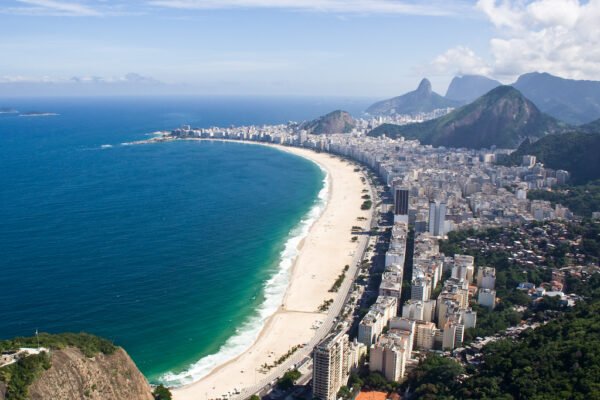
A symbol of Rio de Janeiro, Avenida Nossa Senhora de Copacabana has, in recent years, become a microcosm of the urban disorder affecting the city. Located in the heart of the South Zone, just one block from the beach and surrounded by commerce and hotels, including the rear of the Copacabana Palace, the avenue is one of the neighborhood’s main thoroughfares. Along its approximately 4 km length, it concentrates multiple forms of disorganization, ranging from chaotic traffic and public safety concerns to the presence of homeless populations and the irregular occupation of sidewalks. The area has also been the scene of recent tragic incidents, including the collapse of a building marquee and the electrocution of a Chilean tourist during a storm.
This Content Is Only For Subscribers
To unlock this content, subscribe to INTERLIRA Reports.
Chaotic Traffic
There is only one stretch where a minimum level of order can be observed, at the beginning of the avenue in Leme, which remains relatively calm compared to the rest. Problems begin as early as the intersection with Avenida Princesa Isabel, where drivers frequently run red lights, block crossings, and contribute to heavy congestion. Similar conditions are observed near Rua Rodolfo Dantas, behind the Copacabana Palace, especially after 17:00. Another factor that worsens traffic is the frequent stopping of vehicles for loading and unloading in the left lane, leaving only one lane available for general traffic, since the other two are reserved for buses and taxis with passengers. CET-Rio reports that teams operate daily to improve traffic flow and monitor the road, while the Municipal Guard states that it carries out regular enforcement in the area, having issued 14,127 fines this year.
Irregular occupation of sidewalks
The disorder seen on the roadway extends to the sidewalks. It is common to find bicycles and electric motorcycles circulating on pedestrian paths, which are also used as informal parking areas for these vehicles, leading to accumulation in several sections. Near Rua Paula Freitas, for example, electric motorcycles are frequently parked in front of commercial establishments, such as real estate agencies. Residents report that complaints have been repeatedly filed through the 1746 municipal hotline without effective resolution. Street vendors also contribute to the congestion of sidewalks, displaying a wide range of products that make pedestrian movement difficult, particularly for individuals with reduced mobility, such as wheelchair users and elderly people with walkers. From the corner of Rua República do Peru onward, vendors sell items ranging from books to second-hand goods and cell phone accessories. The most critical areas are near Siqueira Campos and Santa Clara, where more than ten stalls may occupy the same space. In some stretches, such as in front of a department store at number 749, pedestrians are left with only a narrow corridor between vendor stands and bus stop shelters.
Homeless people and rat infestation
In addition to Serzedelo Corrêa Street, located along the avenue, Nossa Senhora de Copacabana includes two squares: Lido Square at the beginning and Sara Kubitschek Square at the end. These locations illustrate another issue affecting the area, the concentration of homeless individuals, who are present throughout the avenue but tend to gather around these points. Sara Kubitschek Square, in particular, is one of the areas most affected by neglect. Alongside the presence of homeless people and drug users, the location has also been facing a significant rat infestation, raising public health concerns for residents and passersby.
Cell phone thefts and robberies
Public security issues further compound the problems along the avenue. People waiting at bus stops, for example, often report fear of being robbed. This concern is reflected in official data. According to the Public Security Institute, there has been an increase in street robberies and thefts in the region. In the area covered by the 12th Police Precinct, cell phone robberies rose from 7 to 15 cases in February of this year compared to the same month in 2025, effectively doubling. Thefts of cell phones also increased by 27%, rising from 118 to 150 cases. Many of these crimes follow a similar pattern: individuals using their phones in public are approached, the device is quickly snatched, and the suspect flees immediately. In one reported case, a young man jumped off a bus, stole a phone from a woman, and escaped.
Analysis:
The situation along Avenida Nossa Senhora de Copacabana reflects a classic case of cumulative urban disorder, where multiple low- and medium-intensity problems interact to produce a broader decline in the quality of public space. Rather than isolated issues, chaotic traffic, irregular sidewalk, and public safety concerns reinforce one another, creating an environment perceived as unpredictable and weakly regulated. This aligns with well-established urban security frameworks, which suggest that visible disorder—such as informal commerce spilling into pedestrian areas or inconsistent traffic enforcement—can erode informal social control and increase the likelihood of opportunistic crime.
Sources: O Globo.

