


Brazil’s political and economic landscape has been shaped by a series of developments involving economic performance, electoral dynamics, public security debates, and institutional investigations. Recent data on economic growth indicates a slowdown after several years of expansion, while new opinion polls reveal shifts in the approval of President Lula’s administration and the consolidation of potential challengers in the presidential race. At the same time, Congress is debating controversial measures related to public security, including a proposal to hold a plebiscite on lowering the age of criminal responsibility. Parallel to these discussions, oversight bodies and law enforcement agencies have launched investigations into alleged irregularities in the energy sector and a large-scale financial fraud scheme involving Banco Master. Together, these issues illustrate the current intersection of economic concerns, political competition, and institutional scrutiny in Brazil.
This Content Is Only For Subscribers
To unlock this content, subscribe to INTERLIRA Reports.
GDP
The Brazilian economy closed 2025 with growth of 2.3%, according to data released by the Brazilian Institute of Geography and Statistics (IBGE) on Tuesday (03/03), with the result mainly driven by strong performance in agriculture during the year. Even so, it represented the weakest performance of the Gross Domestic Product (GDP) since the pandemic period. After the recession in 2020, the reopening of economic activity led to stronger-than-expected growth between 2021 and 2024, surpassing projections and even the pace economists consider to be the country’s potential growth, but 2025 recorded the lowest expansion since the post-Covid-19 recovery began. The result matched market expectations, with analysts projecting 2.3% growth according to the Bloomberg median forecast, compared with 3.4% expansion in 2024. In the fourth quarter of last year, GDP increased only 0.1% compared with the previous quarter, indicating a slowdown that had already been anticipated, with all sectors of the economy losing momentum by the end of the year.
Lula Government Approval
Seven months before the first round of elections, the negative evaluation of the Lula (PT) government reached 40%, according to a new Datafolha survey released on Saturday (07/03). The poll shows that 32% rate the administration as excellent or good, while 26% consider it average and 1% did not express an opinion. In the previous survey, conducted in December last year, the negative evaluation (“bad” or “terrible”) stood at 37%, which indicates a slight upward movement although still within the margin of error of two percentage points. The positive rating remained stable at 32%, while the proportion of respondents who classified the government as average fell from 30% to 26%. Datafolha interviewed 2,004 Brazilians aged 16 or older between the 3rd and the 5th of this month. The negative approval rating comes despite government efforts in the economic field, including the approval of measures such as income tax exemption for individuals earning up to R$ 5,000 per month.
Flávio Bolsonaro
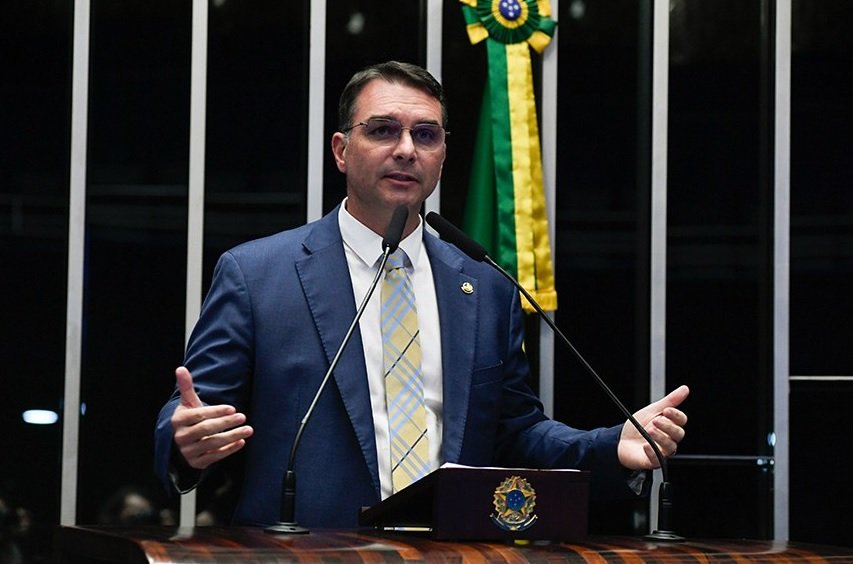
The pre-candidacy of Senator Flávio Bolsonaro (PL) has consolidated itself as the main alternative to Lula (PT) in this year’s presidential race, according to Datafolha. The senator from Rio de Janeiro is approaching the PT candidate in first-round simulations and appears technically tied with him in a potential second round, with 43% against 46% for his opponent. The new survey is the first conducted by the institute since Flávio was launched as a candidate by his father, former president Jair Bolsonaro, while in prison. Initially received with skepticism, especially given the preference of the political center for São Paulo Governor Tarcísio de Freitas (Republicanos-SP), the pre-candidacy has gradually gained traction. Datafolha interviewed 2,004 voters in 137 municipalities between Tuesday (3) and Thursday (5), with a margin of error of two percentage points. Flávio’s consolidation is also visible in spontaneous voting intention, when voters are asked to name a candidate without being presented with options: he was not mentioned in the previous survey in December but now appears with 12%, while Lula moved from 24% to 25% and the next most cited name is the ineligible Jair Bolsonaro, with 3%.
Lowering the Age of Criminal Responsibility
The suggestion to hold a plebiscite on lowering the age of criminal responsibility has become the main point of contention surrounding the Proposed Amendment to the Constitution (PEC) on Public Security, a project that the Lula (PT) government views as an opportunity to leave a lasting mark in the area currently considered the biggest concern for Brazilians. In the opinion of parliamentarians from both the government and the opposition, the dispute is likely to generate additional political pressure for President Lula, who opposes lowering the age of criminal responsibility from 18 to 16 in cases involving violent crimes. The opposition and part of the allied base in Congress support stricter penalties, a measure that usually receives broad public support in opinion polls. The proposal to hold a plebiscite in 2028 so that the population can express its opinion on lowering the age of criminal responsibility was included by the rapporteur of the PEC, Deputy Mendonça Filho (União Brasil-PE), against the government’s wishes, and the change would only be implemented if voters approve it. The debate over lowering the age of criminal responsibility intensified after a series of serious crimes committed by minors.
Ministry of Mines and Energy
The Federal Court of Accounts (TCU) has formally opened an investigation into alleged irregularities in the decision-making process of the Ministry of Mines and Energy (MME) that led to an increase in the maximum prices for the second reserve capacity auction, considered the most important auction of the year in the energy sector and scheduled to take place this month. According to an audit by the oversight body, the ministry failed to present sufficient technical justification for the increase, which could result in an unjustified rise in electricity bills paid by consumers. The assessment is that the measure may violate the principle of tariff moderation and compromise the economic balance of Brazil’s electricity sector. The court appointed Minister Jorge Oliveira as rapporteur to conduct a detailed investigation, while the original maximum prices had already been poorly received by the business sector and generated strong negative reactions among analysts who considered them insufficient to make several projects financially viable.
Banco Master Case
Banker Daniel Vorcaro, owner of Banco Master, was arrested again on Wednesday (04/03) by the Federal Police in São Paulo as part of an investigation into a billion-dollar financial fraud scheme. His brother-in-law, Fabiano Zettel, was also the target of an arrest warrant and later turned himself in at the Federal Police Superintendency. The arrests occurred during the third phase of Operation Compliance Zero, which, according to the Federal Police, aims to investigate the possible practice of crimes including threats, corruption, money laundering and the invasion of computer systems carried out by a criminal organization. The measure was authorized by Supreme Federal Court (STF) Justice André Mendonça in his first decision as rapporteur of the case, which he assumed last month.
Analysis:
Brazil’s recent economic data suggests that the post-pandemic expansion cycle is losing momentum, with growth returning to levels closer to the country’s structural capacity. The 2.3% GDP increase in 2025, driven largely by agriculture, indicates that the economy continues to expand but with less dynamism than in previous years. For the government, this slowdown creates a delicate political environment, since economic performance traditionally plays a central role in shaping voter perceptions in the period leading up to national elections.
At the same time, opinion polls indicate a more competitive electoral landscape, with President Lula facing rising levels of negative evaluation and the opposition consolidating around a potential challenger. The emergence of Flávio Bolsonaro as a viable candidate reflects both the continued influence of the Bolsonaro political network and the search among conservative voters for a figure capable of maintaining the movement’s electoral cohesion.
Sources: A Folha de SP [1], [2], [3], [4], [5]; O Globo [1], [2], [3]; G1.

