

Online scams have become increasingly common, demanding greater attention to the links and online content we interact with daily. Cybercriminals are constantly creating new methods to deceive people for financial gain, ranging from falsified payment receipts to fake technician impersonations. In Brazil, around 71% of the population has already fallen victim to this type of crime, which shows the need for caution when clicking on links in WhatsApp messages, emails, or SMS, as well as avoiding sharing personal information with strangers. To reduce risks, it is essential to understand how these scams work, recognize their main types, learn what to do if you are targeted, and adopt preventive measures to protect your data and avoid financial losses.
This article is part of a series on digital security. You can read the other texts here.
This Content Is Only For Subscribers
To unlock this content, subscribe to INTERLIRA Reports.
Fake CPF Irregularity Scam
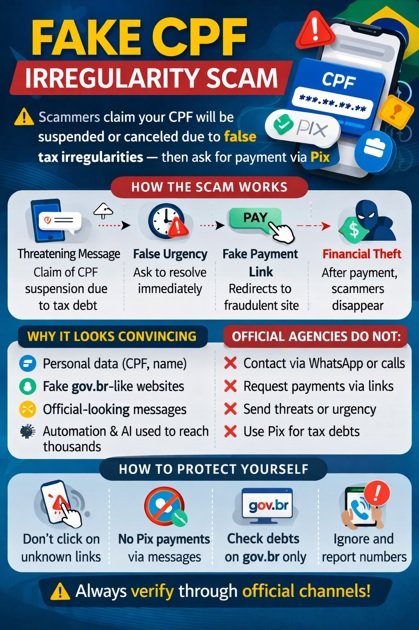
A new scam circulating on WhatsApp claims that a person’s CPF (Physical Persons Register) will be suspended or canceled due to a “serious tax irregularity” or an alleged “Federal Active Debt.” The message usually offers a discounted payment to regularize the situation, but the goal is simply to steal money from the victim.
How the Scam Works
- Threatening Message: The victim receives a WhatsApp message claiming that their CPF is at risk of suspension due to tax problems.
- False Urgency: Criminals create pressure by saying the issue must be resolved immediately to avoid penalties.
- Fake Payment Link: The message includes a link that directs the victim to a fraudulent page requesting payment via Pix.
- Financial Theft: After the payment is made, the scammers disappear and the supposed debt never existed.
Why the Scam Looks Convincing
The messages often include personal information such as the victim’s CPF number or name, making them appear legitimate. Scammers also use domains containing terms like “regularize,” “tax update,” “Federal Revenue,” or “CPF.”
In many cases, automation tools and artificial intelligence allow criminals to send convincing messages to thousands of people at very low cost.
Important: Official Agencies Do Not Contact You This Way
- The Brazilian Federal Revenue Service does not request payments via WhatsApp, phone calls, or messaging apps.
- Official tax payment documents must be generated through the official government website (gov.br).
- The Attorney General of the National Treasury (PGFN) also does not communicate through WhatsApp for debt payments.
How to Protect Yourself
- Never click on links sent by unknown contacts.
- Do not make Pix payments to resolve alleged tax issues sent via messaging apps.
- Always verify tax debts through official government portals.
- If you receive such a message, ignore it and report the number.
Remember: Government agencies do not threaten citizens through messaging apps or request immediate payments via links. When in doubt, verify the information directly through official channels.