


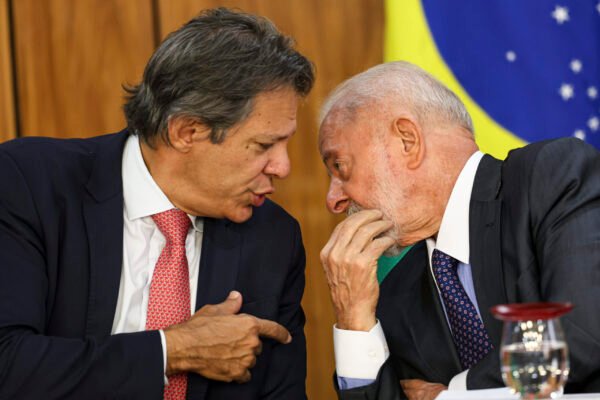
Recent developments in Brazil combine economic concerns, political repositioning ahead of the 2026 elections, and ongoing judicial investigations involving influential figures. New polling data indicates a deterioration in public perceptions of the country’s economic situation, while the federal government has announced emergency measures to contain rising diesel prices amid international tensions. At the same time, discussions about electoral strategies are intensifying, with the possible departure of Finance Minister Fernando Haddad and the future political role of Vice-President Geraldo Alckmin still uncertain. Parallel to these political and economic developments, the Supreme Federal Court continues to analyze the case involving banker Daniel Vorcaro, accused of leading a criminal organization linked to financial fraud and intimidation schemes.
This Content Is Only For Subscribers
To unlock this content, subscribe to INTERLIRA Reports.
Economic Perception
Brazilians’ perception of the country’s economic situation has worsened in recent months, partially reversing the improvement identified in surveys conducted at the end of 2025, according to a Datafolha poll. The survey also indicates an increase in pessimism regarding the future, including concerns about personal financial conditions, unemployment, and inflation. The percentage of respondents who believe that the country’s economic situation has worsened rose from 41% to 46% when comparing surveys conducted in December of last year and March of this year. This level falls between the best result of Finance Minister Fernando Haddad’s administration at the Ministry of Finance—35% in three surveys conducted in 2023 during the first year of Lula’s third term—and the 55% recorded in April 2025. Meanwhile, the proportion of those who believe the economic situation has improved declined from 29% to 24% of the two most recent surveys.
Diesel Price
The federal government announced on Thursday (12/03) its decision to eliminate PIS and Cofins taxes on diesel fuel to curb the rise in fuel prices caused by tensions in the Middle East following attacks on Iran by the United States and Israel. In addition, a provisional measure (MP) will establish the payment of subsidies to diesel producers and importers. The announcement of the measures was made at the Planalto Palace by President Lula (PT). According to Finance Minister Fernando Haddad, the decrees will not interfere with Petrobras’ pricing policy. The minister also explained that the government will issue a provisional measure providing subsidies to diesel producers and importers in the amount of R$ 0.32 per liter. This value will be deducted from the final price, meaning that consumers will receive a discount at the pump.
Haddad’s Departure
Finance Minister Fernando Haddad (PT) confirmed on Tuesday (10/03) that he intends to leave the ministry next week and indicated that his current deputy, Executive Secretary Dario Durigan, would likely assume the position. “I believe so. Dario has a very good relationship with the president, enjoys a great deal of trust, and has effectively been managing the ministry for many years,” Haddad said when asked about the future leadership of the ministry. According to the minister, the government has not yet made a final decision regarding his potential candidacy for governor of São Paulo. He stated that the matter is still under discussion and that a definition will depend on the complete composition of the electoral ticket.
Vice-President
Vice-President Geraldo Alckmin (PSB) announced on Thursday (05/03) that he will step down from his position as Minister of Development, Industry, Trade and Services on April 4, the deadline established by electoral law for public officials who intend to run in the upcoming elections. Alckmin’s role in the 2026 elections has not yet been defined. Although some members of the government consider it natural for Lula to choose a new vice-presidential running mate, others are discussing the possibility of selecting a candidate from another party. In an interview with Folha de São Paulo last week, Education Minister Camilo Santana (PT) stated that the MDB has strong potential candidates for the position, including Transport Minister Renan Filho and the governor of Pará, Helder Barbalho.
Case of Banco Master
The Supreme Federal Court (STF) formed a majority on Friday (13/03) to uphold the decision ordering the arrest of banker Daniel Vorcaro last week. Justices André Mendonça, Luiz Fux, and Nunes Marques voted in favor of maintaining the arrest, while Justice Gilmar Mendes has not yet presented his vote. Vorcaro is suspected of leading a criminal organization that allegedly maintained an “armed wing” used to intimidate adversaries through coercion carried out by a militia-like structure. The Court’s Second Panel will decide whether to confirm or overturn the measure. Messages obtained by the Joint Parliamentary Inquiry Commission (CPI) of the National Institute of Social Security (INSS) from the breach of telephone secrecy of the former banker reveal that the owner of Banco Master maintained dialogue with authorities from the three branches of government as well as major businessmen, according to conversations exchanged with his then girlfriend, influencer Martha Graeff.
Analysis:
Recent developments suggest that Brazil is entering a politically sensitive period in which economic perceptions, electoral positioning, and institutional scrutiny are becoming increasingly interconnected. Public opinion data showing rising pessimism about the economy is particularly significant in the run-up to the 2026 elections, as economic sentiment often plays a decisive role in shaping voter behavior. Even when macroeconomic indicators remain relatively stable, perceptions of inflation, employment prospects, and purchasing power can influence the political climate and place pressure on governments to adopt visible short-term measures at stabilizing prices and maintaining consumer confidence.
The federal government’s decision to eliminate taxes on diesel and provide temporary subsidies reflects this dynamic. Fuel prices have strong political and economic visibility in Brazil because they affect transportation costs, logistics chains, and ultimately the price of consumer goods.
Sources: O Globo [1], [2], [3], [4]; A Folha de SP [1], [2], [3], [4].

