


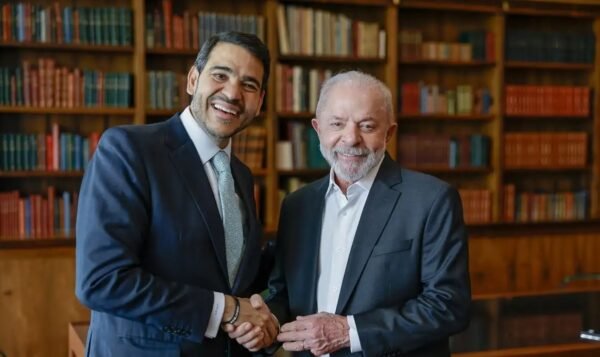
Brazil enters a turbulent political moment marked by escalating tensions between Congress and the Presidential Palace, growing disputes over Supreme Court nominations, and renewed clashes around key legislative agendas. Senate President Davi Alcolumbre’s public criticism of the government set the tone for a week in which the candidacy of Jorge Messias to the Supreme Court became both a point of friction and a test of silent support within the Senate, particularly among evangelical lawmakers. At the same time, the House leadership continues to block the amnesty bill for January 8 defendants, while the Senate advances costly retirement measures for health agents. In parallel, Congress prepares new challenges for the Lula administration on issues ranging from indigenous policy to public security reforms, deepening the wear and tear in relations between the branches of government.
This Content Is Only For Subscribers
To unlock this content, subscribe to INTERLIRA Reports.
New Crisis
In an escalation of tensions with the Presidential Palace, Senate President Davi Alcolumbre (União Brasil) issued a strong statement accusing “sectors of the Executive” of trying to link congressional resistance to political bargaining for government posts. He argued that such insinuations offend not only the President of Congress but the entire Legislative Branch, citing interference related to the nomination of Attorney General Jorge Messias to the Supreme Federal Court (STF). The government responded by trying to de-escalate the dispute. Institutional Relations Minister Gleisi Hoffmann publicly emphasized the administration’s “respect and recognition” for Alcolumbre. Behind the scenes, the strategy is to ease tensions and rebuild bridges with legislative leaders.
Supreme Court Nomination: Silent Support
As the Senate gears up to evaluate Jorge Messias’s nomination to the STF, his allies believe he will receive discreet but crucial support from evangelical senators, including several aligned with former president Jair Bolsonaro. Because the vote is secret, they estimate that lawmakers who would not openly endorse Messias may still vote in his favor. The nomination is scheduled to be analyzed on December 10, requiring 41 votes for confirmation.
Evangelical Leadership
Lula’s decision to nominate Jorge Messias to the Supreme Court was well received by the evangelical sector but created a gap in the government’s religious dialogue strategy. Messias served as the administration’s principal bridge to evangelical leaders and often represented the government at major events such as the March for Jesus. PT members acknowledge the difficulty of finding someone who can occupy this space with equal reach, even with Minister Marina Silva also being evangelical. One internal possibility under consideration is distributing this role among several officials rather than entrusting it to a single figure.
No Amnesty
House Speaker Hugo Motta (Republicans) is not expected to schedule the amnesty bill for defendants in the January 8 attacks—legislation that would directly benefit former president Jair Bolsonaro. Even after Bolsonaro’s arrest on Saturday (22/11), Motta maintains the proposal on hold with the backing of most party leaders. During a meeting on Tuesday (25/11), it became clear that the majority of parties prefer not to engage with the issue, leaving the bill without any foreseeable date for discussion.
Bombshell Agenda
The Senate approved a proposal granting full and equal retirement benefits to community health agents (ACSs) and endemic disease control agents (ACEs). The measure now moves to the House. Congressional technicians estimate that a similar amendment approved earlier by deputies may create a fiscal impact of R$11 billion over three years. The proposal reinstates benefits eliminated in 2003 and sets a minimum retirement age of 50 under a transition rule. It establishes special retirement conditions due to the risks of the profession and introduces more flexible eligibility criteria and generous benefit calculations.
More Wear and Tear
As friction between Congress and the Presidential Palace intensifies, lawmakers are preparing new challenges for the Lula administration. After overturning key presidential vetoes—on environmental licensing and state debt, among other issues—opposition and centrist blocs are moving to advance agendas where the government struggles to assert influence. Upcoming priorities include the proposed constitutional amendment to impose a time frame restricting new indigenous land demarcations, initiatives to reverse decrees expanding indigenous land rights, and deliberations on the Public Security PEC and the anti-gang bill. Although these last two proposals originated from the government, both may undergo significant modifications during congressional proceedings.
Analysis:
Brazil’s current political turbulence reflects a structural clash between institutional agendas, electoral positioning, and competing centers of power within Brasília. The confrontation between Senate President Davi Alcolumbre and the Executive exposes a deeper dispute over influence and autonomy, especially regarding Supreme Court appointments—a domain historically sensitive to partisan interests and personal alliances. Alcolumbre’s sharp reaction signals that congressional leaders intend to assert greater control over the process, making clear that Senate support cannot be taken for granted even when the government seeks to maintain a conciliatory tone. At the center of this dispute is Jorge Messias’s nomination for the Supreme Court, which functions both as a legal milestone and a political stress test. Although Messias is expected to receive discreet backing from evangelical senators, his departure from his previous institutional role leaves a vacuum in the government’s religious outreach strategy at a particularly delicate moment.
Simultaneously, Congress is broadening its legislative agenda in ways that heighten pressure on the Lula administration. By approving costly retirement benefits for health agents, lawmakers are asserting their independence while advancing proposals with significant fiscal and political implications. The upcoming debates on indigenous policy, public security reforms, and the anti-gang bill further illustrate a fragmented environment in which even government-backed initiatives may be reshaped or challenged by congressional forces.
Sources: O Globo [1], [2], [3], [4], [5], [6]; A Folha de SP [1], [2].

