



Summary
As one of Brazil’s primary hubs for oil, natural gas, and offshore exploration, Espírito Santo is experiencing a substantial influx of capital into major energy, maritime, and infrastructure projects. The expansion of offshore production fields, port logistics, and transition-energy initiatives brings an increased operational footprint across the state. In this context, analyzing state-level crime indicators and violence dynamics is essential to evaluating operational risks, helping ensure the safety of operating companies, personnel, and foreign contractors during their transit and day-to-day activities across the region.
In recent years, Espírito Santo has achieved significant progress in Public Security, showing decreases in homicides and across different categories of property crimes. In 2025, the state recorded the lowest number of intentional homicides since the beginning of the historical series in 1996. However, this positive trend contrasts with the persistence of armed clashes, the consolidation of criminal factions, and the expansion of their illicit activities, particularly in the Greater Vitória Metropolitan Region. The growing integration between local criminal organizations and factions from other states, coupled with increased firearms availability and the diversification of extortion practices, poses a challenge to law enforcement and business stability across the region.
This Content Is Only For Subscribers
To unlock this content, subscribe to INTERLIRA Reports.
Statistical Evolution of Public Security in Espírito Santo
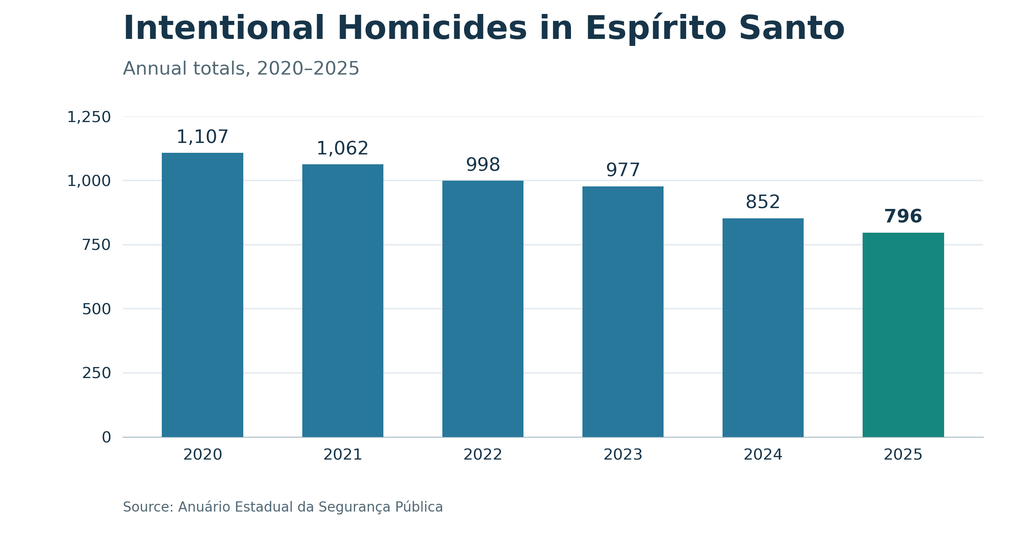
Espírito Santo shows progress in public security, marked by a reduction in intentional homicides and various typologies of property crimes. In 2025, the state recorded 796 intentional homicides, the fifth consecutive year of decline. According to the State Secretariat of Public Security and Social Defense, it was the first time the annual total fell below 800 victims. This outcome mirrors the nationwide downward trend in intentional violent deaths, although state-level progress also relies on local factors and the specific security policies implemented.
Despite these advances, challenges linked to the circulation of firearms and the activity of criminal factions persist. In 2024, 3,792 firearms were seized in Espírito Santo, averaging approximately ten per day. Although the total volume of seizures has remained relatively stable in recent years, according to the Sou da Paz Institute, rifle seizures rose by 212% between 2021 and 2025, underscoring the need to monitor the firepower of criminal groups.
In this context, deaths resulting from State agent interventions reached 78 in 2024, the highest level since 2009 and a 9.3% increase compared to the previous year. According to the State Public Security Yearbook, this spike is primarily driven by expanding criminal factions, whose turf wars have escalated armed clashes and resulting lethal encounters with police.
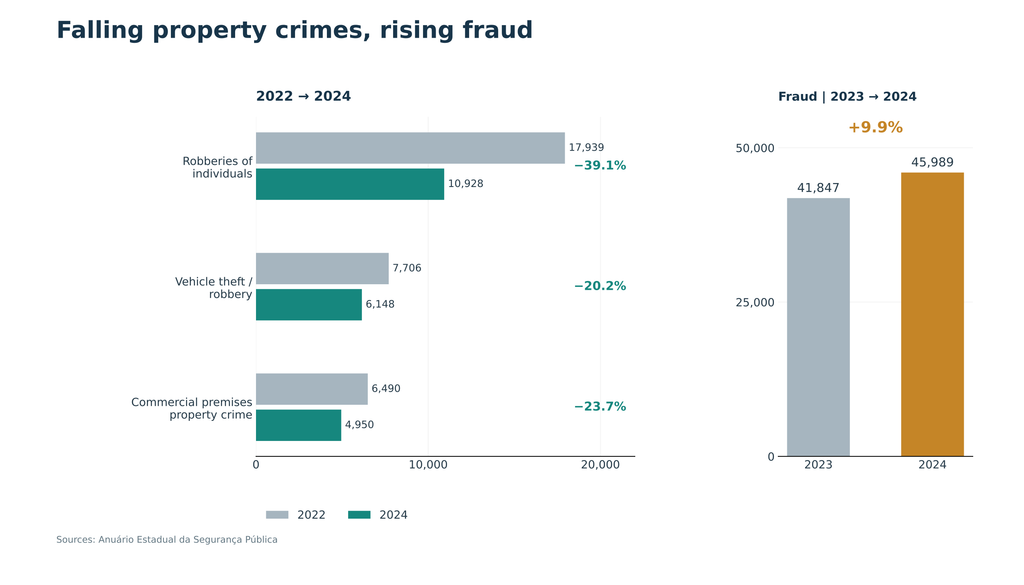
Regarding traditional property crimes, indicators also point to improvement. Between 2022 and 2024, robberies of individuals dropped by 39.1%, falling from 17,939 to 10,928 incidents. Over the same period, vehicle theft and armed carjacking fell by 20.2%, from 7,706 to 6,148 cases, while commercial establishment theft and burglary decreased by 23.7%, from 6,490 to 4,950 reported incidents. These reductions represent advancements in safeguarding both the general population and economic activities.
Concurrently, the rise in scams and fraud signals a shift in the profile of property crime. Following increases between 2020 and 2022 and a slight drop in 2023, reports resumed growth in 2024, climbing from 41,847 to 45,989 incidents, a roughly 10% increase. The expansion of these crimes is also evident nationwide, reflecting the growing appeal of illicit activities that yield substantial financial returns, offer broader reach through digital platforms, and minimize both perpetrators’ visibility and legal repercussions.
Overall, these indicators demonstrate progress in Espírito Santo’s Public Security aligned with the national reduction in lethal violence, while simultaneously exposing an evolution of underlying risks. The decline in homicides and traditional property crimes coexists with the spread of fraud and ongoing armed skirmishes. For corporations and residents alike, this environment requires combining physical protection measures with scam prevention, digital security, and continuous tracking of local violence dynamics.
Geographic Distribution of Crime
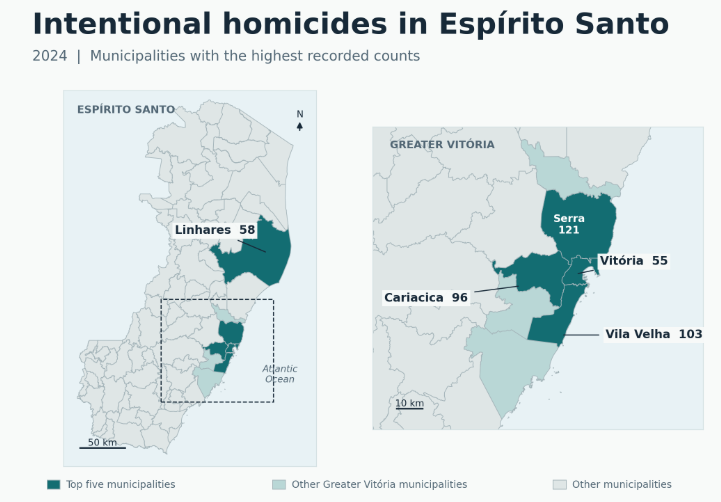
The region of Espírito Santo accounting for the highest concentration of homicides is the Metropolitan Region, with 406 cases in 2024. During the same period, the only area showing an increase was the Serrana Region, up by 9.3%. The most significant decrease occurred in the Northern Region, which saw a 25.8% reduction in cases.
Recorded homicides are concentrated in five municipalities that collectively account for over 51% of all cases: Serra, Vila Velha, Cariacica, Linhares, and Vitória. Four of these five municipalities, except Linhares, are part of the Greater Vitória Metropolitan Region.
An analysis of reports on deaths resulting from police intervention in Espírito Santo in 2024 reveals a strong territorial concentration. Out of the 78 recorded deaths, 77% took place in Greater Vitória, with 47% recorded exclusively within the municipality of Vitória (37 cases). The state capital, in turn, featured a critical hotspot centered in the Penha neighborhood and its surroundings, which accounted for 70% of the municipality’s incidents, corresponding to roughly one-third (1/3) of all occurrences across the entire state.
The concentration of deaths resulting from police intervention in Greater Vitória, notably in Penha and neighboring areas, is tied to territorial disputes among criminal factions. Battles for control over drug distribution points and strategic sectors of the Metropolitan Region, combined with increased circulation of illegal weapons, have heightened the offensive capability of criminal groups and intensified clashes with law enforcement.
A survey conducted by the Military Police revealed that in the final quarter of 2023, the Penha cluster, comprising nine neighborhoods and communities, accounted for nearly half of all shootouts with police registered in Vitória, while representing 10% of such occurrences across the entire state.
The high incidence of these confrontations occurs within a broader context of territorial struggles between criminal factions in the capital. In June 2024, an attempted takeover of the Jaburu community by members of the Primeiro Comando de Vitória (PCV), an area then dominated by the Terceiro Comando Puro (TCP), resulted in four deaths, three of which occurred during shootouts with police. The persistence of these disputes was further demonstrated in October 2026, when an operation against the PCV in the Grande São Pedro area of Vitória led to the arrest of 28 suspects tied to drug trafficking and the coordination of attacks against rival neighborhoods. The operation mobilized around 200 police officers and targeted members of armed wings and leadership tiers within the criminal syndicate, illustrating the scale of the structures engaged in territorial conflicts in the capital.
The Structure of Organized Crime in Espírito Santo
In Espírito Santo, organized crime is structured through alliances between national factions and local groups. The primary organization is the PCV, allied with the Comando Vermelho (CV). Under this arrangement, the CV provides narcotics and logistics, while the PCV preserves local operational autonomy.
The operation of criminal factions in Espírito Santo displays growing integration with factions based in Rio de Janeiro, notably via the sharing of operational criminal infrastructure, drug commercialization, and weapons supply chains. According to the State Secretariat of Public Security and Social Defense (Sesp), in September 2025, five of Espírito Santo’s ten most wanted criminals were hiding in Rio de Janeiro’s communities, notably Rocinha and Complexo do Alemão. Sesp’s Undersecretary of Intelligence, Romualdo Gianordoli, noted that these fugitives began participating directly in local drug trafficking and building commercial partnerships with Rio-based groups, facilitating the pipeline of heavy weaponry, including assault rifles, into Espírito Santo. These connections are also reflected in the sway exerted by external state factions over local groups. According to then-Secretary of Public Security Eugênio Ricas, the PCV operates under the influence of Rio de Janeiro’s CV, whereas Espírito Santo’s Terceiro Comando Puro (TCP) is influenced by São Paulo’s Primeiro Comando da Capital (PCC). Given that both national cartels control major interstate trafficking routes, regional factions rely on them directly for drug and weapons pipelines.
A clear manifestation of this cross-border dynamic came on October 14, 2026, when Civil Police raided the PCV in Vitória’s Grande São Pedro region, arresting 28 operatives implicated in narcotics distribution and planned turf incursions. According to Chief Ramiro Diniz, head of Vitória’s Homicide and Personal Protection Division (DHPP), several suspects under investigation were harbored in the Rocinha community in Rio de Janeiro, demonstrating how Rio’s territory functions as a haven for criminal operatives active in Espírito Santo.
Diversification of Criminal Activities
The activities of criminal factions in Espírito Santo have expanded beyond drug trafficking to incorporate extortion practices and the control of economic activities and essential utilities across communities under their influence. This diversification marks an evolution in territorial control strategies, involving the enforcement of rules and levies on businesses and residents, which amounts to structured social dominance. One documented instance occurred in Vila Velha, where criminal groups linked to the PCV and TCP began extorting internet service providers to allow service operations in specific communities. According to investigations by the Civil Police of Espírito Santo (PCES) under Operation NarcoNet, in Vila Garrido, a neighborhood in Vila Velha, TCP-affiliated traffickers demanded up to R$ 3,000 per week from local providers. Companies refusing to pay were targeted with sabotage against cables and hardware, cutting off internet access for residents. At least seven companies were impacted by the scheme.
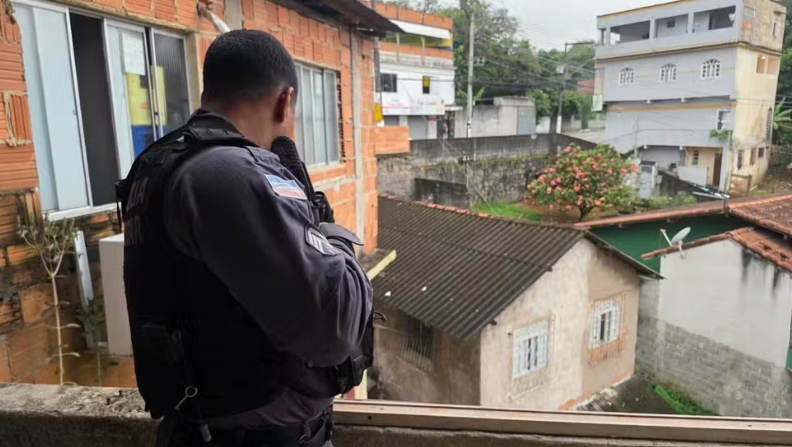
Alongside extortion, criminals have adopted surveillance technologies to tighten territorial oversight. During Operation Provedor.Net 2.0, conducted on October 9, 2026, the Civil Police seized 15 cameras linked to a clandestine monitoring network used to track the movements of police and residents within PCV-controlled territory. The continuation of these activities triggered Operation NarcoNet on October 19, resulting in six arrests. According to the Civil Police, inquiries expanded to investigate practices of structured social dominance, highlighting an operational model that blends diversified revenue streams with surveillance mechanisms, intimidation, and disruption of essential services.
State Response and Recommendations for Corporate Security
The Government of Espírito Santo structures its public safety policy through the State Public Security and Social Defense Plan 2023–2035, which prioritizes institutional integration, combating organized crime, and modernizing law enforcement agencies. Within this framework, the Estado Presente em Defesa da Vida Program blends targeted enforcement with social prevention, prioritizing zones with severe rates of violence and social vulnerability[1]. Its Police Protection and Social Protection pillars coordinate intelligence, multi-agency operations, weapons seizures, community empowerment, and the expansion of social opportunities.
For corporate security, this institutional strategy must be factored into risk assessments alongside continuous tracking of criminal dynamics and the operational disruptions caused by police interventions. Companies are advised to evaluate the geographic location of facilities, accommodations, and suppliers, plan secure transit routes and schedules, and establish robust communication and incident response protocols. Training staff and travelers regarding higher-risk areas and emergency procedures further reduces vulnerability. Given the rise in digital fraud and criminal extortion targeting essential services, organizations should reinforce payment and vendor verification controls, data security protocols, and business continuity plans. These measures must include contingency options for telecommunications interruptions and access restrictions, particularly in areas susceptible to territorial disputes, with threat assessments continuously updated as the local landscape evolves.

These tailored precautions will be particularly vital ahead of high-profile industry gatherings—most notably the upcoming Vitória PetroShow, scheduled for April 7–9, 2027. As the state prepares to welcome international executives, delegations, and exhibitors across the oil, natural gas, maritime, and renewable sectors, proactive corporate risk management and comprehensive travel security planning will ensure participants navigate the metropolitan environment safely while taking full advantage of the region’s commercial opportunities.
[1] The Estado Presente em Defesa da Vida Program was first launched in 2011 by the Government of the State of Espírito Santo under the administration of Governor Renato Casagrande, aimed at pulling the state out of a decade-long crisis of extreme violence. The initiative was temporarily suspended between 2015 and 2018. The policy was formally relaunched in 2019 with a modernized framework, and its governance model was expanded via a state decree in February 2025. Today, the program operates under the strategic oversight of the Secretariat for Economy and Planning (SEP), coordinating three core axes managed by the Secretariat for Public Security and Social Defense (SESP), the Secretariat for Human Rights (SEDH), and the State Secretariat for Women (SESM).

