


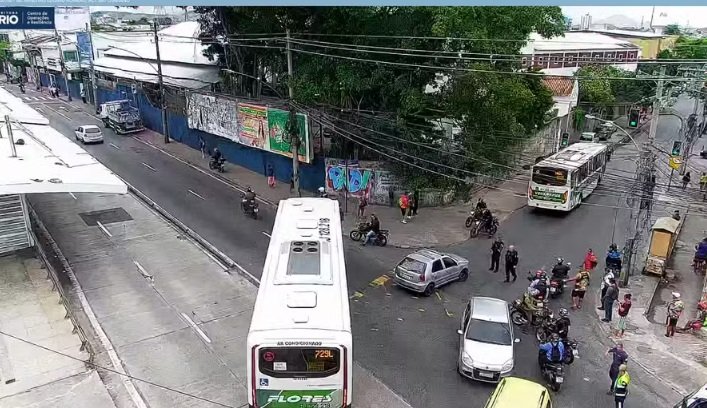
Criminals used at least 12 buses as barricades on four major roads in Madureira, in Rio de Janeiro’s North Zone, on Tuesday afternoon (27), in an apparent retaliation for a police operation carried out in the region earlier in the day. According to information confirmed by TV Globo, at least one private car was also stopped by the attackers, who took the vehicle’s keys to block traffic. In Rocha Miranda, another neighborhood in the North Zone, four additional buses were similarly used to obstruct streets, expanding the impact of the action to nearby areas and causing widespread disruption to mobility.
This Content Is Only For Subscribers
To unlock this content, subscribe to INTERLIRA Reports.
Removal of Barricades
According to the Military Police, the situation unfolded after an operation aimed at removing barricades and repressing criminal activity in several communities. Seven suspects were arrested earlier that day during actions in Cajueiro, in Madureira, as well as in the communities of Faz Quem Quer, Morro da Congonha, and Morro do Terço. Among those detained were Cristian Costa Moreira and Douglas Henrique Oliveira de Almeida, who were arrested in Cajueiro while in possession of a pistol, a magazine, ammunition, and 20 capsules of cocaine. Police say the arrests may have triggered the retaliatory actions that followed hours later.
More than just buses
In Madureira, the criminals did not limit themselves to buses operated by companies affiliated with Rio Ônibus. Two buses from Semove and a Comlurb garbage collection vehicle were also seized and used as barricades. According to RioÔnibus, nine vehicles were immobilized in the early afternoon along Edgar Romero, Conselheiro Galvão, Leopoldino de Oliveira, and Estrada do Otaviano avenues, all key routes in the neighborhood. By around 6:30 pm, these vehicles had been released, but shortly afterward, four more buses had their keys stolen, again interrupting circulation. The union reported that at least 19 bus lines were forced to alter their routes due to the incidents. An intercity bus was also targeted and had its key taken. The Bus Rapid Transit (BRT) system experienced operational changes as well, although service was gradually normalized by approximately 17:40.
Analysis:
The coordinated use of buses and service vehicles as barricades in Madureira reflects a well-established tactic employed by criminal groups to assert territorial control and retaliate against state action. By targeting major traffic arteries rather than isolated streets, these groups maximize disruption, amplify public visibility, and signal their capacity to impose immediate costs on urban mobility. This strategy is less about direct confrontation with police and more about demonstrating power through paralysis of daily life, using civilian infrastructure as a pressure point against authorities.
From an operational standpoint, the timing of the barricades shortly after arrests suggests a rapid mobilization capability and a degree of local coordination among offenders. Such actions indicate that criminal groups maintain contingency plans to respond to police incursions, even when leadership figures are detained.

