


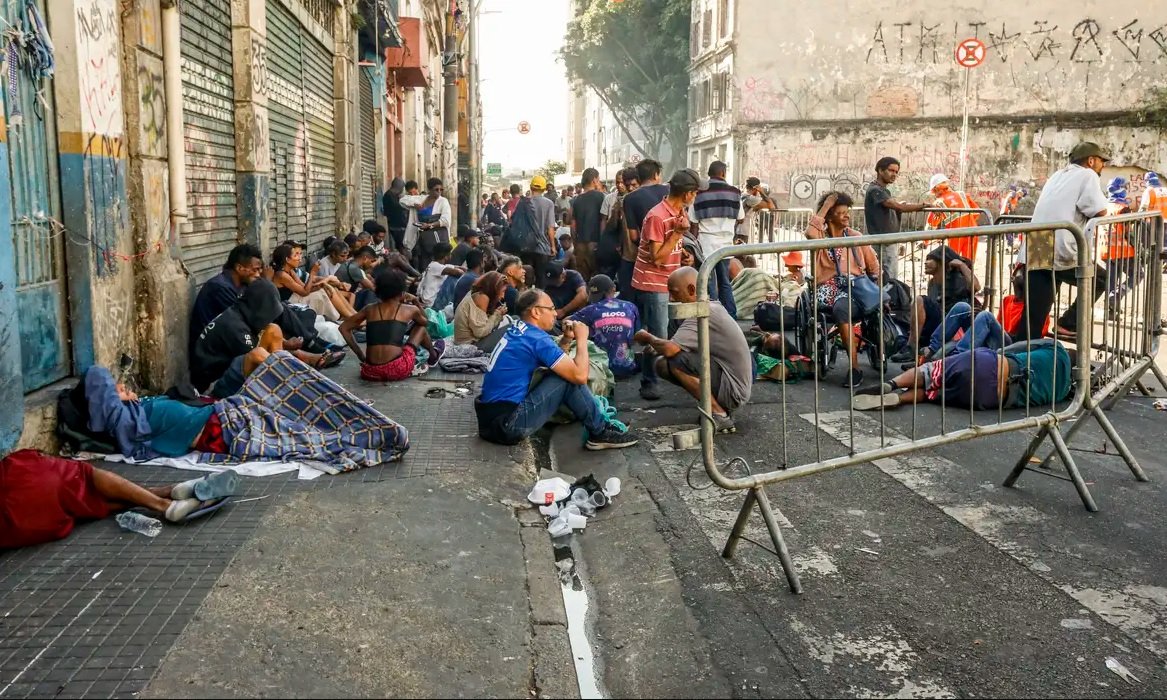
Footage recorded by a national TV channel shows drug trafficking and consumption occurring in broad daylight at several locations in downtown São Paulo. The so-called “Cracolândia flow” has spread throughout the central region, and it is common to see groups of people openly consuming drugs. In the images, it is possible to observe that a camera from the Smart Sampa surveillance program, installed in front of the Municipal Market, records the movement of people on the street, but not what occurs a few meters away under the Diário Popular Viaduct.
This Content Is Only For Subscribers
To unlock this content, subscribe to INTERLIRA Reports.
Drug Users
The flow of people is constant in the narrow corridors of the occupation located beneath the Diário Popular Viaduct. Drug users arrive carrying small bills and leave with crack rocks in their hands, many already with improvised pipes hanging from their shoulders.
Metropolitan Civil Guard
The footage was recorded between February 26 and 27. In one of the recordings, a team from the Metropolitan Civil Guard can be seen arriving at the location, after which several people leave the area. With weapons drawn, the officers approach some of the individuals who remain in the space. They speak briefly with them and then leave the scene. No arrests are made. The images also show that once the police vehicle departs, drug trafficking resumes. In one moment, a man emerges from the shacks stuffing large banknotes into his wallet. Wearing a gold chain and a designer T-shirt, he then drives away in a luxury car.
Other Locations
Although the trade is more concentrated under the viaduct, the sale and consumption of drugs occur at several other points across the central region. In some cases, the activity happens openly and without concern for discretion, sometimes even near police presence. “The police sometimes pass by and do nothing. They just turn on the siren, people hear it and leave, and soon they come back,” said a resident of the area. On Alameda Barão de Piracicaba, almost anything can be traded, even a pair of used flip-flops. In Parque Dom Pedro II, near the São Paulo State School, part of the building appears completely abandoned. The surrounding area is largely deserted, and under another viaduct next to the school, the number of people consuming drugs together is striking, forming what residents describe as a kind of mini-Cracolândia.
Protestant Street
Until May 2025, the concentration of drug users known as the Cracolândia flow was located on Protestant Street, near Luz Station. However, after a series of interventions by public authorities, the drug users who had gathered there dispersed. A theater that operated on city-owned land was also located in that area.
Public Security
The Public Security Secretariat stated that drug sales points are constantly shifting. When the police dismantle one location, traffickers quickly establish another. According to the government, authorities monitor these changes and maintain a mapped system to enable operations in these areas. In a statement, the São Paulo City Hall said it maintains continuous efforts to assist and support people experiencing homelessness and social vulnerability, with social assistance teams working day and night in the Parque Dom Pedro II and Campos Elíseos regions. The administration also stated that the Metropolitan Civil Guard provides visible policing 24 hours a day across the capital.
Analysis:
The scenes recorded in downtown São Paulo illustrate the persistence and adaptability of open-air drug markets in large urban centers. Areas historically associated with concentrated drug use have repeatedly shifted locations following police operations and urban interventions, creating a pattern of spatial displacement rather than structural reduction. When enforcement actions dismantle a specific concentration point, users and dealers often relocate to nearby streets, underpasses, or abandoned spaces where surveillance and policing are less consistent. This dynamic explains how the phenomenon commonly referred to as the Cracolândia flow continues to reappear across different parts of the central region.
More broadly, the situation reflects the intersection of public security, urban vulnerability, and public health challenges. Many individuals present in these areas are simultaneously involved in drug consumption, informal survival economies, and homelessness, making purely repressive approaches insufficient to produce lasting change.
Sources: G1.

