


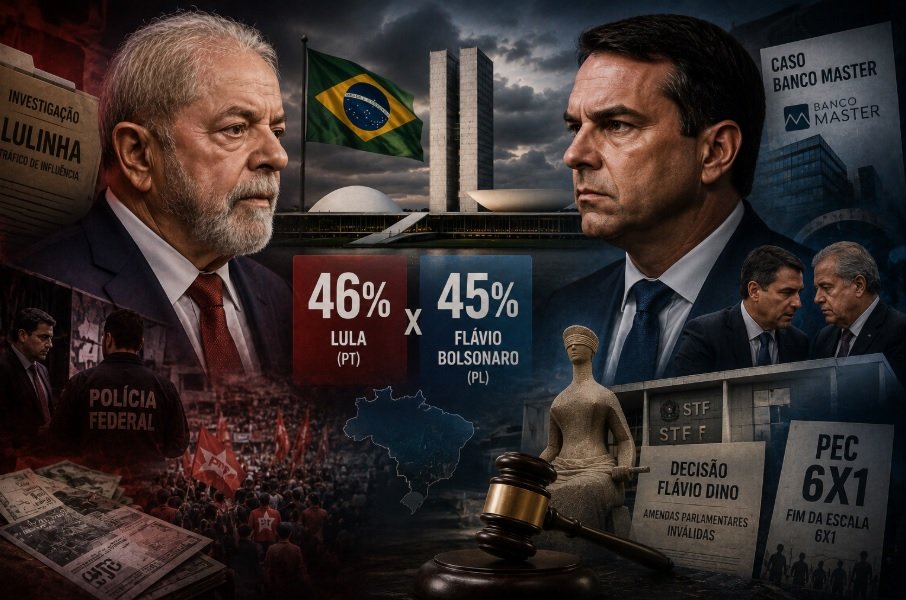
As Brazil’s campaign season intensifies, both presidential contenders are navigating a complex landscape where legal proceedings, scandals, and institutional decisions are proving as consequential as the battle for votes. Investigations touching both camps — including allegations of influence peddling involving President Lula’s son “Lulinha” and the ongoing fallout from the Banco Master case affecting Flávio Bolsonaro — have kept both campaigns on the defensive, while a landmark STF ruling by Justice Flávio Dino voiding parliamentary amendments influenced by party leaders outside Congress added fresh turbulence to the political environment. On the legislative front, the PEC ending the 6×1 work schedule has re-emerged as a flashpoint, with Flávio Bolsonaro’s campaign scrambling to counter what it views as a key electoral asset for Lula following signs that Senate President Alcolumbre may bring the proposal to a vote. Meanwhile, the latest polling shows the race remaining essentially deadlocked, with Lula and Flávio statistically tied at 46% to 45% in a simulated runoff nationally — though a regional breakdown reveals important distinctions, with Flávio leading in São Paulo, Rio de Janeiro, and the Federal District, while Lula holds advantages in the Northeast.
This Content Is Only For Subscribers
To unlock this content, subscribe to INTERLIRA Reports.
Campaign Challenges
Beyond the battle for votes, the campaigns of Lula (PT) and Flávio Bolsonaro (PL), the leading presidential contenders, are focused on making strategic adjustments to either avoid or capitalize on investigations, court rulings, and scandals shaping this year’s electoral landscape. Actions by the Federal Police and justices from the Supreme Federal Court (STF) and the Superior Electoral Court (TSE), along with long-standing tensions between branches of government, have largely influenced shifts in the race, which initially favored the PT candidate but has more recently moved in Flávio’s direction. So far, each candidate has found himself at the center of at least one controversy stemming from Federal Police investigations authorized by STF justices. In May, The Intercept Brasil revealed messages between Flávio and Daniel Vorcaro concerning the film Dark Horse, linking the Bolsonaro ally to the Banco Master case. This month, the Federal Police are investigating Fábio Luís Lula da Silva, known as “Lulinha,” for alleged influence peddling. He is suspected of working alongside lobbyist Roberta Luchsinger to secure federal government contracts. Luchsinger is also under investigation for ties to the individual known as “Careca do INSS,” a central figure in another high-profile scandal involving fraudulent deductions from pension payments, a controversy from which the PT campaign is seeking to distance itself.
Invalidation of Amendments
On Sunday (23/08), Supreme Federal Court (STF) Justice Flávio Dino ruled that any parliamentary amendment is absolutely void if the process through which it was designated involved interference by political party leaders or individuals who do not hold seats in the National Congress. The decision follows suspicions that PL president Valdemar Costa Neto and former congressman Eduardo Cunha (Republicanos) acted to influence the allocation of amendments, allegations that led to the freezing of both men’s assets in July. The PL itself told Dino that Valdemar had no legal authority over the allocation of parliamentary amendments and that his participation was limited to making suggestions, which lawmakers were not necessarily required to follow. Days earlier, however, he had stated in interviews that such involvement was a natural part of his political role.
6×1 Work Schedule
Senate President Davi Alcolumbre’s (União Brasil) indication that he may bring the Proposed Constitutional Amendment (PEC) ending the 6×1 work schedule to a vote has mobilized members of Flávio Bolsonaro’s (PL) campaign. The proposal is a key component of President Lula’s campaign platform and gained momentum in the Senate after the PT leader began a rapprochement with the head of the chamber.Within Flávio Bolsonaro’s campaign, efforts surrounding the PEC are being led by Senator Rogério Marinho (PL), coordinator of the party’s presidential campaign. The lawmaker has introduced an alternative PEC and is attempting to redirect the debate in the Senate. Congress reduced its activities during the election period and decided to hold only two weeks of concentrated legislative effort before the vote. The first took place in early August, while the second is scheduled for the week beginning August 31.
New Poll
President Lula (PT) and Senator Flávio Bolsonaro (PL) remain statistically tied in a potential runoff, with 46% and 45% of voting intentions, respectively, according to a BTG/Nexus poll released on Monday (24/08). In the previous survey, the PT candidate registered 47%, compared with 44% for his main rival. A total of 2,006 voters aged 16 and older nationwide were interviewed by telephone between Friday (21) and Sunday (23). The confidence level is 95%. A new Datafolha poll, released on Saturday (22), also provides a regional picture of the presidential race across six key electoral districts. In runoff scenarios, Senator Flávio Bolsonaro (PL) leads in São Paulo and Rio de Janeiro states, as well as in the Federal District. President Lula (PT), meanwhile, leads in Pernambuco and Piauí. In Minas Gerais, the two candidates are statistically tied.
Analysis:
Brazil’s presidential race is increasingly being shaped not only by voter preferences but also by the institutional environment surrounding the two leading candidates. Investigations involving figures connected to both Lula and Flávio Bolsonaro create political risks even when they do not directly implicate the candidates themselves, because each campaign can use the other side’s controversies to reinforce narratives about corruption, political influence, and institutional misconduct. The STF decision on parliamentary amendments adds another layer to this dispute by placing greater emphasis on formal institutional procedures and limiting the influence of party leaders and other political actors who do not hold congressional mandates. In an election already marked by strong polarization, decisions of this nature are likely to become part of the broader political confrontation between the Executive, Congress, and the judiciary.
Sources: O Globo [1], [2], [3], [4], [5], [6]; A Folha de SP [1], [2], [3], [4].

