


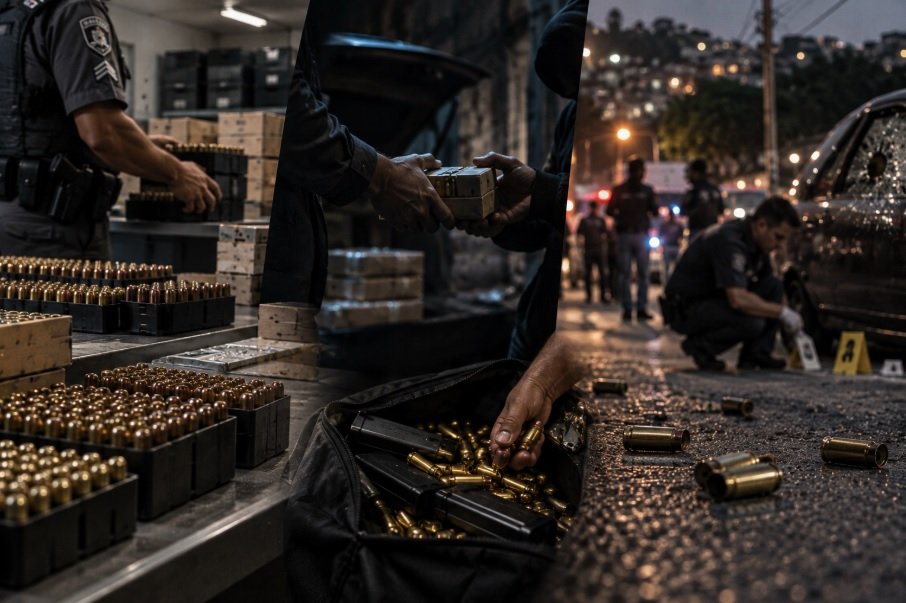
A stock of ammunition purchased by the São Paulo Military Police more than a decade ago has continued to surface in criminal investigations, exposing persistent weaknesses in the control and traceability of ammunition supplied to security forces. According to a survey by the Instituto Sou da Paz, ammunition from two PM-SP lots acquired in 2005 and 2007 has been identified in several violent incidents since 2012, including mass killings in Greater São Paulo, Londrina (PR), and São Gonçalo (RJ). The most recent case cited by the report involves the November 2025 death of lawyer Carlos Alves Vieira, known as Ferrugem, who was shot by Rota officers in Itaquaquecetuba.
This Content Is Only For Subscribers
To unlock this content, subscribe to INTERLIRA Reports.
Irregular Ammunition Lots
The investigation identified lots AAE67 and BAY18 as having been acquired in quantities far above the limit established by an Army regulation intended to facilitate traceability. The AAE67 lot contained 438,000 9mm rounds, while BAY18 included 320,000 9mm rounds and 1.4 million .40-caliber rounds, despite the regulation establishing a 10,000-round limit for each identification code.
Use in Major Crimes
Ammunition from these lots has been identified at crime scenes over a period of more than 14 years. The survey links the rounds to killings in Osasco and Carapicuíba in 2012, the 2015 Osasco-Barueri massacre that left 17 people dead, an attack in São Gonçalo that killed two people, and the 2016 Londrina massacre, in which 11 people were killed. The recurrence of the same ammunition codes indicates that diverted stocks remained available for criminal use over an extended period.
Traceability Failures
The case highlights significant gaps in the ability of authorities to track ammunition from procurement to its final use. Brazil requires ammunition sold to police and armed forces to carry alphanumeric identification codes, but there is no unified public database containing all ammunition lots acquired by security institutions. The Instituto Sou da Paz argues that the absence of such a database makes it more difficult to identify diversion, investigate crimes, and establish institutional accountability.
The Ferrugem Case
The most recent case also raises questions about evidence preservation and the reliability of operational records. Investigators found PM ammunition in a Glock 9mm attributed to Ferrugem, but the weapon did not appear in the available body-camera footage. The recording began more than six minutes after the shooting, while other evidence indicated that officers handled the vehicle involved in the incident during the period not covered by the cameras. The Glock and another pistol found in the vehicle also had their original identification numbers removed or altered, preventing their origins from being traced.
Analysis:
The diversion of government-issued ammunition represents a significant security risk because it creates a long-term illicit supply channel that can directly support organized crime and violent offenders. The fact that ammunition from the same police lots has appeared in unrelated criminal incidents over more than a decade suggests that diversion is not necessarily an isolated loss of inventory, but can become a persistent vulnerability when stock control, accountability, and forensic traceability are inadequate.
From a corporate security perspective, the case reinforces the importance of considering the illicit diversion of state-controlled weapons and ammunition as part of the wider organized-crime environment. Weak traceability can complicate investigations following shootings, increase uncertainty surrounding the provenance of weapons and ammunition, and potentially undermine confidence in official security operations. For companies operating in environments exposed to armed crime, this reinforces the importance of monitoring the availability of illicit firearms and ammunition, assessing the quality of local law-enforcement controls, and incorporating ammunition-related risks into broader assessments of criminal violence and personnel security.
Sources: A Folha de SP.

