


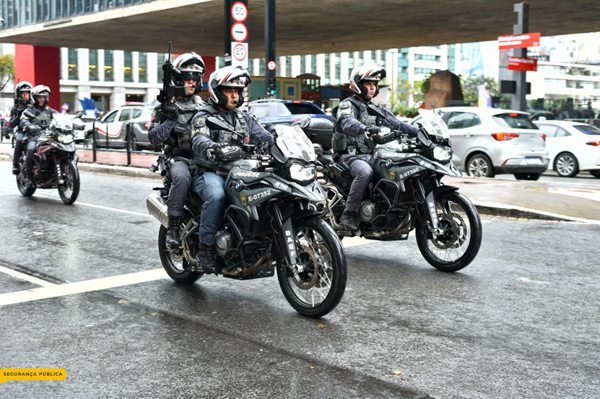
On September 22, 2026, the Government of São Paulo announced the creation of the Advanced Operational Response Battalion (Batalhão de Resposta Avançada Operacional – BRAvO), a new Military Police structure designed to combat robberies and thefts in the state capital’s highest-crime areas. The objective is to expand mobility and police response capacity, particularly against crimes committed by fake delivery drivers and specialized groups that smash car windows to steal valuables. The battalion’s establishment represents a major commitment by the state government to combine criminal intelligence, operational mobility, and ostensive patrolling to confront urban crime.
This Content Is Only For Subscribers
To unlock this content, subscribe to INTERLIRA Reports.
Policing Strategy and Operational Areas
BRAvO was developed to operate in designated critical zones using statistical data, heat maps, and intelligence from Muralha Paulista, the state government’s monitoring network, to direct team deployments. The initiative brings together 250 military police officers and 150 motorcycles, with teams operating in pairs and equipped with assault rifles during patrols. Initially concentrating on São Paulo, the battalion can be redeployed to other regions as crime trends evolve. The use of motorcycles aims to navigate congested traffic and enable faster response times. Beyond ostensive patrolling, officers are authorized to conduct stop-and-searches, checkpoints, inspections, and operations in peripheral neighborhoods and favelas. All personnel will wear body-worn cameras while on duty.
Operational Structure and Workforce Management
Despite being introduced as a new battalion, BRAvO features a non-traditional operational structure within the Military Police. Operating under a matrix model, the unit lacks its own permanent staff, fixed commander, or official headquarters; instead, it draws officers from various existing battalions, including territorial and specialized units. A portion of the personnel participates via the Military Police Extra Duty Pay Program (Diária Especial por Jornada Extraordinária de Trabalho Policial Militar – Dejem), which offers additional compensation for officers working during off-duty hours. According to the Secretariat of Public Security (Secretaria da Segurança Pública – SSP), this framework temporarily scales up police presence in priority areas without permanently stripping agents from their home units. However, relying on extra-duty hours raises questions regarding the long-term operational sustainability of the initiative and officer fatigue management.
Analysis
The launch of BRAvO highlights a public safety strategy centered on concentrating police resources in high-crime zones by pairing intelligence with agile, high-firepower ostensive intervention. Utilizing motorcycles provides critical tactical advantages in a heavily congested metropolis, while data analytics helps deploy officers to vulnerable locations during peak crime hours.
For the private sector, the initiative may help reduce exposure to robberies and thefts for field workers, clients, and logistics operations within covered zones. However, its ultimate success will hinge on sustained patrol continuity, the ability to adapt as criminal patterns shift, and the long-term viability of relying on off-duty personnel from other units. Furthermore, concentrating heavy enforcement in specific districts risks displacement, pushing criminal activity into less-monitored adjacent areas.
Companies operating in São Paulo should monitor evolving crime statistics and shifts in BRAvO’s operational footprint while maintaining independent preventive security measures, such as dynamic route planning, scheduled timing adjustments, access controls, employee safety briefings, and ongoing local threat assessments.
Sources: Folha de SP; O Globo; Poder 360.

