


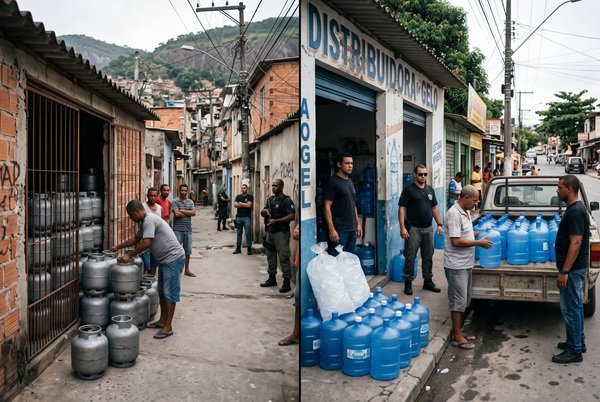
The illicit control over the distribution of water, ice, and cooking gas enables criminal groups to secure recurring revenue streams and directly disrupt the daily routines of residents, merchants, and businesses. Two law enforcement operations conducted in October 2026 across the state of Rio de Janeiro illustrate this mechanism: one targeting an ice factory and a bottled water distributor allegedly linked to a militia in Nova Iguaçu, and another dismantling an organization tied to the Red Command (Comando Vermelho – CV) that monopolized cooking gas sales in communities under factional control. Both schemes relied on intimidation, extortion fees, and forced exclusive supplier agreements to stifle competition. These cases demonstrate how armed territorial dominance is leveraged to seize commercial operations and turn everyday consumption into a primary engine of criminal financing.
This Content Is Only For Subscribers
To unlock this content, subscribe to INTERLIRA Reports.
Water and Ice: Forced Suppliers in Nova Iguaçu
On Tuesday, October 27, the Civil Police executed an operation against the paramilitary militia known as Bonde do Varão in Nova Iguaçu, within the Baixada Fluminense region. Nine search and seizure warrants were served across the Valverde, Jardim Alvorada, Jardim Jasmim, and Jardim Pernambuco neighborhoods. Among the primary targets were an ice manufacturing plant and a water distributor that investigators allege were controlled by the group. Members of this paramilitary outfit were reportedly demanding mandatory “security fees” from local shopkeepers, residents, and residential condominiums. Furthermore, they coerced locals into purchasing ice and water exclusively from militia-designated vendors to monopolize the local economy. Financial intelligence uncovered roughly R$ 373,000 moved over a six-month period through one target account, a volume deemed inconsistent with the declared financial capacity of its holder. Investigators also flagged recurring, structured deposits from individuals and local commercial establishments within the impacted areas, alongside approximately R$ 43,000 transferred across 96 transactions to another suspect tied to the water and ice distribution racket. The courts authorized asset freezes and the breach of banking secrecy.
Cooking Gas: A Monopoly Enforced by Threats and Violence
On Wednesday, October 28, the Civil Police and the Public Prosecutor’s Office of Rio de Janeiro (Ministério Público do Rio de Janeiro – MPRJ) launched Operação Dominus against a criminal syndicate affiliated with the CV that exploited the retail distribution of cooking gas (LPG) in territories controlled by the faction. The operation targeted 9 arrest warrants and 44 search and seizure warrants across São Gonçalo, Itaboraí, Duque de Caxias, Niterói, and Rio, including the neighborhoods of Recreio dos Bandeirantes and Taquara. The judiciary additionally ordered the freezing of over R$ 350 million and the seizure of assets tied to the suspects. Among those arrested was Adriano Pereira Vasconcelos Junior, known as “Junior Playboy,” identified as the principal coordinator and ringleader of the criminal enterprise. The gang used the drug faction’s armed control to monopolize gas cylinder sales and suppress free-market competition. The racket forced retailers to source cylinders exclusively from sanctioned suppliers or make recurring extortion payments, referred to as “gas quotas”, under threat of physical retaliation. The investigation revealed a clear division of labor between a business wing, managing supply chains, collections, and regional expansion, and an armed wing responsible for intimidating merchants, carrying out acts of violence, and vandalizing non-compliant storefronts. Authorities reported that these extortion fees and compulsory markups drove retail prices as high as R$ 150 per cylinder in certain communities. Evidence also pointed to front companies and straw owners used to launder revenue and conceal assets, highlighting the fusion of registered commercial entities with criminal coercion.
Analysis
These cases illustrate how criminal factions convert territorial dominance into commercial monopolies, forcing supplier mandates and levying surcharges that crush competition and drive up the baseline cost of essential consumer goods.
Mandated supplier schemes strip businesses of commercial autonomy and expose corporate entities and property managers to extortion, inflated operational costs, sudden supply disruptions, and physical threats against staff and contractors. Mitigating these risks requires vetting vendor supply chains, monitoring hyper-local security dynamics, and auditing any sudden, non-contractual price spikes or mandatory vendor substitutions. Coordinated action across corporate security, procurement, compliance, and legal departments is critical to prioritizing life safety and maintaining operational continuity.

