


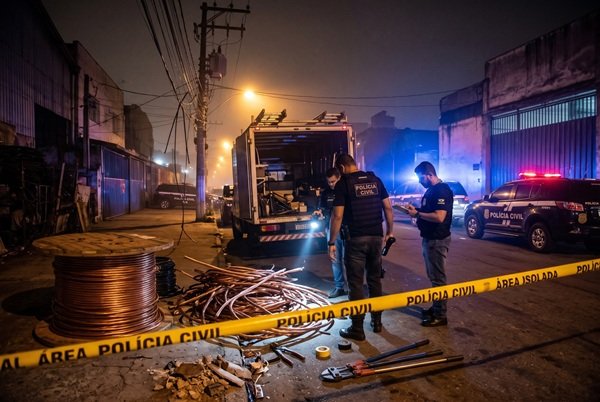
On Wednesday, November 4, 2026, the Civil Police of the State of Rio de Janeiro launched Operation Blackout to investigate the suspected involvement of 25 employees of utility provider Light in copper cable thefts targeting the company’s own infrastructure. The investigation was initiated after the removal of approximately 500 meters of cabling from an electrical facility in Botafogo, located in the capital’s South Zone, which disrupted local power supply. The operation executed seven search and seizure warrants across the capital and the Greater Rio Metropolitan Area. That same evening, in a separate incident, an outsourced contractor was arrested in flagrante delicto for equipment theft at a Light facility in the North Zone.
This Content Is Only For Subscribers
To unlock this content, subscribe to INTERLIRA Reports.
Use of Company Vehicles and Specialized Equipment
The initial theft that prompted the investigation took place in the early morning hours of April 11 along Rua da Passagem, resulting in an estimated loss of R$ 80,000. CCTV surveillance footage captured a uniformed crew manipulating the electrical grid using specialized Light equipment and an official branded company vehicle. According to the chief investigator handling the case, the cables were extracted from an access point requiring advanced technical expertise. Light reported that its internal inquiry detected evidence of employee misconduct, prompting the company to report the incident to law enforcement and dismiss two technicians.
Cable Pipeline to Scrap Metal Yards
Vehicle tracking data indicated that the company vehicle traveled directly to a scrap yard in Parque Boa Esperança, located in the Caju neighborhood, identified by police as the probable drop-off location for the stolen copper. Between April 12 and May 19, investigators confirmed that 16 Light vehicles visited the same scrap yard on 37 distinct occasions without work orders or operational justification. The Civil Police are investigating whether these vehicle movements correspond to additional thefts that, collectively, may exceed two kilometers of extracted cable. The scrap yard is situated within territory influenced by the Pure Third Command (TCP). While official reports note the criminal faction’s territorial dominance in the area, the investigation into the downstream fencing and monetizing of the material remains ongoing.
Inventory Diversion from Central Warehousing
In Penha Circular, in the North Zone, detectives from the Delegated Services Protection Precinct (DDSD) made an in flagrante arrest of a warehouse clerk employed by a third-party service contractor for Light. According to the Civil Police, the suspect exploited his access to inventory and systematically siphoned materials at the end of each shift. During the arrest, detectives recovered unopened connectors designed for tap-ins on overhead distribution networks. The precinct is investigating the fencing pipeline for these components alongside potential prior inventory losses. At the time of reporting, authorities were treating this arrest and Operation Blackout as legally distinct cases.
Analysis
These two incidents demonstrate distinct manifestations of insider threat. In Botafogo, legitimate access to the electrical grid, technical expertise, and the deployment of branded fleet vehicles allowed unauthorized cable extraction to masquerade as standard operational maintenance. In Penha Circular, the vulnerability centered on systematic inventory shrinkage by an employee with direct warehouse access. For a utility provider, the former directly threatens service delivery and business continuity—as seen in the Botafogo blackout—while the latter compromises component availability critical for rapid maintenance and grid restoration.
For critical infrastructure operators, these cases underscore the operational value of cross-referencing fleet telemetry (GPS) against open work orders and inventory checkout/return logs. Unscheduled, recurring stops outside approved operational corridors and warehouse dispersals lacking linked work requisitions represent identifiable anomalies that automated monitoring can flag before losses scale. Enforcing uniform traceability controls across both in-house personnel and third-party contractors is critical to safeguarding physical assets and preventing operational disruptions.
Sources: G1 [1], [2]; O Globo; Folha de SP.

