


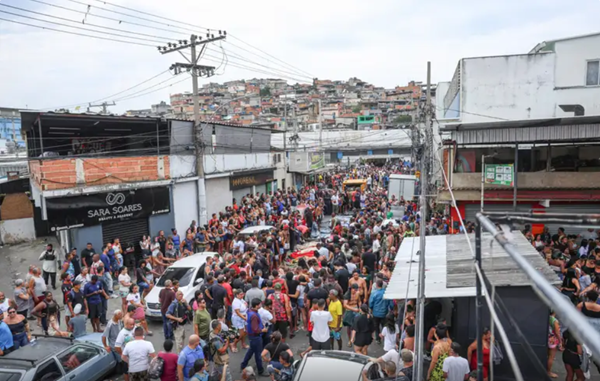
Conducted on October 28, 2025, across the Penha and Alemão favela complexes in the North Zone of Rio de Janeiro, Operação Contenção (Operation Containment) mobilized approximately 2,500 police officers and resulted in 122 deaths, including five law enforcement personnel. One year later, an analysis of the operation reveals an uneven landscape: while shootings and violent mortality indicators declined across the evaluated time frames, key faction leaders remain at large, and the red Command (Comando Vermelho – CV) continues to exercise both territorial and economic control. An assessment therefore requires decoupling the raid’s immediate aftermath from sustainable, long-term shifts in local security.
This Content Is Only For Subscribers
To unlock this content, subscribe to INTERLIRA Reports.
Fewer Shootings, Accompanied by Lower Police Activity
In the 12 months preceding the mega-operation, the Fogo Cruzado Institute (Instituto Fogo Cruzado) recorded 41 shootings across the Penha and Alemão complexes, resulting in 12 deaths and 17 injuries. In the 11 months and 15 days following the crackdown, the institute tracked 16 shootings, with 1 death and 1 injury. This represents a 61% reduction in the absolute number of incidents, adjusting for the slightly differing observation windows. These figures describe the baseline periods before and after, excluding the death toll of the mega-operation itself. Of the 41 shootings logged prior to the raid, 33 occurred during police actions or operations. In the subsequent period, 4 of the 16 shootings occurred during police incursions, with only one classified by the institute as a full-scale operation. In a separate comparison between two six-month intervals, formal police operations fell from five to two. Data from the Public Security Institute (Instituto de Segurança Pública – ISP) also shows improvement within the 22nd Integrated Public Security Area, which encompasses a broader jurisdiction beyond the two complexes. Comparing November 2024–September 2025 against November 2025–September 2026, violent deaths dropped from 71 to 55 (a 23% decrease), while homicides fell from 39 to 34 (a 13% decline). October 2025 was excluded from this dataset due to the exceptional casualty figures of the operation itself.
Territorial Control, Extortion, and Daily Disruptions Persist
During the operation, security forces seized 122 firearms: 96 rifles of various calibers, 25 handguns, and 1 revolver, alongside magazines, ammunition, and 12 explosive devices. The direct financial blow to the CV regarding lost weaponry was estimated at R$ 12 million. However, there is no evidence of permanent state territorial reclamation. Armed gunmen, systemic extortion, and the forced provision of cartel-run services, such as clandestine internet connections, continue to impact residents. Investigations also highlight the faction’s exploitation of local real estate, extortion levies imposed on retail businesses, and involvement in cargo and vehicle theft. The impact on public services has likewise persisted: in Complexo do Alemão, the number of municipal schools forced to shut their doors at least once due to violence rose from 25 to 29 when comparing October 2024–September 2025 with October 2025–September 2026. In Penha, the metric held steady, with 16 school facilities closing at least once in each corresponding period. While this metric measures affected institutions rather than total instructional days lost, it demonstrates that fewer armed clashes have not eliminated disruptions to daily life.
Recording Failures Impede Accountability of Police Action
Investigating the circumstances surrounding the fatalities remains a critical issue. According to a review by Human Rights Watch (HRW), not a single killing is captured within the roughly 4,400 hours of analyzed body-worn camera (BWC) footage. The Rio de Janeiro state government stated that 23% of the 2,500 civil and military police officers deployed during the raid were equipped with body cameras. HRW evaluated footage from 527 officers provided by the Military Police to the Rio de Janeiro State Public Defender’s Office. The organization identified significant interruptions or recording blackouts around midday in 55% of the retrieved files, pointing to potential indications of equipment tampering and possible unlawful killings. These conclusions represent the organization’s findings and remain subject to judicial inquiry. The Public Prosecutor’s Office reported that it has indicted 28 military police officers for various offenses, including non-compliance with body camera protocols.
Analysis
The data confirms a measurable decrease in armed firefights and violent deaths across the analyzed periods, yet it demonstrates no disruption of the Red Command’s top command, illicit revenues, or territorial domination. A reduction in gun battles can readily coexist with extortion rackets, restricted movement, and dependence on forced commercial monopolies. Sustainable security progress must therefore also be benchmarked by freedom of movement, commercial choice, uninterrupted public services, and the rollback of criminal coercion.
For corporate security planning, aggregate violent crime indices must be weighed alongside localized intelligence, supplier integrity screenings, and route assessments, as a reduction in visible violence does not signify a reduction in criminal control.

