


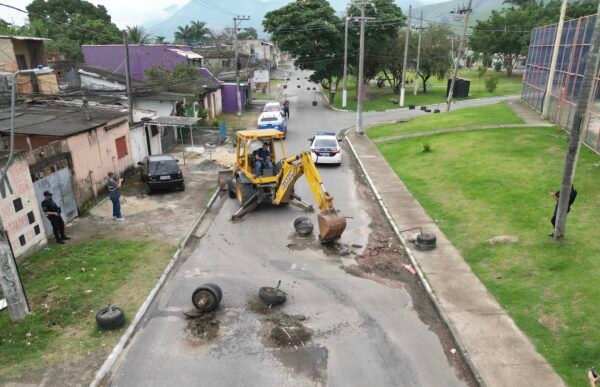
Agents from the Rio de Janeiro state government security forces removed 593 tons of materials used as barricades across five municipalities on Monday (24/11), as part of Operation Barricade Zero. Seven people were arrested during the action. In Cidade de Deus, in the West Zone, teams cleared concrete blocks, tires, and mattresses from Zózimo do Amaral Street, parallel to Estrada dos Bandeirantes—an essential route for residents traveling to Barra da Tijuca, Curicica, and Taquara in the Southwest Zone. Teams also intervened on Avenida Cidade de Deus, along the banks of the Arroio Fundo Canal, removing stones embedded in the ground. In addition to Rio, operations were conducted in Duque de Caxias, Nova Iguaçu, São Gonçalo, and Queimados.
This Content Is Only For Subscribers
To unlock this content, subscribe to INTERLIRA Reports.
Gratifications
“Our intention is for municipalities to maintain ongoing monitoring, while removals are carried out with planning to ensure the safety of both residents and workers,” said Governor Cláudio Castro (PL). “We will establish a reward system for battalions that removes these barricades and prevents them from being reinstalled,” he added.
Zero Barricade
The operation is coordinated by the Institutional Security Office, and it brings together teams from the Military Police, Civil Police, Infrastructure and Public Works, Cities, Social Housing, as well as Emop, the Public Security Institute, and local administrations. This marks the first phase of the Zero Barricade program, announced by the state government. The initiative mirrors the barricade-removal campaign launched in Belford Roxo by Mayor Márcio Canella (União), an ally of the governor.
Mapping
According to the state government, 13,604 obstructions are currently mapped across Rio de Janeiro, identified through drone surveillance and reports submitted via the anonymous hotline. Authorities believe the real number may be even higher. The governor explained that four categories of barricades exist in the state: Those created from debris; those formed through asphalt excavation; concrete-based structures; and so-called “engineering works,” classified by police as the most complex to dismantle. Some of these include electrified components.
Seven Arrested
On Tuesday (25/11), the second day of the operation, a backhoe operator was shot in the Mangueirinha community, in the Corte 8 area of Duque de Caxias, Baixada Fluminense. According to the Military Police, the municipal employee was struck in the clavicle but did not suffer serious injury and was taken to a hospital. BOPE teams were sent to secure the area. In total, operations extended into communities in São Gonçalo and Mesquita, resulting in seven arrests.
Analysis:
The large-scale removal of barricades across Rio de Janeiro reflects a renewed attempt by state authorities to reassert territorial control in areas where criminal groups have long dictated mobility and public order. Clearing more than 500 tons of material in a single day demonstrates both the magnitude of the problem and the level of institutional coordination required to confront it. Barricades—often strategically placed to restrict police entry or channel residents through controlled passageways—serve as physical instruments of domination. Their systematic removal is therefore not merely an infrastructural task but a direct challenge to the power structures embedded within these communities.
At the same time, the operation exposes the operational risks and political sensitivities surrounding state incursions. The shooting of a backhoe operator in Duque de Caxias illustrates how criminal organizations react quickly and violently to any perceived threat to their territorial defenses.
Sources: A Folha de SP; Extra.

