

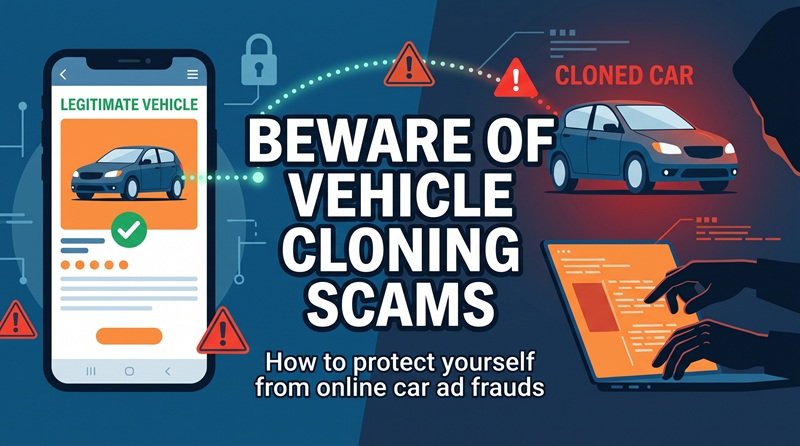
Online scams are becoming increasingly sophisticated, combining information obtained from legitimate advertisements with criminal networks to deceive victims and generate financial gain. Cybercriminals are constantly developing new methods to exploit information publicly available on the internet, including vehicle advertisements, photographs, registration details, and other identifying characteristics. A recent investigation by the Civil Police in Rio de Janeiro highlights how criminals can use legitimate online vehicle listings as a blueprint to clone stolen vehicles and subsequently sell them through digital platforms. The case demonstrates the importance of caution when purchasing vehicles online and verifying both the seller and the vehicle independently before completing a transaction.
This Content Is Only For Subscribers
To unlock this content, subscribe to INTERLIRA Reports.
Online Vehicle Cloning Scams
The growing use of social media, online marketplaces, and vehicle-sale platforms has created new opportunities for criminals to identify legitimate vehicles and use their information to facilitate fraud. In a recent the case investigated by the Civil Police in Rio de Janeiro, a criminal organization allegedly searched the internet for legitimate vehicles offered for sale and used their characteristics to create a “cloning template.”
The criminals would then obtain similar vehicles through illicit means, alter their identifying characteristics to reproduce those of the legitimate vehicle, and place the modified vehicles back on the market using social media profiles and other digital platforms.
Investigators also identified an organized structure involving individuals responsible for the operational, financial, and digital aspects of the scheme. According to the investigation, some vehicles were advertised at prices far below their normal market value, in some cases reportedly as low as 5% of the market price, as part of the strategy to attract potential buyers.
The case also illustrates how online vehicle fraud can be connected to broader criminal activity, including the use of armed individuals, signal-blocking devices, intermediaries or “money mules,” and digital payment systems such as PIX.
How the Scam Works
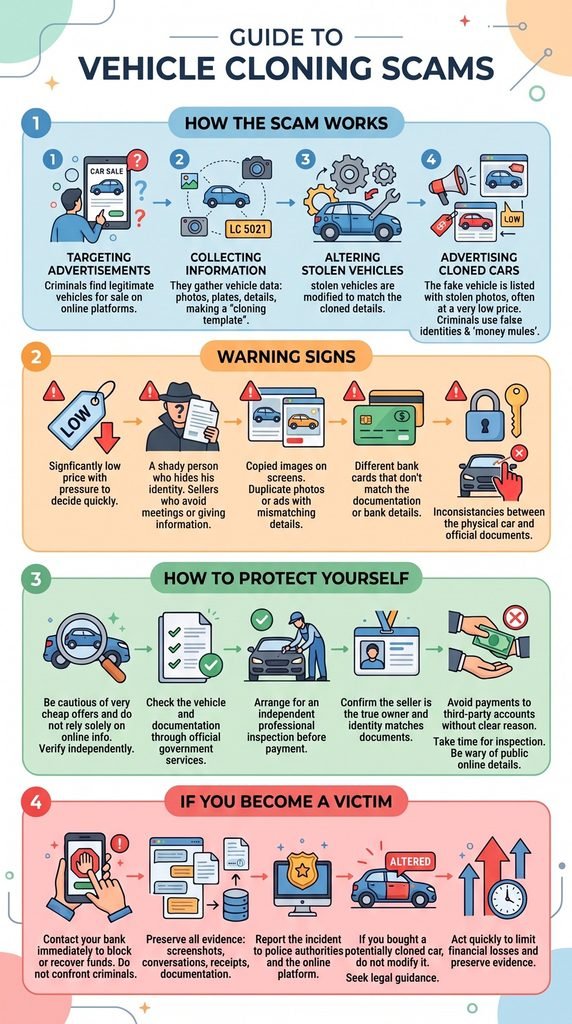
- Criminals search online marketplaces, social media, and vehicle-sale platforms for legitimate vehicles advertised for sale.
- They collect information such as the vehicle’s make, model, year, color, photographs, license plate, and other identifying characteristics that may be visible in the advertisement.
- If not all information is available, they may ask for more, including photos.
- This information can be used to create a “cloning template” for a stolen or illegally obtained vehicle of the same or a similar model.
- Criminals may alter the stolen vehicle’s identifying characteristics to make it appear to correspond to the legitimate vehicle found online.
- The cloned vehicle is then advertised through social media profiles, online marketplaces, or other digital channels, often using photographs and information copied from legitimate advertisements.
- Prices significantly below market value may be used to attract buyers quickly and discourage detailed verification.
- Criminals may use third parties, false identities, or “money mules” to receive and distribute payments, including through PIX.
- In more organized schemes, different criminal groups or individuals may be responsible for obtaining the vehicle, altering its identifying characteristics, advertising it, receiving the money, and providing logistical support.
Warning Signs
- A vehicle advertised at a price significantly below its normal market value, particularly when the seller pressures you to make a quick decision.
- Sellers who avoid face-to-face meetings, provide inconsistent explanations, or refuse to provide complete documentation.
- Vehicle photographs or advertisements that appear copied from another listing, including identical images, descriptions, or unusual inconsistencies in the information provided.
- A seller whose name, bank-account holder, telephone number, or other information does not correspond to the person identified in the vehicle documentation.
- Requests to make payments or deposits to third-party accounts, especially when the reason for doing so is unclear.
- Pressure to transfer money before the buyer has independently verified the vehicle, documentation, and seller.
- Differences between the physical vehicle and the information contained in its documentation, including inconsistencies involving license plates, identifying marks, model characteristics, or vehicle history.
- Sellers who discourage the buyer from conducting an independent inspection or verification.
- Requests to complete the transaction exclusively through messaging applications or social-media platforms rather than through established and verifiable procedures.
How to Protect Yourself
- Be especially cautious about offers that appear significantly cheaper than comparable vehicles on the market. A very low price can be used to create a sense of urgency and discourage verification.
- Do not rely solely on photographs, advertisements, or information provided by the seller. Independently verify the vehicle and its documentation.
- Check the vehicle’s identifying information through official government or authorized vehicle-registration services before completing a transaction.
- Whenever possible, arrange for an independent professional inspection before making any payment.
- Confirm that the person selling the vehicle is the legitimate owner or an authorized representative and that the seller’s identity corresponds to the documentation and payment details.
- Avoid making deposits or transferring funds to accounts belonging to third parties without a clear and independently verified reason.
- Do not allow pressure from the seller to influence the verification process. Legitimate sellers should generally be willing to provide reasonable time for documentation and inspection.
- Be careful when using information from online vehicle advertisements. Photographs and vehicle details publicly available on the internet can potentially be exploited by criminals.
- When purchasing a used vehicle, consider checking its history, ownership records, outstanding restrictions, and other available official information.
- Remember that a legitimate-looking advertisement does not necessarily mean that the vehicle being offered is legitimate. Criminals may copy information from genuine advertisements to make fraudulent offers appear credible.
If You Become a Victim
- If you have transferred money in connection with a suspected vehicle scam, contact your bank immediately and ask about available procedures to block or recover the funds.
- Do not attempt to confront suspected criminals or personally investigate the organization behind the fraud.
- Preserve screenshots of advertisements, conversations, telephone numbers, social-media profiles, photographs, payment receipts, bank details, vehicle documentation, and any other evidence associated with the transaction.
- Report the incident to the appropriate police authorities and to the platform where the fraudulent advertisement appeared.
- If you purchased a vehicle that may have been cloned or contains altered identifying information, avoid attempting to modify, replace, or conceal any identifying characteristics. Seek legal and law-enforcement guidance.
- Acting quickly can help limit financial losses, preserve evidence, and prevent the fraudulent vehicle or related information from being used against additional victims.
The case demonstrates that online vehicle scams are not limited to fake sellers or fraudulent advertisements. Criminals can also exploit information from genuine listings to support sophisticated vehicle-cloning schemes. As digital marketplaces become increasingly important to vehicle transactions, independent verification of the seller, vehicle, documentation, and payment details remains essential.