


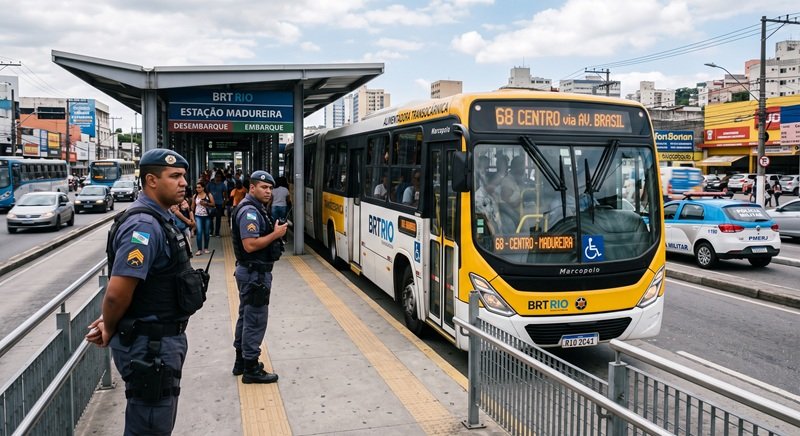
A passenger died after being shot inside a BRT bus on Wednesday morning (30th), in Jacarepaguá, in Rio’s Southwest Zone, while the Military Police were conducting an operation in the Dois Irmãos community. One of the investigators’ hypotheses is that the shots were fired by drug traffickers to hinder the police operation in the area. The incident occurred in the region that has come to lead, in 2026, in absolute numbers, the indicator of violent deaths and deaths caused by the police across the entire state of Rio de Janeiro. Violence in the Southwest Zone is driven by an intense territorial war in which the Red Command (Comando Vermelho – CV) faction seeks to gain strategic control of favelas and neighborhoods dominated by militias and the Pure Third Command (Terceiro Comando Puro – TCP). This dispute has a direct impact on the increase in violent lethality in the region, directly victimizing the civilian population.
This Content Is Only For Subscribers
To unlock this content, subscribe to INTERLIRA Reports.
Data Pointing to an Increase in Violence
From January to August, the area of the 18th BPM (Military Police Battalion), which encompasses neighborhoods such as Jacarepaguá, Taquara, Praça Seca, and Rio das Pedras, registered 177 violent deaths, compared to 112 in the same period of 2025, a 58% increase, according to data from the ISP (Public Security Institute). It is the highest increase in the state. In the rest of Rio, the indicator fell by 7.4%. The region, which ranked seventh in violent lethality in 2025, moved up to first place. The surge was driven by homicides, which rose from 64 to 108 (+69%), while in the rest of the state they dropped by 7.7%. As a result, the area jumped from ninth to third place in homicides in Rio. Police lethality is also higher there, going against the state trend: deaths due to intervention by state agents rose from 47 to 64 (+36%). The conflict has been reflected in violent incidents in recent weeks. On the night of August 29th, shootouts in Jacarepaguá left four dead and one wounded, and 14 buses were used as barricades in Muzema, Curicica, Gardênia Azul, and Taquara.
A Zone of Conflict Between Factions and Militias
According to police, the rise is a consequence of disputes between criminal groups. The CV is expanding, coming into conflict with militias and the TCP. The region has been disputed for years by militias and the CV, an escalation that intensified during the pandemic. The faction began expanding through the West Zone in recent years and gained territory in Greater Jacarepaguá. Based on data from the Group for the Study of New Illegalisms (Geni) at UFF and the Civil Police, it was shown that the faction financed and coordinated dozens of attacks in 2022. In Jacarepaguá alone, 19 communities across 14 different neighborhoods, previously dominated by militias, were taken over by the CV. The interest goes beyond expanding drug dens: the traffickers, much like the militias in their origin, profit from the territories themselves, through the sale of cooking gas and internet packages, for example, or through real estate exploitation.
Police Containment Measures
Since the beginning of September, the Special Police Operations Battalion (BOPE) of the Military Police has set up an advanced base in Rio’s Southwest Zone this Thursday. Agents set up a camp in a wooded area between the communities of Muzema and Rio das Pedras, also close to the Itanhangá Corridor, a set of traffic arteries bordering the region. The operation, which has no scheduled end date, aims to combat the territorial war between factions. According to the PM, the camp serves as a base for tactical deployment, giving officers access to the trails used by criminal groups to move around and attempt to invade areas controlled by rival criminals. In addition to BOPE, other units of the PM’s Special Operations Command (COE) and local battalions, the 31st BPM (Recreio dos Bandeirantes) and 18th BPM (Jacarepaguá), are also operating in the area. According to the PM, since 2023, when clashes between criminal groups intensified, more than 5,700 arrests and more than 320 apprehensions of minors have been made in the 18th BPM area.
Analysis
The security situation in Rio de Janeiro’s Southwest Zone demonstrates that the dispute between factions and militias for control of services and territory has turned daily life for the population into a constant risk. Although reinforcements from the 18th BPM and BOPE, as well as arrests, are essential to containing this rise in violence, police actions tend to displace conflicts to other areas. This situation calls for the implementation of preventive measures to avoid the area’s imminent risk of stray bullets. The best approach is to avoid the region completely; maintain updated emergency training; pre-plan best routes; evaluate the adequacy of the current vehicles used – bulletproof or not –; have a reliable source of real-time security information, and hire a hotline service.
Sources: G1; Folha de SP; O Globo [1], [2].

