


Summary
Brazil’s solar boom has become both a symbol of sustainability and a new target for organized crime. The rapid expansion of renewable energy, combined with strong sustainability-oriented capital inflows, has created fertile ground for sophisticated fraud and laundering schemes operating under the cover of green investment. Recent investigations reveal that financial structures historically consolidated in Brazil’s fuel distribution market—shell companies, simulated transactions, layered ownership, and asset integration—are now being replicated within solar ventures. Organized crime has strategically migrated toward a sector associated with legitimacy, innovation, and long-term growth, exploiting regulatory asymmetries and technical opacity. As market development outpaces supervisory capacity, the green economy is at risk of becoming a new laundering frontier, reinforcing the urgency of stronger governance, regulatory coordination, and enhanced due diligence to preserve market integrity and investor confidence.
Migration to Renewable Energies
The transition toward renewable energy in Brazil has not only attracted legitimate investment but has also created opportunities for sophisticated financial fraud. Driven by strong ESG appeal and substantial international capital inflows, renewable energy has become a strategic pillar of Brazil’s economic modernization. The pace of expansion has been remarkable: in 2025 alone, 21,707 new consumers migrated to Brazil’s free energy market, a 193% increase compared to 2024, bringing the total number of registered consumers to more than 85,000. This rapid growth has significantly outstripped regulatory development, creating exploitable governance gaps. The same structural mechanisms historically used in traditional energy markets are now visible in the solar sector, where rapid growth and strong sustainability narratives have facilitated large-scale capital mobilization with limited immediate scrutiny.
A central example is the case investigated under Operation Pleonexia and its 2026 expansion, Operation Pleonexia II, conducted by the Polícia Federal. Authorities dismantled a financial nucleus responsible for laundering proceeds derived from fraudulent investment schemes tied to alleged solar energy ventures. In the second phase alone, courts ordered the blocking of approximately R$ 244 million in assets, executed preventive arrests, and seized around 50 luxury vehicles.

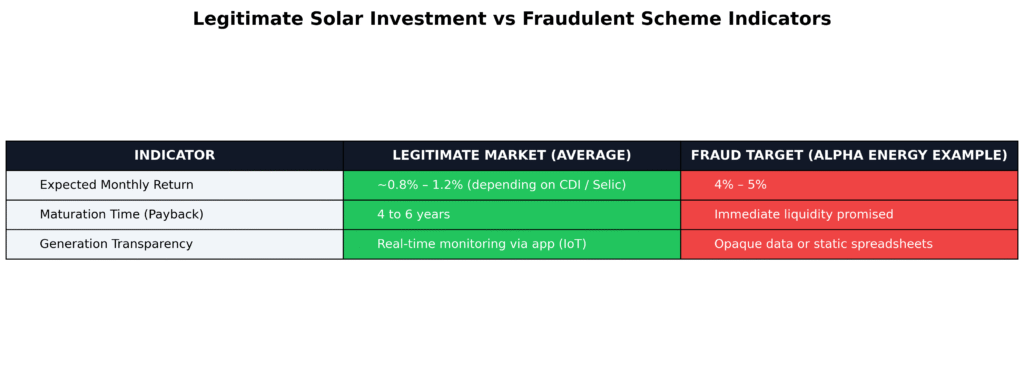
The investigation centered on Alpha Energy Capital, which operated offices in Natal and Barueri and promised investors fixed monthly returns between 4% and 5%, allegedly generated through the commercialization of solar energy credits. The company advertised eleven solar plants with a projected output exceeding 1.2 million kWh per month. However, investigators identified only one operational facility connected to the grid, producing a fraction of the claimed capacity. Regulatory checks confirmed the absence of proper authorization to generate or trade electricity.
This type of scheme is facilitated by institutional fragmentation within Brazil’s electricity regulatory framework. Information on generation authorizations issued by the Agência Nacional de Energia Elétrica (ANEEL) is not integrated with investor-facing verification mechanisms, and there is no unified public database allowing investors to easily cross-reference company ownership (CPF/CNPJ of shareholders) with registered generation assets or trading authorization. As a result, fraudulent operators can present portfolios of non-existent or unlicensed plants without immediate detection by potential investors.
According to authorities, more than R$ 151 million was raised from approximately 6,300 investors across 732 municipalities, with funds diverted to real estate, luxury vehicles, jewelry, and other high-value assets through simulated contracts and layered corporate structures.
The scale of the operation illustrates how renewable branding can be instrumentalized to mobilize capital at national scale before detection mechanisms are triggered.
The Fuel Sector as a Laboratory
The financial fraud schemes now emerging under the banner of solar energy and the “green transition” do not represent an isolated phenomenon. Rather, they reflect the redeployment of a criminal architecture previously consolidated within Brazil’s traditional energy markets. To understand the mechanics behind fraudulent solar investment platforms and phantom renewable assets, it is necessary to examine how organized crime historically operated in the fuel sector.
In August 2025, a nationwide task force dismantled what authorities described as the largest operation in Brazilian history against organized crime in the energy sector. Operation Carbono Oculto exposed a multibillion-real scheme allegedly commanded by members of the First Capital Command (PCC), who evaded more than R$ 7.6 billion in taxes. Investigations revealed irregular methanol imports diverted from the Port of Paranaguá and used to adulterate gasoline and ethanol, with hundreds of gas stations implicated.
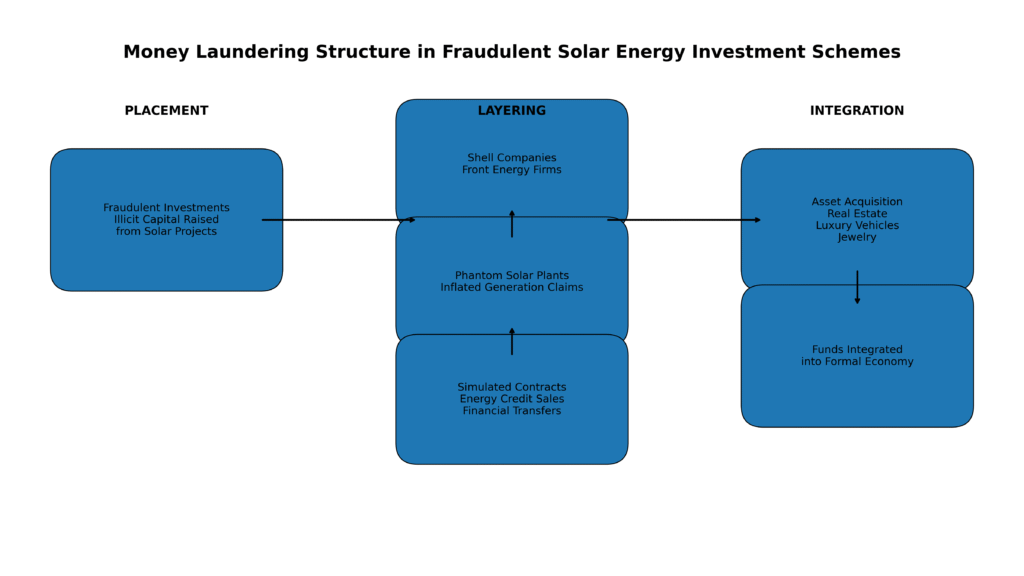
Beyond product fraud and tax evasion, authorities uncovered a sophisticated financial structure. At least 40 investment funds, holding approximately R$ 30 billion in assets, were allegedly controlled by the organization and used to conceal wealth and finance the acquisition of port terminals, ethanol plants, fuel fleets, farms, and luxury real estate. Fintech payment institutions were employed to circulate funds outside traditional banking channels, complicating traceability.
Operation Carbono Oculto demonstrated how the fuel sector functioned as a laboratory for asset integration, shell structures, financial layering, and parallel management nuclei. The relevance is direct: the architecture refined in fossil fuels now appears increasingly adaptable to renewable energy markets, where accelerated growth and sustainability-oriented capital inflows create new opportunities for replication.
Why the Solar Sector Is Vulnerable
Brazil’s solar energy sector has become particularly exposed to organized crime and financial fraud due to a combination of structural and market-driven dynamics. The rapid expansion of renewables, propelled by the global shift toward a “green economy,” has attracted substantial private capital and generated strong expectations of profitability. Criminal groups have leveraged this environment by appropriating the language of sustainability and innovation to market high-yield investment opportunities that appear both modern and socially responsible. The sustainability narrative itself has become a protective shield, providing fraudulent operators with an aura of legitimacy that reduces initial investor skepticism and facilitates capital mobilization.
Regulatory development has not advanced at the same speed as market growth. As a relatively young segment of the energy industry, solar power operates within a framework where oversight remains fragmented and supervisory capacity is uneven. This gap has enabled shell companies to operate for extended periods without holding proper authorizations from institutions such as Agência Nacional de Energia Elétrica (ANEEL) or formal participation in the Câmara de Comercialização de Energia Elétrica (CCEE), both essential for lawful generation and commercialization.
Technical opacity further heightens vulnerability. For most investors, independently verifying whether a photovoltaic plant exists is connected to the grid, and produces the advertised output is highly complex. Fraudulent actors exploit this informational asymmetry by presenting inflated generation data and simulated contracts that are difficult to assess without specialized knowledge.
At the same time, the substantial inflow of capital into renewables offers a favorable environment for the circulation and concealment of illicit funds. The combination of strong growth expectations limited technical transparency, and evolving oversight frameworks, has created conditions in which large-scale fraud can operate with relative plausibility, shaping the broader strategic implications for the sector.
Strategic Implications
The expansion of organized crime into renewable energy markets reflects a structural shift in Brazil’s criminal economy. Because renewable energy occupies a central role in Brazil’s long-term development strategy, infiltration into this sector carries broader economic and governance consequences. Rather than remaining at the margins, criminal organizations are embedding themselves within strategic infrastructure sectors. The laundering mechanisms once consolidated in the fossil fuel distribution market are now being adapted to renewable energy, exploiting legitimacy, scale, and regulatory gaps to integrate illicit capital into a future-oriented industry.
The solar sector, marked by rapid growth and evolving oversight, has been used to channel millions of reais through phantom plants, simulated contracts, and pyramid schemes disguised as energy ventures. When financial fraud becomes intertwined with essential infrastructure, the impact extends beyond individual investors. Market stability, regulatory credibility, and long-term investment confidence are directly affected.
Reputational exposure is particularly relevant for foreign investors. Brazil’s energy transition relies heavily on international capital guided by ESG standards and strict compliance requirements. The perception that renewable platforms may serve as vehicles for fraud or money laundering can increase due diligence costs, delay investment decisions, and discourage participation in legitimate projects.
There is also a broader market effect. The appropriation of sustainability narratives by criminal groups weakens trust across the renewable ecosystem. Legitimate companies face reduced consumer confidence and unfair competition from shell entities that use clean energy discourse as a façade for illicit enrichment.
These dynamics indicate that the issue extends beyond isolated criminal cases and relates to the overall resilience and governance of Brazil’s energy transition, framing the broader conclusions that follow.
The “Green Economy” as a New Laundering Frontier
The evidence examined throughout this analysis points to a repeated structural pattern. The mechanisms now identified in fraudulent solar investment schemes—shell companies, simulated contracts, asset-based integration, layered ownership, and parallel financial management—mirror the architecture previously consolidated in Brazil’s fuel sector. What has changed is not the method, but the environment. Criminal organizations have intentionally migrated toward renewable energy, a sector associated with innovation, legitimacy, and long-term growth, adapting tested laundering models to a rapidly expanding market.
This shift illustrates how the “green economy,” while essential for sustainable development, can also become a new frontier for financial crime when growth outpaces oversight and technical complexity limits transparency. The convergence of investor enthusiasm, ESG-aligned investment flows, and evolving regulatory frameworks has created conditions that sophisticated criminal groups are prepared to exploit.
Mitigation requires both institutional and individual vigilance. Authorities and industry specialists recommend enhanced due diligence before entering solar-related contracts. Fraudulent operators frequently use targeted digital advertising on social media to reach specific audiences—such as retirees or first-time ESG investors, while sustainability narratives and technical language help create an appearance of legitimacy. Investors should verify corporate registration and operational history, confirm the existence of physical headquarters, and demand detailed technical projects, timelines, and formal contracts. Promises of unusually high and rapid financial returns should be treated with caution, particularly when linked to energy credits or generation capacity that cannot be independently verified. Large upfront payments without adequate safeguards also represent a significant warning sign. Ultimately, safeguarding the credibility of Brazil’s energy transition depends on strengthening compliance frameworks, improving regulatory coordination, and reinforcing market transparency—measures that are essential to ensure that sustainable development is not undermined by criminal infiltration. The integrity of Brazil’s green transition will depend not only on technological innovation, but also on the state’s capacity to prevent criminal capture of emerging markets.

