


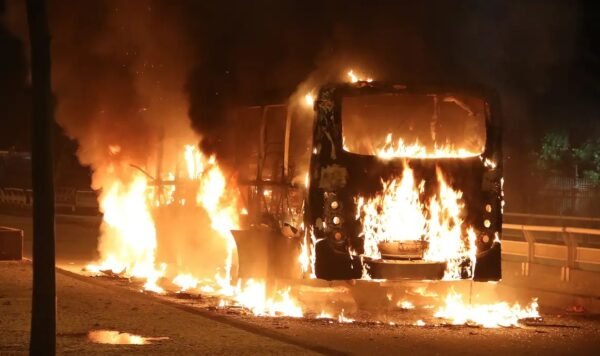
Four more municipal buses in São Paulo were attacked for the second consecutive day in the city’s southern zone on Wednesday night (18/02). Two vehicles were stopped by a group on Avenida Yervant Kissajikian, in the Americanópolis neighborhood, around 20:00, according to SPTrans and the Municipal Secretariat of Urban Mobility and Transport (SMT). The suspects ordered passengers and the driver off the bus and set the vehicle on fire. The group then vandalized two other buses on the same avenue. A fifth bus had its key removed by the suspects but was left at the scene.
This Content Is Only For Subscribers
To unlock this content, subscribe to INTERLIRA Reports.
Lines
The buses were operating on line 5175/10 Balneário São Francisco–Praça da Sé, run by Mobibrasil. The Fire Department was called to contain the flames, but one vehicle was completely destroyed—reduced to its metal frame—while the other suffered partial damage. The group later vandalized two more buses on the same avenue. Those vehicles belonged to A2 Transportes and were operating lines 5759/10 Parque Primavera–Metrô Conceição and 5752/10 Vila Missionária–Metrô Conceição.
Suspects Fled
Military Police officers were called and found the group near a bus. Most suspects fled, but one man was detained and is under investigation, according to the Public Security Secretariat (SSP). In a car parked near the scene, police found three lighters and an empty container. Forensics were called in, and the case was registered as arson and an attack on the safety of another means of transport at the 98th Police Precinct (Jardim Miriam). Because of the incident, 17 routes were fun until early Thursday morning (19/02) as a safety measure.
First Case
On Tuesday night (17/02), the bus on line 7016/10 Jardim Ângela–Terminal Santo Amaro was targeted in a criminal attack on Avenida Guarapiranga, also in the southern zone. The vehicle, operated by the Metrópole company, was set on fire by a group around 23:30. According to the SSP and SPTrans, the driver reported that the bus was stopped by a group of men who forced him to get off. The suspects then set the bus on fire. The vehicle rolled about 100 meters, crashing into a beauty salon and an illuminated sign. As a result, several businesses in the area were left without electricity.
Analysis:
The coordinated nature of these bus attacks in São Paulo’s southern zone suggests more than isolated vandalism. Stopping vehicles, ordering passengers off, and setting them on fire indicates intent to disrupt public transport and generate symbolic impact rather than to cause mass casualties. Such tactics are often associated with organized retaliation, territorial signaling, or attempts to pressure authorities, particularly when multiple vehicles and routes are targeted within a short timeframe. The repetition over consecutive days reinforces the hypothesis of planned action rather than spontaneous unrest.
From a security management perspective, attacks on bus corridors expose critical vulnerabilities in urban mobility systems. Public transport fleets operate on predictable routes and schedules, making them accessible targets. Beyond material losses, these incidents create fear among drivers and passengers, potentially reducing service reliability and increasing operating costs due to insurance, security reinforcement, and emergency response measures.

