

Online scams have become increasingly common, demanding greater attention to the links and online content we interact with daily. Cybercriminals are constantly creating new methods to deceive people for financial gain, ranging from falsified payment receipts to fake technician impersonations. In Brazil, around 71% of the population has already fallen victim to this type of crime, which shows the need for caution when clicking on links in WhatsApp messages, emails, or SMS, as well as avoiding sharing personal information with strangers. To reduce risks, it is essential to understand how these scams work, recognize their main types, learn what to do if you are targeted, and adopt preventive measures to protect your data and avoid financial losses.
This article is part of a series on digital security. You can read the other texts here.
This Content Is Only For Subscribers
To unlock this content, subscribe to INTERLIRA Reports.
Prompt Injection Scam
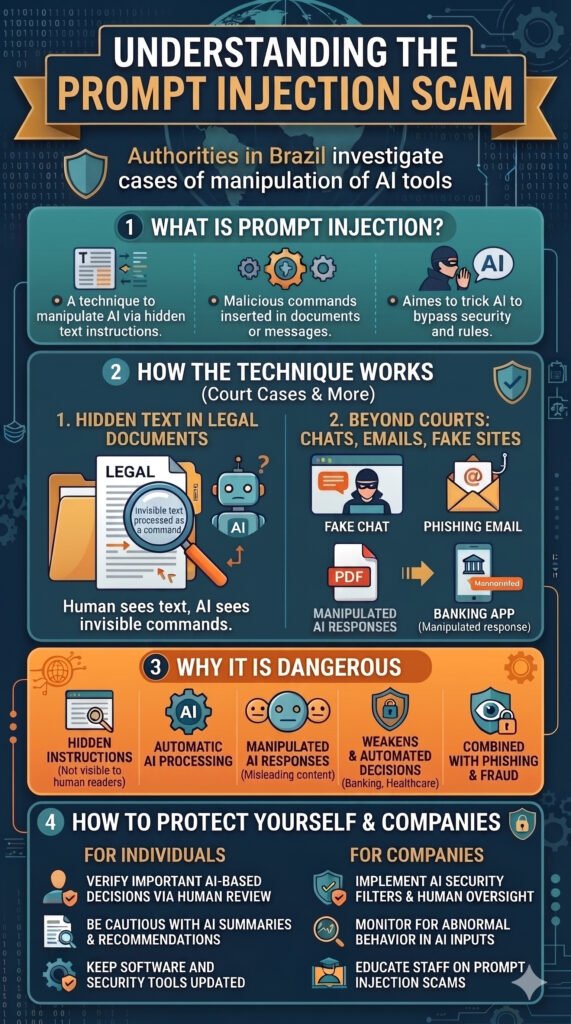
Authorities in Brazil have begun investigating cases involving “prompt injection,” a technique used to manipulate artificial intelligence systems through hidden instructions embedded in documents, messages, or websites. The issue gained attention after Brazilian courts identified attempts to interfere with AI tools used in judicial analysis.
What Is Prompt Injection?
Prompt injection is a malicious technique in which hidden or deceptive commands are inserted into text to influence how an AI system responds.
The goal is to trick the AI into:
- Ignoring security rules;
- Producing misleading or incomplete analyses;
- Revealing confidential information;
- Executing unintended actions;
- Generating false or manipulated content.
How the Technique Works
In reported cases involving Brazilian courts, hidden instructions were embedded inside legal documents using white text on a white background, making them invisible to human readers but detectable by AI systems processing the file. The malicious commands attempted to influence how the AI analyzed the document by instructing it to produce superficial responses or ignore evidence.
Cybercriminals and fraudsters can use similar techniques in other environments, including:
- Fake customer support chats;
- Fraudulent emails;
- Malicious PDFs or attachments;
- AI-powered banking or corporate systems;
- Phishing websites designed to manipulate automated assistants.
Why It Is Dangerous
As AI becomes more integrated into banking, customer service, healthcare, legal systems, and cybersecurity, prompt injection attacks may be used to manipulate automated decisions or weaken security protections.
The technique is particularly dangerous because:
- Hidden instructions may not be visible to humans;
- AI systems may process malicious commands automatically;
- Victims may trust AI-generated responses without realizing they were manipulated;
- The attacks can be combined with phishing, fake websites, or social engineering scams.
How to Protect Yourself
- Be cautious with AI-generated summaries or automated recommendations involving sensitive information.
- Verify important decisions through official or human-reviewed channels.
- Keep software, browsers, and security systems updated.
- Companies should implement AI security filters and human oversight for sensitive operations.
- Organizations using AI tools should monitor for hidden instructions or abnormal behavior in uploaded documents.
Experts warn that prompt injection attacks are likely to become more common as AI tools expand into everyday services. Awareness, human verification, and strong cybersecurity practices remain essential to reducing risks.