



Summary
Artificial intelligence has crossed a threshold. It is no longer a technology companies are considering; it is one they are actively deploying, at scale, and at speed. Across industries and geographies, AI has moved from pilot projects to core operations, reshaping how businesses compete, how security teams work, and how risks are managed.
The question, then, is no longer whether to adopt AI. The question is how to adopt it in a way that makes the gains outweigh the risks. That distinction matters more than it might seem. Organizations that move fast without the right foundations are not simply taking a calculated risk. They are creating vulnerabilities they may not even be aware of. The opportunity is real. So is the exposure. And the gap between capturing one and avoiding the other comes down to how deliberately a company chooses to act.
This Content Is Only For Subscribers
To unlock this content, subscribe to INTERLIRA Reports.
Changing the Rules
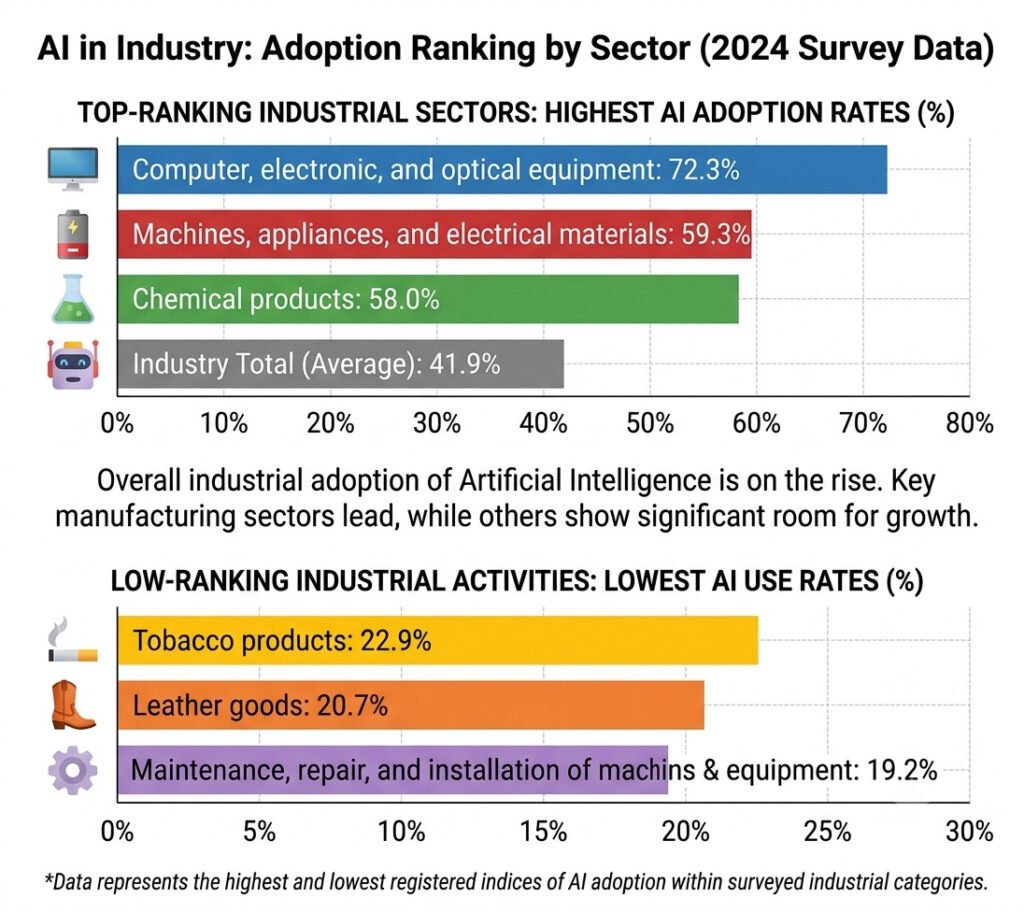
The scale of AI adoption speaks for itself. According to a 2025 KPMG study, 86% of Brazilian professionals say their organizations already use AI, with 71% reporting noticeable gains in efficiency, work quality, and innovation potential. In the industrial sector, IBGE data shows adoption jumped from 16.9% of companies in 2022 to 41.9% in 2024, a 163% increase in just two years. Globally, McKinsey reports that AI use in business operations has doubled since 2017, and 63% of executives expect their investment in the technology to grow over the next three years. What was once a technology reserved for large enterprises with deep R&D budgets is now reshaping competitive dynamics across industries of all sizes. In this environment, not engaging in AI is itself a strategic choice, and increasingly a costly one.
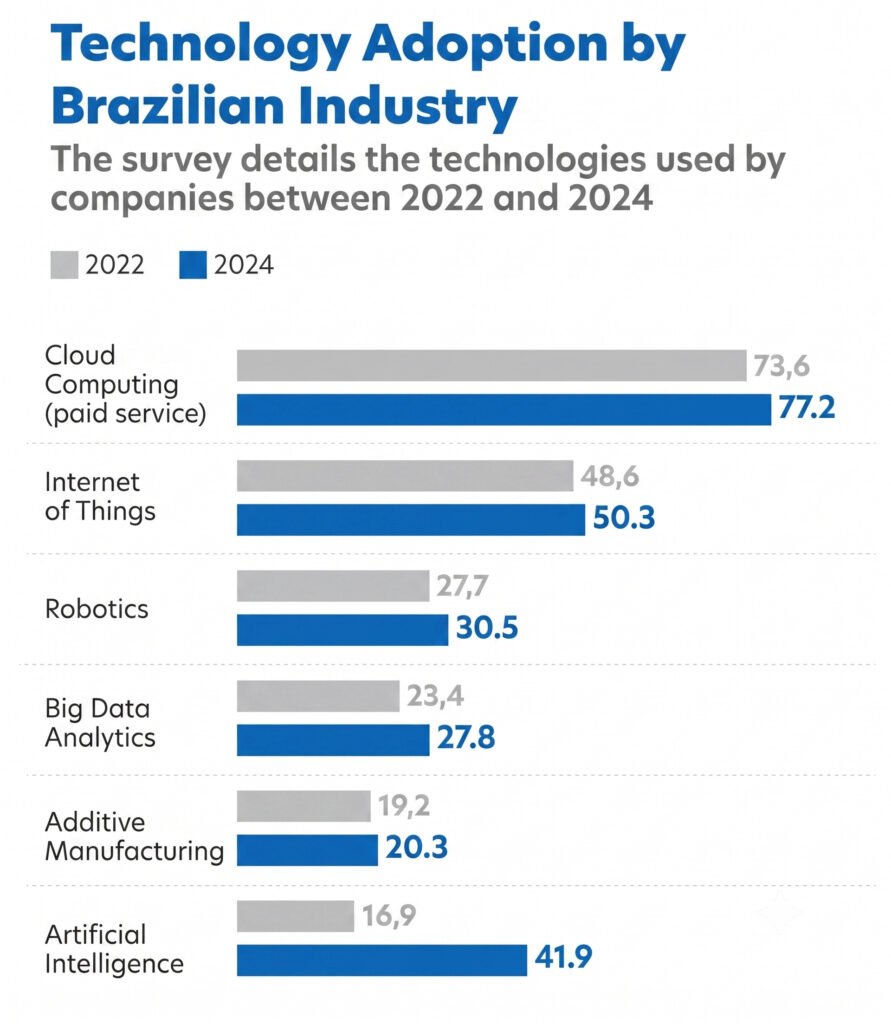
The concrete applications driving these numbers are varied and expanding. Companies are using machine learning, natural language processing, and computer vision to automate repetitive tasks, process large volumes of data in real time, improve decision-making, and enhance customer experience. According to IBM, AI tools are being applied across IT operations, sales, marketing, supply chain management, and cybersecurity, with results that are increasingly measurable. IBGE’s Pintec survey found that among companies adopting advanced digital technologies, 90.3% cited increased efficiency and 89.5% pointed to greater flexibility in administrative and operational processes. These are not marginal improvements. They represent structural changes in how work gets done.
For instance, in the security domain specifically, AI is enabling a new generation of capabilities: threat monitoring and anomaly detection, OSINT-driven intelligence gathering, fraud prevention, and automated response to cyberattacks. IBM’s 2023 data breach report found that organizations using AI and security automation extensively saved an average of USD 1.76 million compared to those that did not, a figure that makes the business case for AI-driven security difficult to ignore.
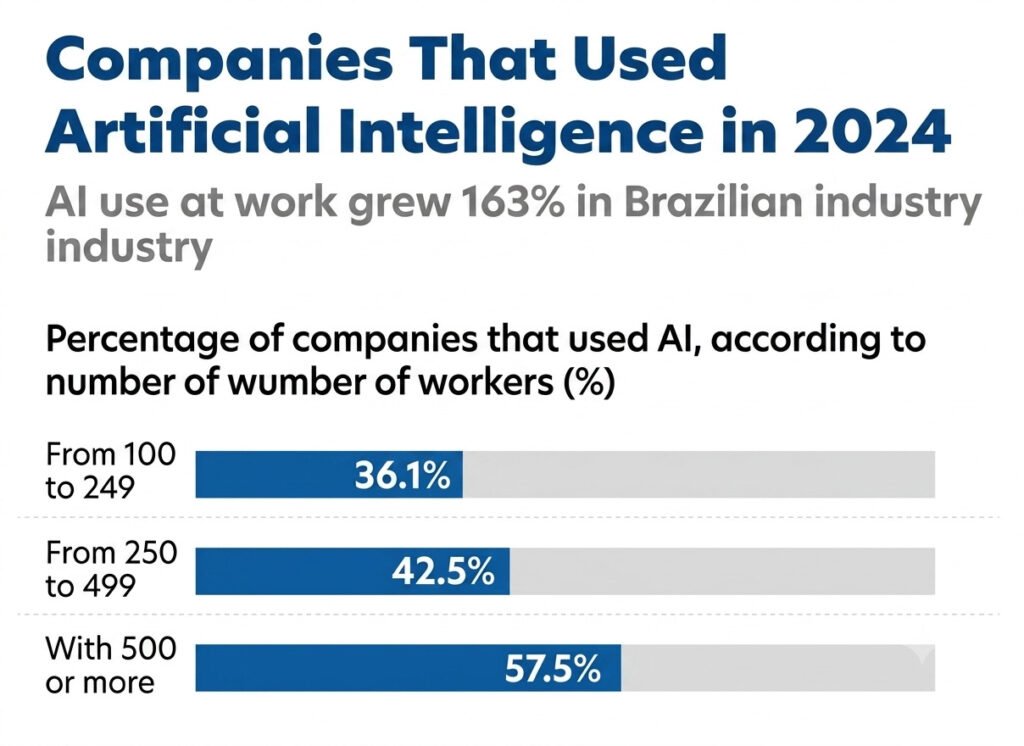
What makes this moment particularly significant is not just the scale of adoption, but its pace. The speed at which companies are integrating AI into their operations is, itself, a variable that needs to be managed, and one that most organizational frameworks were not designed to account for. The opportunity is real. So is the distance between moving fast and moving well.
The Risks That Come with the Technology
The same acceleration that is driving competitive advantage is also opening doors that organizations may not be ready to close. The faster a company adopts AI without adequate structure, the larger the surface area of risk it creates, and the less likely it is to detect problems before they become costly.
External threats have evolved significantly. AI is now being used by malicious actors to generate convincing phishing emails, clone voices, create false identities, and produce deepfakes: realistic synthetic media designed to deceive, manipulate, or extort. These are not hypothetical scenarios. They are documented techniques being applied in social engineering attacks and corporate fraud schemes. As organized crime and cybercriminal networks develop their own AI capabilities, the adversarial landscape is shifting in ways that traditional security frameworks were not designed to handle. The same tools that help a company optimize its operations can, in the wrong hands, be turned against it with increasing sophistication.
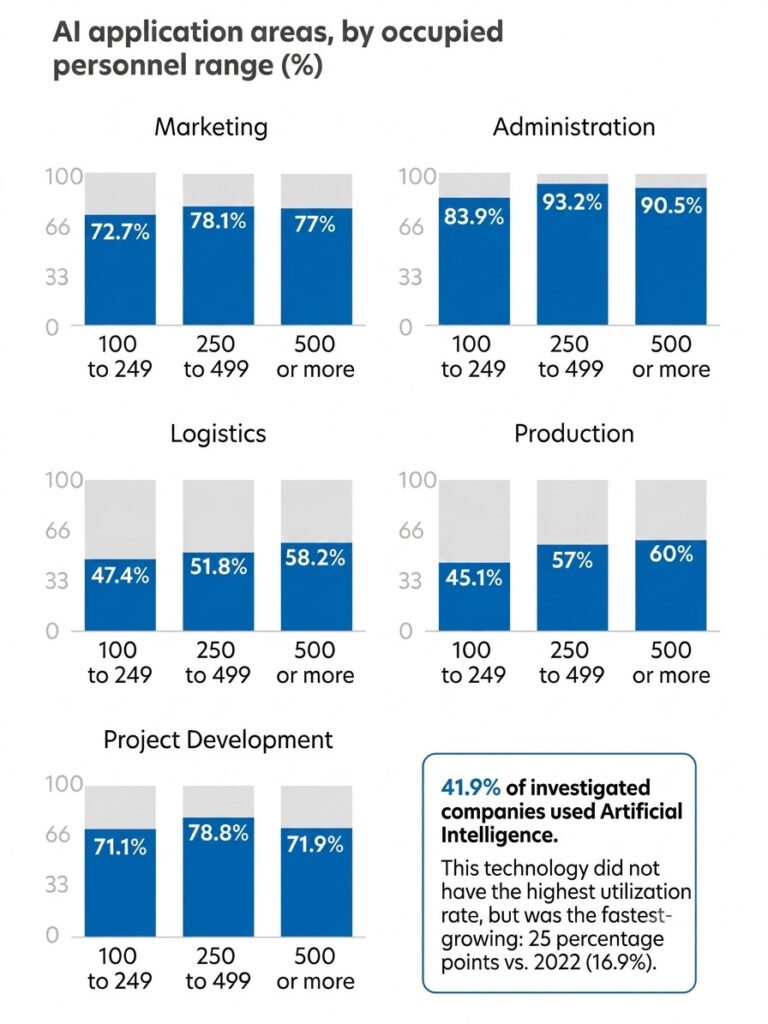
The numbers reinforce the urgency. IBM’s 2024 report puts the global average cost of a data breach at USD 4.88 million. More troubling still: only 24% of generative AI initiatives are currently secured, meaning the vast majority of companies deploying AI are doing so with significant security gaps in place. The technology is outpacing the governance structures meant to contain it.
Internal risks are just as significant, even if less visible. When AI systems are trained on biased data, they produce biased outputs, with consequences that can affect hiring decisions, credit assessments, customer profiling, and more. When employees use AI tools without clear guidelines, they may inadvertently expose sensitive business data, intellectual property, or personal information covered by privacy regulations. These are not edge cases. They are among the most frequently reported issues by organizations that have already gone through an AI-related incident. And when no one inside the organization has clear accountability for AI outcomes, errors are harder to detect, attribute, and correct.
Perhaps the most dangerous gap is the one between awareness and readiness. Many organizations understand at a general level that AI brings risks. Far fewer have the internal capabilities to actually respond when something goes wrong. Recognizing a threat is only the first step, and stopping there creates a false sense of security that can be more harmful than ignorance.
Maximizing Benefits and Reducing Exposure
The risks outlined above are not reasons for slowing down. They are reasons to build better. The organizations that have navigated AI adoption most successfully are not the ones that moved most cautiously. They are the ones that moved with structure. Most organizations that struggled did not fail because the technology was wrong for them. They failed because they treated adoption as a destination rather than a discipline. Closing the gap between ambition and accountability requires focus on three interconnected areas.
Governance before deployment. The most common mistake companies make is treating AI adoption as a purely technical decision. It is not. It is a governance decision. Before deploying any AI system, an organization needs to define who is responsible for its outcomes, what data it can and cannot access, who has authority to intervene when something goes wrong, and what regulatory obligations apply. This means creating an internal AI policy, not as a bureaucratic formality, but as an operational framework that gives everyone, from leadership to end users, clarity on the rules of engagement. As regulatory frameworks like the EU AI Act begin to set binding standards globally, having this governance structure in place is no longer just good practice. It is increasingly a legal requirement. Governance does not slow down innovation; it makes innovation sustainable.
People and culture. Technology is only as secure as the people who operate it. A sophisticated AI system deployed within a workforce that has not been trained to use it responsibly is not a security asset. It is a liability. Training needs to go beyond technical instruction. Employees need to understand what data should never be entered into an AI tool, how to identify AI-generated manipulation such as phishing attempts or deepfakes, and what to do when they encounter something suspicious. Equally important is creating a culture where raising concerns about AI use is encouraged, not penalized. Security awareness is not a one-time onboarding module. It is an ongoing practice that evolves as the threat landscape does. The organizations that build this culture are the ones that catch problems early.
Continuous oversight. Deploying an AI tool is a starting point, not a finish line. Models drift, threat landscapes change, and business needs evolve, which means AI systems need to be monitored, evaluated, and adjusted continuously. This requires establishing regular review cycles, defining performance and safety metrics from the outset, and building feedback loops between the teams using AI and the teams responsible for its governance. Companies that treat adoption as a one-time implementation project tend to discover problems reactively. Those that build ongoing oversight into their operating model tend to catch and correct issues before they escalate.
These three axes are not sequential. They work together. Governance defines the rules; culture ensures they are followed; continuous oversight ensures they remain relevant. Together, they form the infrastructure that allows a company to move quickly on AI without losing control of where it is going.
Conclusion
There is a version of AI adoption that creates genuine competitive advantage, and a version that creates the illusion of it while quietly accumulating risk. The difference between the two is rarely about the technology chosen. It is about whether the organization building around that technology took the time to ask the harder questions before moving fast.
The companies that will lead in this next phase are not necessarily the ones with the largest AI budgets or the most aggressive deployment timelines. They are the ones that resisted the temptation to separate speed from accountability and understood early that the two are complementary. An organization that governs well, trains deliberately, and monitors continuously is not moving slower than its competitors. It is moving in a way that compounds: each iteration builds on a foundation that holds, rather than one that silently erodes.
This also requires a cultural shift at the leadership level. For too long, security and innovation have been treated as competing priorities, one belonging to the risk team, the other to the growth team. AI makes that division untenable. The same system that automates a business process can be exploited if left unguarded. The same model that accelerates decision-making can embed bias if left unexamined. Leaders who internalize this are not simply managing risk. They are building the conditions under which innovation can be sustained.
The trajectory of AI adoption is not going to slow down. Organizations that approach it with both ambition and discipline, treating security not as a barrier but as the infrastructure that makes bold moves possible, are the ones that will still be in a position of strength when the next wave arrives. Those that do not will find that the risks they chose to ignore have a way of compounding, just like the opportunity they were chasing.

