


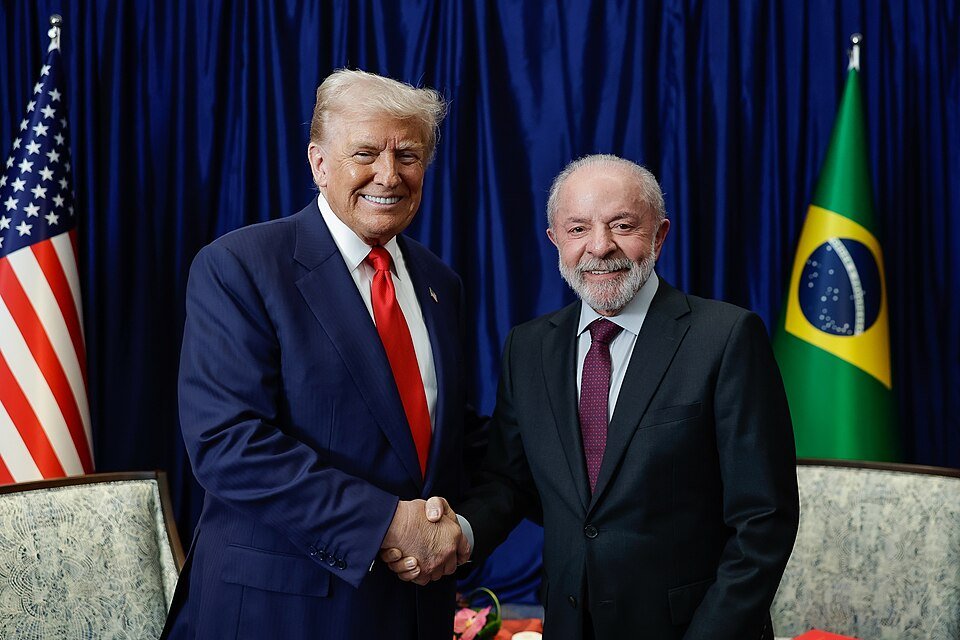
A pivotal week in Brazilian politics saw the long-anticipated U.S. tariff decision confirmed, a major legal development involving former President Jair Bolsonaro, and a notable shift in the electoral landscape. The Trump administration officially imposed a 25% surcharge on Brazilian exports on July 15, prompting a sharp rebuke from the Lula government, which invoked the Reciprocity Act and declared the date a historic low point in Brazil-U.S. relations — though an extensive list of over 2,100 product exemptions, including key exports such as meat, aircraft components, and orange juice, softened the blow. On the legal front, Justice Alexandre de Moraes tightened restrictions on Jair Bolsonaro’s house arrest after concluding he had violated precautionary measures by authoring a letter endorsing his son’s presidential campaign, with Flávio Bolsonaro now barred from visiting his father for 90 days. Meanwhile, the latest Quaest poll points to a widening electoral gap, with Lula extending his lead over Flávio Bolsonaro to eight percentage points in a simulated runoff — and, for the first time since late 2024, the president’s approval rating has numerically surpassed his disapproval rating, suggesting a meaningful improvement in his political standing heading into the official campaign season.
This Content Is Only For Subscribers
To unlock this content, subscribe to INTERLIRA Reports.
Tariffs Confirmed
The Lula administration responded to the new 25% tariff on Brazilian products, confirmed by the Office of the United States Trade Representative (USTR) on Wednesday (15/07). In an official statement, the Planalto Palace said it “repudiates” the measure, announced it would invoke mechanisms provided under Brazil’s Reciprocity Act, and criticized former President Jair Bolsonaro’s family. The government stated that July 15, 2026, will be remembered in the history of Brazil-US relations as “a regrettable milestone.” The U.S. justifications for the measure include concerns related to Pix, the treatment of Big Tech companies, deforestation, barriers affecting American ethanol exports, and even commerce on São Paulo’s 25 de Março Street.
Exceptions
The new 25% U.S. surcharge on Brazilian products includes an extensive list of exceptions, covering more than 2,100 products, including different variations of the same items. Exemptions include major Brazilian exports such as meat, orange juice, aircraft components, açaí, and coconut water. Some products were removed from the preliminary tariff list, notably instant coffee and organic honey, after representatives from the affected sectors participated in public hearings held earlier this month in Washington to present arguments against the measure proposed by the USTR. Other products removed from the list include aluminum hydroxide, certain animal hides, skins and leather products, certain fishery products, certain medicines and pharmaceutical ingredients, and pig iron.
House Arrest
Supreme Federal Court (STF) Justice Alexandre de Moraes ruled on Friday (17/07) to maintain the humanitarian house arrest of former President Jair Bolsonaro while imposing stricter restrictions on his confinement. The decision followed the justice’s conclusion that Bolsonaro had violated precautionary measures by producing a letter endorsing the presidential pre-candidacy of his son, Senator Flávio Bolsonaro. Among the new restrictions, Moraes suspended all social visits to the former president for 30 days, permitting only medical appointments, physical therapy sessions, and visits from his lawyers. Flávio Bolsonaro remains prohibited from visiting his father for 90 days under a previous ruling because of the letter’s dissemination on social media. Moraes also prohibited visits for political or electoral purposes until the conclusion of the 2026 general elections and barred the publication of political or electoral statements authored by Bolsonaro, including those disseminated through third parties, regardless of the medium used.
Election Poll
A Quaest poll released on Wednesday (15/07) shows President Lula (PT) leading Senator Flávio Bolsonaro (PL) by eight percentage points in a simulated presidential runoff. Lula receives 45% of voting intentions, compared with 37% for Flávio Bolsonaro. In June, the president had 44% and the senator 38%; in May, the two were statistically tied. In the first-round scenario, Lula leads with 40%, while Flávio Bolsonaro receives 28%. The remaining candidates trail significantly, with Ronaldo Caiado (PSD) at 4%, Renan Santos (Missão) at 3%, and Romeu Zema (Novo) at 2%. Rejection rates stand at 57% for Flávio Bolsonaro and 50% for Lula, making them both the best-known and the most rejected candidates. Lula also leads in all four simulated runoff scenarios, with his narrowest advantage against Flávio Bolsonaro and his widest margin—a 12-point lead—over Renan Santos. The survey further indicates that Lula’s approval rating has continued to improve and now numerically exceeds his disapproval rating for the first time since the end of 2024.
Analysis:
The combination of the U.S. tariff decision, the judicial restrictions imposed on former President Jair Bolsonaro, and the latest polling suggests that the political environment has become more favorable to President Lula as the election campaign approaches. Although the tariffs represent an economic challenge, the broad list of exempted products limits their immediate impact on key export sectors, reducing the likelihood of widespread economic disruption. Politically, however, the dispute allows the government to reinforce a narrative centered on national sovereignty and external pressure, particularly after linking the trade measures to figures associated with the opposition.
The new restrictions imposed on Jair Bolsonaro also have broader implications beyond the legal sphere. By limiting his ability to communicate politically and restricting contact with Flávio Bolsonaro during the campaign period, the Supreme Federal Court has reduced the former president’s capacity to coordinate strategy and mobilize his political base directly.
Sources: O Globo [1], [2], [3], [4], [5], [6]; G1 [1], [2], [3].

