


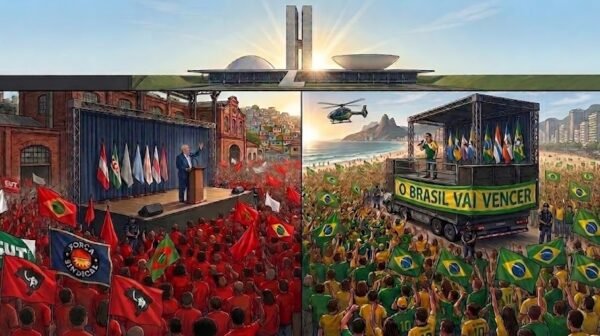
Brazil’s official campaign season opened on August 16 with both presidential candidates launching their street campaigns in symbolic venues, setting the tone for what promises to be a sharply contested election. President Lula kicked off his reelection bid at the historic 1º de Maio Stadium in São Bernardo do Campo, positioning himself as a working-class candidate with strong appeals to faith and female voters, and pledging to create a Ministry of Public Security. Senator Flávio Bolsonaro took his campaign to Copacabana Beach, centering his message on public security and anti-government criticism while invoking the absent figure of his imprisoned father — whose letter he had previously read publicly — in an emotionally charged rally. Behind the scenes, Lula has been consolidating his political position through a series of strategic rapprochements with key congressional leaders, including Senate President Alcolumbre and Chamber President Hugo Motta, while successfully keeping the PP from formally joining Flávio Bolsonaro’s ticket. On the economic front, inflation data offered the government a welcome piece of good news, with the 12-month IPCA rate declining to 4.44% in July and remaining within the Central Bank’s tolerance band.
This Content Is Only For Subscribers
To unlock this content, subscribe to INTERLIRA Reports.
Lula
At the first event of his reelection campaign on Sunday (16/08), President Lula (PT) portrayed himself as a “blue-collar worker” who understands the Brazilian people and represents the working class. He repeatedly invoked God, sought to appeal to female voters, and pledged to create a Ministry of Public Security to “liberate” favelas and low-income neighborhoods controlled by organized crime. The PT organized the rally at the 1º de Maio Stadium in São Bernardo do Campo (SP), described as the place “where it all began,” in reference to the strikes led by Lula in 1979, when he was the main figure of the ABC Metalworkers’ Union. The president was accompanied by Geraldo Alckmin (PSB), once again his running mate, and Fernando Haddad (PT), former Finance Minister and candidate for State Governor of São Paulo.
Flávio Bolsonaro
Senator Flávio Bolsonaro (PL) called President Lula (PT) a “defaulter on hope” and intensified his criticism of the government on Sunday (16/08) at Copacabana Beach, marking the beginning of the street campaign. The senator also attacked the administration in a speech focused largely on public security and recent tensions between the Planalto Palace and the United States. Barred from visiting his father until early October after releasing a letter written by the former president while under house arrest, Flávio said his father could watch the rally on television and led the crowd in chanting “come back, Bolsonaro.” The senator also played an audio recording of a speech by the former president. The event also marked the launch of the candidacy of State Deputy Douglas Ruas (PL), selected to head the Bolsonarista ticket for the Rio de Janeiro state government this year. Alongside the two main candidates was Federal Deputy Alfredo Gaspar (PL-AL), former chair of the INSS Joint Parliamentary Inquiry Commission (CPMI) and Flávio’s vice-presidential candidate. Under investigation for the alleged misappropriation of parliamentary budget amendments and facing an accusation of raping a 13-year-old girl, Gaspar was described by Flávio as the target of “one of the biggest pieces of fake news this country has ever seen.”
Rapprochement
After spending much of his third presidential term in a volatile, on-again, off-again relationship with congressional leaders, President Lula has recently moved toward a rapprochement with key figures in the Legislative Branch. Over the past two weeks, he has held three meetings with Senate President Davi Alcolumbre (União Brasil), secured explicit support for his presidential bid from Chamber of Deputies President Hugo Motta (Republicanos), and seen PP President Senator Ciro Nogueira (PI) and former Chamber President Arthur Lira (PP-AL) act to prevent the PP from nominating a running mate for Flávio Bolsonaro, the PL’s presidential candidate and Lula’s main rival. Dialogue with these parties occurs either directly, as with Motta and Alcolumbre, who meet personally with Lula, or indirectly, as in the case of Ciro Nogueira, who relies on allies such as PP leader in the Chamber, Congressman Doutor Luizinho (RJ), to broker political agreements.
Inflation
The Extended National Consumer Price Index (IPCA), considered Brazil’s official inflation indicator, rose by 0.07% in July, according to data released on Tuesday (11/08) by the Brazilian Institute of Geography and Statistics (IBGE). The result represents a slowdown compared with June, when prices increased by 0.16%. Year-to-date inflation in 2026 stands at 3.44%. Meanwhile, the 12-month rate ending in July reached 4.44%, down from the 4.64% recorded through June. With this result, accumulated inflation over the previous 12 months remains within the tolerance range of the target established by the Central Bank (BC). Since 2025, the continuous inflation-targeting system has set the target at 3%, with a tolerance range extending from 1.50% to 4.50%.
Analysis:
The opening of the official campaign demonstrates that Lula and Flávio Bolsonaro are adopting markedly different political narratives, with public security emerging as one of the central themes of the election. Lula’s decision to begin his campaign in São Bernardo do Campo reinforces his historical connection with organized labor and the working class, while Flávio Bolsonaro, by contrast, chose Copacabana as the setting for a campaign centered more explicitly on crime, public security, and opposition to the federal government. The continued use of Jair Bolsonaro’s political image also demonstrates the importance of political continuity and family identity within the Bolsonaro camp, particularly while the former president remains unable to participate directly in campaign activities.
The political negotiations taking place alongside the public campaign are equally important for understanding the electoral landscape. Lula’s recent rapprochement with the leadership of Congress, particularly Davi Alcolumbre and Hugo Motta, strengthens his institutional position at a time when broad legislative alliances can influence campaign organization and regional support. The decision by the PP not to formally join Flávio Bolsonaro’s ticket is also significant because Centrão parties possess extensive local political networks that can be valuable in a fragmented presidential election.
Sources: O Globo [1], [2], [3], [4], [5]; A Folha de SP [1], [2], [3]; G1 [1], [2].

