


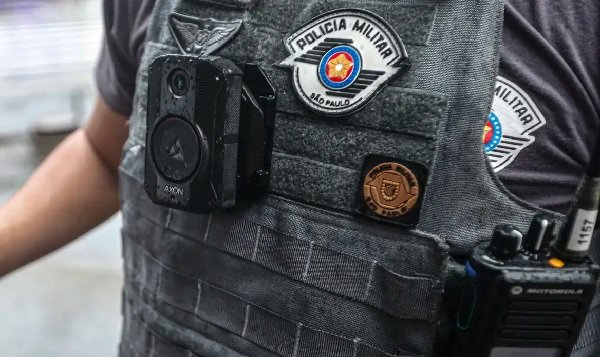
The São Paulo Military Police opened 928 administrative disciplinary proceedings to investigate indications of improper use of body-worn cameras by officers during the first half of 2026. This represents more than five cases per day over the period and a 208% increase—more than three times the previous figure—compared to the second half of 2025, when 301 proceedings were opened. No public data is available on the number of proceedings initiated during the first half of 2025, preventing a year-on-year comparison.
This Content Is Only For Subscribers
To unlock this content, subscribe to INTERLIRA Reports.
Growth
The figures appear in a semiannual report prepared by the Secretariat of Public Security (SSP) under the administration of Governor Tarcísio de Freitas (Republicanos) and finalized on August 20. The document also shows an increase in the number of body-worn cameras in operation, from 11,900 in December to 15,000 in May and June, representing a 26% expansion. In a statement, the SSP said that any comparison involving the number of proceedings opened to investigate potential violations must take into account the growing number of portable operational cameras (COPs) in use, as well as the volume of recordings generated. In June alone, more than one million videos were produced.
After Shots Are Fired
There have also been recurring cases in which police officers activated their body-worn cameras only after shots had already been fired. This practice prevents the recording of alleged confrontations from their outset and can hinder Civil Police investigations into fatal incidents involving officers. Delayed activation violates guidelines issued by the Military Police’s general command, which require cameras to be active during 16 specific types of situations, including police operations, stops, and inspections.
Investigations
Of the 928 proceedings opened between January and June 2026, 175 had been concluded, resulting in 107 disciplinary penalties: 81 reprimands, 25 disciplinary detentions, in which officers are confined to their battalions, and one formal warning. Among the problems identified through audits, 7.6% involved alleged obstruction of the camera, while failure to comply with applicable regulations accounted for 29.67% of cases. Rules governing the use of the equipment are detailed in a 26-page directive signed in 2025 by then-Commander General José Augusto Coutinho. The majority of cases, representing 62.52% of the records, were classified as “incorrect categorization.” The report does not provide further details about the specific violations allegedly committed in these cases.
Activation
Recordings from body-worn cameras used by the São Paulo Military Police previously operated continuously throughout an officer’s entire shift. The equipment, originally supplied by Axon, was replaced last year following a new bidding process initiated by Governor Tarcísio de Freitas’s administration. The Motorola model currently in use requires officers to activate the camera manually, although activation can also be triggered remotely by the 190 emergency dispatch center or through Bluetooth. The change in activation procedures has resulted in relevant footage being lost in some incidents, including the death of businessman Carlos Alves Vieira during an encounter with officers from Rota. In that case, the body-worn camera was activated only after the shots had been fired. The circumstances surrounding the incident remain under investigation.
Analysis:
The 928 disciplinary proceedings opened in the first half of 2026 should not be dismissed; they represent a significant part (6.2%) of the 15,000 body-worn cameras currently in operation. Moreover, the significance also lies in the nature of the incidents being investigated, particularly cases involving police use of lethal force. These are precisely the situations in which reliable audiovisual evidence is most important for determining whether officers acted within legal and operational guidelines. The 208% increase in proceedings compared with the previous six months may partly reflect the expansion of the camera program and the greater volume of footage available, but it also demonstrates that compliance remains a serious institutional challenge.
The transition from continuous recording to a manually activated system represents a significant change in the evidentiary environment surrounding police encounters. When cameras are activated only by officers or through external triggers, there is a greater possibility that crucial moments immediately preceding a confrontation will not be documented, and the absence of footage can weaken investigations and reduce public confidence, particularly when an encounter ends in death.
Sources: A Folha de SP.

