


Online scams are becoming increasingly sophisticated, combining information obtained from legitimate advertisements with criminal networks to deceive victims and generate financial gain. Cybercriminals are constantly developing new methods to exploit information publicly available on the internet, including vehicle advertisements, photographs, registration details, and other identifying characteristics. A recent investigation by the Civil Police in Rio de Janeiro highlights how criminals can use legitimate online vehicle listings as a blueprint to clone stolen vehicles and subsequently sell them through digital platforms. The case demonstrates the importance of caution when purchasing vehicles online and verifying both the seller and the vehicle independently before completing a transaction.
This Content Is Only For Subscribers
To unlock this content, subscribe to INTERLIRA Reports.
The Fake Relative Scam
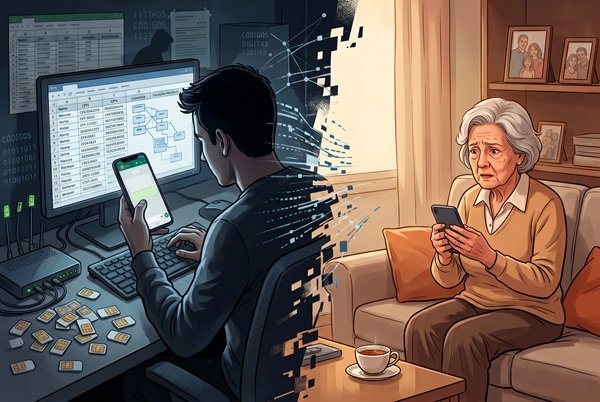
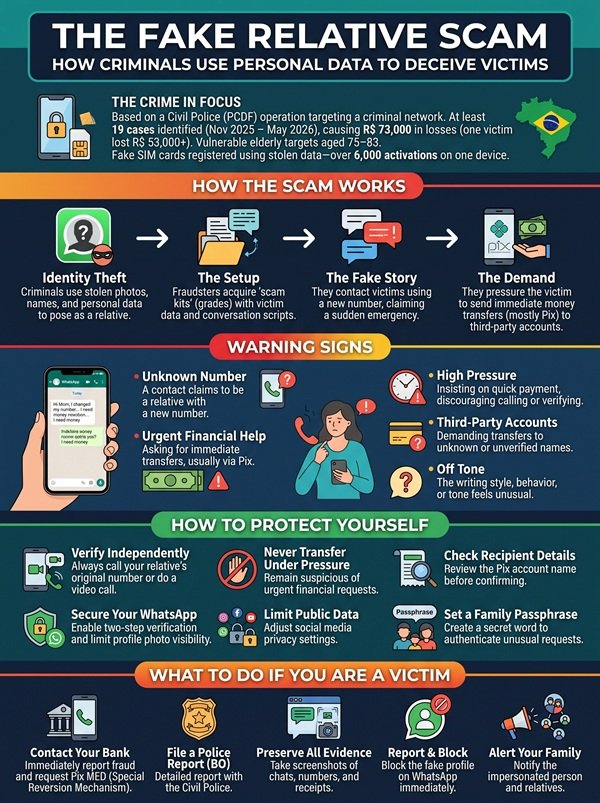
The “fake relative” scam is a type of digital fraud in Brazil where criminals impersonate family members or close friends on messaging apps, primarily WhatsApp, to obtain fraudulent financial transfers. On Wednesday, October 7, the Civil Police of the Federal District (Polícia Civil do Distrito Federal – PCDF) launched an operation against a criminal organization suspected of executing the scheme and supplying other scammers with personal data and resources to replicate it. Five suspects were arrested in Ceilândia and Taguatinga, in the Federal District, and in Goiânia, Goiás. Investigators identified at least 19 cases tied to the group between November 2025 and May 2026, causing financial losses of approximately R$ 73,000. A single victim lost over R$ 53,000, while other victims included elderly individuals aged between 75 and 83. One case involved a former telecommunications employee who registered SIM cards using third-party CPFs without their consent. Investigators uncovered over 6,000 SIM card activations linked to a single device. The investigation highlighted the increasing sophistication of this type of fraud.
How the Scam Works
Criminals create fake WhatsApp profiles using the real names, photos, and personal information of actual people to pose as relatives or friends and request money transfers. The criminals operate through distinct sub-groups responsible for registering SIM cards, creating fake WhatsApp accounts, and selling information to other perpetrators.
Another group produced and sold turn-key scam kits, known as grades, containing personal data of potential victims and their relatives, conversation scripts, and supporting materials sourced from illicit databases. Armed with these assets, scammers reach out to victims with convincing messages, exploit family bonds to build trust, and demand immediate money transfers.
Warning Signs
• A contact reaches out from an unknown number not saved in your phone, claiming to be a close relative who changed their number.
• The sender claims to face an emergency or sudden financial trouble and asks for an immediate transfer, almost always via Pix.
• The WhatsApp profile displays the person’s real name and photo to build credibility, data easily scraped from social media.
• The requests involve third-party bank accounts, with the alleged relative asking for transfers to unknown or unverified individuals.
• There is high pressure to act without verifying, as the scammer insists on urgent payment and discourages calling or using alternative contact channels.
• The tone of the conversation, writing style, or behavior feels off or different from usual, even if the message includes accurate personal details.
How to Protect Yourself
• Confirm the identity of the person by messaging or by calling your relative’s original phone number before making any transfers, rather than trusting the new number.
• Use independent verification methods, such as video calls or asking personal questions whose answers cannot be found online.
• Never transfer money under pressure and remain suspicious of urgent requests for financial help, no matter how convincing the story seems.
• Carefully review the recipient’s details before confirming a Pix transfer to ensure the account holder’s name matches your relative.
• Limit personal data exposure by adjusting social media privacy settings to prevent criminals from exploiting your information and family connections.
• Strengthen WhatsApp security by enabling two-step verification, keeping confirmation codes private, and restricting profile photo visibility.
• Warn your family about this scam, especially elderly relatives, and set up a family passphrase to authenticate unusual requests for money.
What to Do If You Become a Victim
• Contact your bank immediately to report the fraud, request a hold on the funds, and ask to initiate the Pix MED (Special Reversion Mechanism).
• File a Police Report (Boletim de Ocorrência) with the Civil Police, detailing the messages received, receipts, and how the scam occurred.
• Preserve all digital evidence by taking screenshots of conversations, phone numbers involved, WhatsApp profiles, and bank transaction receipts without deleting any messages.
• Report and block the fake profile using WhatsApp’s built-in tool right after saving the necessary records for the investigation.
• Notify the impersonated person and other family members about the identity theft to alert your family network and prevent further financial transfers.
• Protect potentially leaked information by changing credentials and notifying institutions if you shared passwords or sensitive codes.
• Monitor your bank account and track financial activity to ensure no further unauthorized access or suspicious transactions occur.
Sources: G1; Metropoles.

