


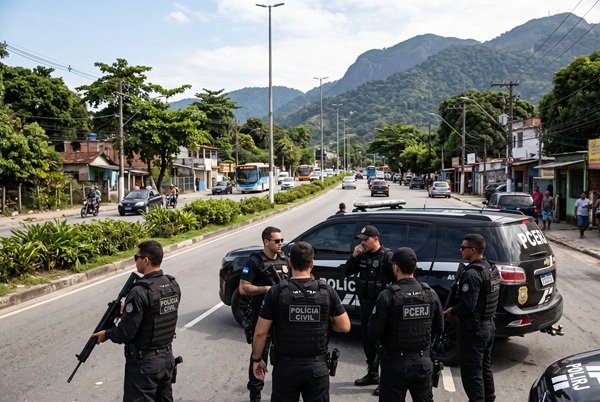
On Sunday, October 4, the Civil Police (Policia Civil) of Rio de Janeiro arrested Jhon Vitor do Nascimento Araújo, known as Malandrex, at Galeão International Airport in the city’s North Zone. Identified as a key operational leader within Red Command (Comando Vermelho – CV), he is suspected of taking part in the faction’s territorial expansion into Vargem Grande and neighboring districts in Rio’s Southwest Zone. His arrest and the intensification of territorial disputes among criminal organizations in Rio de Janeiro highlight a shifting dynamic in armed violence, marked by factions advancing into areas previously held by militia groups. The CV has played a central role in this push, particularly in the West and Southwest Zones.
This Content Is Only For Subscribers
To unlock this content, subscribe to INTERLIRA Reports.
The Arrest of Malandrex and Red Command’s Expansion into Vargem Grande
On Sunday, October 10, Civil Police officers arrested 28-year-old Jhon Vitor do Nascimento Araújo, alias Malandrex, upon his landing at Galeão International Airport on Ilha do Governador. According to investigations, he held a strategic position in CV‘s organizational hierarchy in the César Maia community in Vargem Pequena, overseeing the procurement of weapons, ammunition, and drugs, as well as providing logistical support for territorial expansion. Police state that Malandrex operated under the orders of Edgar Alves de Andrade, known as Doca, and Carlos da Costa Neves, alias Gardenal, the latter identified as responsible for leading the faction’s expansion across Jacarepaguá, the Vargens region, and Recreio dos Bandeirantes. This offensive includes targeted attacks on communities controlled by Pure Third Command (Terceiro Comando Puro – TCP) in Vargem Grande, specifically Pombo Sem Asas, Taboinhas, and Cascatinha, with the participation of operatives from César Maia, Coroado, Fontela, Gardênia Azul, and Cidade de Deus.
Intensification of Inter-Faction Territorial Battles
CV’s push into the Vargens region reflects a broader trend of escalating clashes between armed groups across Rio de Janeiro. As unallocated areas available for expansion have dwindled, factions have pivoted toward capturing territories already held by rivals, especially those previously controlled by militias weakened by internal splits. According to data from Instituto Fogo Cruzado, the Metropolitan Area recorded 34 shootouts linked to territorial disputes in July 2026, up from 16 in June, leaving 29 people shot. Between January and July, 138 such shootouts were recorded. Beyond drug trafficking, the drive into new territories is motivated by controlling illegal extortion markets and local monopolies, including informal transport services, cooking gas, internet provision, and resident fees. Retaliation from rival groups frequently sparks secondary clashes in adjacent communities, spreading instability beyond original points of conflict.
Analysis
From a corporate security perspective, the escalation of these disputes poses a rising risk to companies and personnel operating along Rio de Janeiro’s major transit corridors. In the Southwest Zone, the proximity of disputed territories to key thoroughfares, such as Avenida das Américas, Avenida Salvador Allende, and access roads to Vargem Grande and Vargem Pequena, warrants heightened vigilance. While these avenues are not necessarily direct targets of criminal groups, active firefights, police operations, and potential road blockades can disrupt vehicle traffic and expose employees, contractors, and cargo to violent incidents. Furthermore, the arrest of high-level figures does not guarantee a cessation of conflict; it often triggers internal restructuring or renewed territorial pushes. Consequently, organizations are advised to maintain real-time security monitoring, update risk assessments, establish contingency transit routes, and enforce incident response protocols to minimize employee exposure and safeguard operational continuity.

