

Between November 16 and November 23, Brazil’s political and economic environment was dominated by negotiations over the Moretti fiscal package, depreciation of the Brazilian Reais, disagreements within the government and institutional tensions involving the STF, Federal Police and Banco Master. The dollar closed at R$5.775 on November 16 and around R$5.93 on November 19 before reaching an intraday high of R$6.006 on November 23. During the same period, extreme weather affected Pará and Rio Grande do Sul, while government audits identified shortcomings in Brazil’s preparation for El Niño.
This Content Is Only For Subscribers
To unlock this content, subscribe to INTERLIRA Reports.
Moretti Plan and Fiscal Adjustment
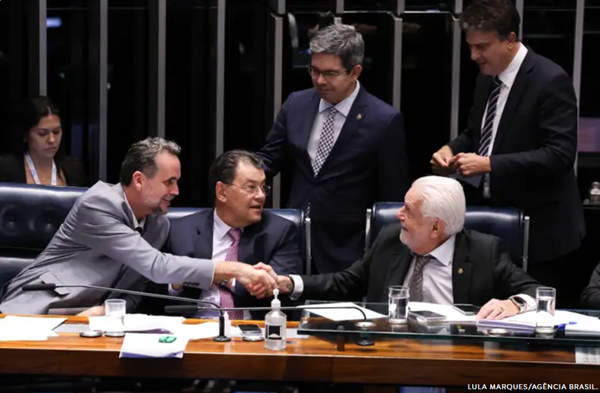
The government continued efforts to approve the Moretti Plan, which is expected to generate an additional fiscal impact of approximately R$46 billion to R$56 billion in 2027. The package seeks to strengthen mechanisms for containing expenditures and improving the primary balance. The Senate approved its basic text, while Chamber President Hugo Motta announced that discussions would continue in the lower house.
Analysts cited in the annex argued that the package may be insufficient to stabilize public debt, projected to reach approximately 83.7% of GDP by the end of 2026. They also noted that around two-thirds of the package’s expected impact comes from additional revenue rather than expenditure reductions.
One controversial measure allows restrictions on companies’ use of tax credits if additional expenditure contingencies are triggered. Business organizations said the provision could affect cash flow, while economists disagreed over whether the measure represents a genuine fiscal gain or an anticipation of revenue.
The government is also considering its own proposal to regulate public-sector remuneration above the constitutional ceiling. According to government estimates cited in the article, tighter rules could save approximately R$2 billion to R$3 billion annually.
Government Disagreements
Negotiations over the fiscal package exposed differences inside the administration. Planning Minister Bruno Moretti participated directly in negotiations with senators, while Finance Minister Dario Durigan remained outside some of the principal political discussions. Vice President Geraldo Alckmin publicly defended the fiscal measures.
The Finance Ministry also opposed a provision allowing up to R$10.5 billion in diesel-subsidy expenditure to be excluded from the 2026 fiscal target, a measure negotiated by the Planning Ministry in Congress. Durigan denied opposing the overall package and said differences between ministries were part of the negotiating process.
Lula later publicly defended the Moretti Plan amid criticism from PT members and sectors of the left. The president argued that the proposal would not affect Bolsa Família or constitutional health and education spending floors.
Dollar and Stock Market Reaction
Brazilian assets experienced significant pressure during the week. On November 16, the dollar rose 2.12% to close at R$5.775, while the Ibovespa fell 1.83%. Foreign investors had withdrawn approximately R$5.5 billion from the Brazilian stock market by November 12.
On November 19, the dollar closed around R$5.93. The Central Bank sold US$1 billion in the spot market after the exchange rate approached that level. Former Central Bank market director Sérgio Goldenstein argued that the currency movement reflected concerns regarding fiscal policy and that intervention would not resolve the underlying issue.
On November 23, the dollar reached R$6.006 intraday before trading near R$5.967 later in the morning. The article associated the movement with domestic fiscal concerns, global dollar appreciation, expectations regarding U.S. interest rates and geopolitical risks.
Morgan Stanley also downgraded its recommendation for Brazilian equities, projecting a possible 7% decline in the Ibovespa under its base scenario and citing fiscal deterioration, high interest rates and weaker corporate earnings.
Labor, Food Prices and Climate Risks
Lula signed regulations implementing the transition away from the 6×1 work schedule on November 19. Monthly salaries are maintained, while the reference hourly value increases as the standard maximum workweek moves initially to 42 hours and subsequently to 40 hours. Collective agreements can provide flexibility in some cases.
Another article identified pressure on food prices from the weaker real, transportation costs, and El Niño-related agricultural conditions. It also highlighted high household indebtedness and slower growth in disposable family income.
On November 20, Pará had 66 municipalities under emergency declarations due to fires and drought. Federal authorities deployed a task force, while the Federal Police investigated indications that some fires could have criminal causes.
The same day, a storm in Tupanciretã, Rio Grande do Sul, killed at least three people, injured dozens and damaged buildings, electricity networks and water infrastructure. Recorded wind gusts reached approximately 114 km/h.
A TCU audit published on November 21 identified outdated water-security plans, weaknesses in monitoring and deficiencies in coordination among federal agencies responsible for preparing for El Niño and other climate events.
STF and Banco Master
The Banco Master investigation continued to generate disputes within the STF over the handling and supervision of Federal Police reports. STF President Edson Fachin sent reports to the Attorney General’s Office containing references to Justices Alexandre de Moraes, Dias Toffoli and Kassio Nunes Marques. The PGR will assess whether the information warrants additional investigative measures; the reports’ references do not, by themselves, establish wrongdoing.
The case also generated disagreement over whether Justice André Mendonça should remain responsible for the investigation, following previous controversies over the way information involving Supreme Court members was collected and reported by the Federal Police.
Analysis
The articles indicate a simultaneous increase in fiscal, institutional, and climate-related uncertainty. Fiscal concerns are already reflected in exchange-rate volatility, higher interest-rate expectations, and weaker equity performance. For companies, these developments may translate into greater financing and import costs and increased uncertainty for investment planning.
The Banco Master case represents an additional institutional risk because it involves disagreements over investigative procedures and information concerning senior judicial officials. Separately, events in Pará and Rio Grande do Sul, combined with the TCU findings, demonstrate the potential for climate events to disrupt infrastructure, transportation, utilities and local operations.
Companies operating in Brazil should therefore monitor fiscal negotiations, exchange-rate movements, developments involving the STF and Federal Police, and regional weather alerts, as these factors may affect operating costs, business continuity and corporate-security planning.
Sources: Folha de SP [1], [2], [3], [4], [5], [6], [7], [8], [9], [10], [11], [12], [13], [14], [15], [16], [17].

