


Brazil is experiencing a period of institutional tension and political repositioning, marked by growing scrutiny of the judiciary, strategic negotiations between branches of government, and unfolding corruption investigations. Public opinion reflects a complex view of the Supreme Federal Court, seen as both powerful and essential, while political actors move to manage frictions between the Executive and Legislative branches, as illustrated by the renewed alignment between President Lula and Senate leadership. At the same time, the investigation into the Banco Master case deepens concerns about governance and corruption within financial institutions. In parallel, regional political dynamics, such as the leadership dispute in Rio de Janeiro’s state legislature, add to the broader scenario of uncertainty. Economic measures, including support for exporters affected by global tensions, further demonstrate how domestic politics, institutional stability, and international pressures are increasingly interconnected.
This Content Is Only For Subscribers
To unlock this content, subscribe to INTERLIRA Reports.
Supreme Court Justices
A Datafolha survey indicates that public opinion regarding the Supreme Federal Court (STF) is marked by a dual perception. While 75% of respondents believe that the justices hold excessive power, 71% simultaneously consider the Court essential for safeguarding democracy. The survey, conducted between April 7 and 9 with 2,004 participants across 137 municipalities, reflects a moment of heightened scrutiny of the Judiciary, influenced in part by ongoing investigations related to the Banco Master case. The data also reveal political differences: among voters of former president Jair Bolsonaro, 88% believe the STF has too much power, compared to 64% among Lula voters. The survey further shows that Justice Alexandre de Moraes is the most widely recognized member of the Court, known by 89% of respondents, largely due to his role in high-profile investigations. However, he also appears among those with the highest negative ratings, alongside Dias Toffoli and Gilmar Mendes. In contrast, justices such as André Mendonça, Cármen Lúcia, and Luiz Fux have higher approval levels. As this is the first time these questions have been asked, there is no historical data for comparison.
Lula and Alcolumbre Reconcile
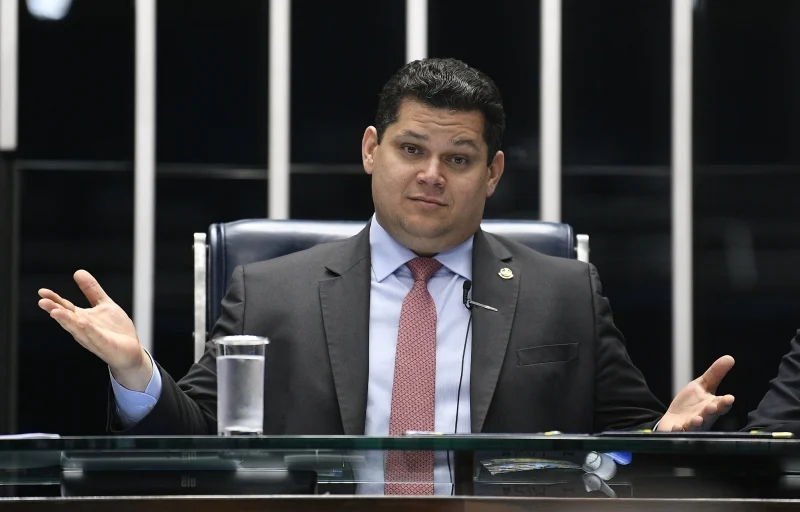
Amid rising tensions between the Supreme Federal Court (STF) and the Legislative branch, the relationship between President Lula (PT) and Congress has shown signs of improvement, particularly due to movements by Senate President Davi Alcolumbre (União Brasil). The two had been at odds following Lula’s nomination of Attorney General Jorge Messias to the STF. The formal submission of Messias’s nomination to the Senate only occurred on the April 1st, more than four months after the president publicly announced his choice, raising concerns that Alcolumbre might delay the process further. However, the Senate president moved forward with the procedure and scheduled the confirmation hearing for the 28th of this month. At the same time, Alcolumbre made a gesture toward the opposition by scheduling a congressional session for April 30 to analyze the presidential veto related to reducing sentences for those convicted in the coup attempt, a move that is expected to face pressure for reversal.
Master Case
A new phase of Operation Compliance Zero, carried out by the Federal Police, led to the arrest of Paulo Henrique Costa, former president of Banco de Brasília (BRB), on Thursday (16/04). He is suspected of failing to follow governance protocols and enabling transactions between BRB and Banco Master without proper financial backing. Investigators allege that Costa received at least six properties valued at R$ 146 million from Daniel Vorcaro, owner of Banco Master, in exchange for facilitating irregular operations involving the bank. In an official statement, the Federal Police reported that the operation investigates financial crimes, corruption, money laundering, and involvement in a criminal organization. This marks the first time authorities have formally cited the alleged corruption of a public official from the Federal District in connection with the broader investigation into Banco Master and BRB.
President of Alerj
State deputy Douglas Ruas (PL) was elected on Friday (17/04) as the new president of the Legislative Assembly of the State of Rio de Janeiro (Alerj). The voting session was marked by attempts at obstruction from the political group aligned with former Rio mayor Eduardo Paes (PSD), a pre-candidate for governor and a likely opponent of Ruas in the upcoming October elections. After the result, the deputy stated that he would formally communicate his election to the interim governor, Ricardo Couto, and to the Supreme Federal Court (STF). According to Ruas, maintaining dialogue with other institutions is essential to address the current uncertainty regarding the state’s line of succession. With both the governor and vice-governor positions vacant, and the previous Alerj president, Rodrigo Bacellar (União Brasil), removed by court order, the state continues to be governed by Judge Ricardo Couto, who assumed the role as president of the Rio Court of Justice (TJRJ). The current interpretation of the TJRJ is that Couto will remain in office until the STF defines the rules for the interim election that will replace Cláudio Castro.
Aid to Exporters
The federal government has expanded its support measures for companies affected by international economic pressures by including exporters to Persian Gulf countries in the Sovereign Brazil Plan. The initiative covers companies operating in markets such as Saudi Arabia, Bahrain, Qatar, the United Arab Emirates, Iraq, Iran, Kuwait, and Oman, as well as their suppliers. To qualify, businesses must derive at least 5% of their revenue from exports to these regions. The R$ 15 billion allocated to the program will come from the surplus of the Export Guarantee Fund (FGE) and may be used for working capital, acquisition of equipment, expansion of production capacity, and strengthening of supply chains. In addition to companies affected by the conflict involving Iran, the plan also targets strategic industrial sectors with medium- and high-technology output, as well as firms impacted by recent U.S. tariff measures.
Analysis:
Brazil is currently navigating a delicate balance between institutional authority and political negotiation, as reflected in public perceptions of the Supreme Federal Court. The coexistence of concerns about excessive judicial power with strong support for its role in safeguarding democracy suggests a society that recognizes the necessity of institutional checks while remaining wary of overreach. This dual perception is not unusual in polarized environments, where courts are increasingly called upon to arbitrate politically sensitive issues, and the visibility of figures such as Alexandre de Moraes reinforces how judicial actors can become central to political debates, intensifying both scrutiny and political pressure on the institution.
At the political level, the renewed alignment between Lula and Davi Alcolumbre indicates a pragmatic effort to stabilize relations between the Executive and Legislative branches, with the handling of Jorge Messias’s nomination illustrating how institutional appointments remain closely tied to political bargaining. At the same time, developments surrounding the Banco Master investigation and regional disputes, such as the leadership transition in the Legislative Assembly of Rio de Janeiro, point to ongoing challenges in governance and institutional credibility, as corruption allegations deepen concerns about oversight while uncertainty at the state level shows how judicial decisions can directly shape political outcomes.
Sources: O Globo [1], [2], [3]; A Folha de SP [1], [2], [3], [4]; G1.

