


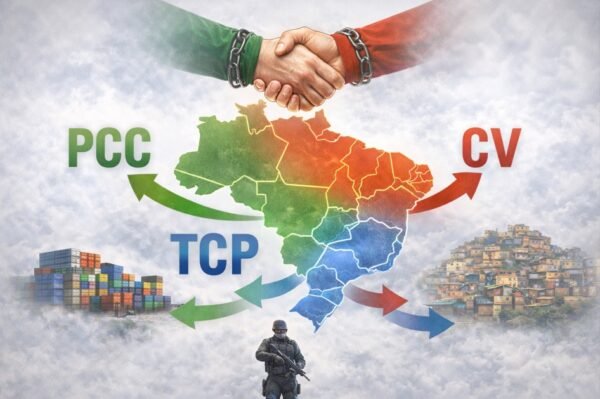
At least 17 Brazilian states have recorded the presence of criminal factions such as the First Capital Command (PCC), Red Command (CV), and Third Pure Command (TCP) operating through alliances either among themselves or with regional groups. A survey by Folha de São Paulo, based on investigations by the Federal Police and state civil police forces, as well as data from the Brazilian Forum of Public Security, indicates that these alliances are primarily pragmatic. Their objective is territorial expansion and the strengthening of illicit markets, with a clear focus on maximizing profits rather than maintaining fixed rivalries.
This Content Is Only For Subscribers
To unlock this content, subscribe to INTERLIRA Reports.
National Presence
The PCC and CV maintain a nationwide presence and exercise hegemony in at least 13 states, shaping the structure of organized crime across Brazil. States where a single faction dominates without competition, such as São Paulo under PCC control, are not included in this mapping. According to David Marques, program manager at the Brazilian Forum of Public Security, organized crime in Brazil has evolved from a local phenomenon into a national and even transnational network. This transformation accelerated after the rupture between the PCC and CV in 2016 and 2017, following the assassination of Jorge Rafaat, a key drug trafficking intermediary on the Paraguay border. After this episode, the PCC consolidated control over the Caipira Route, while the CV intensified its expansion into the North and Northeast regions through alliances with local groups.
Distinct Strategies
The two main factions have developed different operational models. The CV has maintained a strategy centered on armed territorial control and the exploitation of local criminal activities, often relying on visible dominance over communities. The PCC, in contrast, has focused on a more structured and business-oriented model, emphasizing wholesale drug distribution, logistical coordination, and partnerships that ensure the steady flow of narcotics. It has also expanded its activities into formal markets as part of its money laundering operations. Both factions operate with a transnational outlook, using Brazil as a strategic logistical hub to move drugs and access high-value consumer markets in regions such as Europe, Asia, and Africa.
The Advance of the TCP
One of the most notable recent developments is the expansion of the TCP, which has extended its influence beyond Rio de Janeiro and established alliances in at least ten states. In certain contexts, the group has aligned itself with the PCC to confront its historical rival, the Red Command. According to David Marques, the TCP is emerging as an expanding force, following a trajectory like that of the CV, although it remains smaller in scale compared to the two dominant factions. Researcher Bruno Paes Manso, from the Center for Violence Studies at the University of São Paulo, argues that these alliances are heavily influenced by longstanding rivalries, with the TCP becoming a natural partner for groups seeking to resist the expansion of the CV in various regions.
Reduction in the Number of Factions
Bruno Paes Manso also points out that Brazil is experiencing a reduction in the overall number of criminal factions, a process he describes as the consolidation of alliances. This shift is driven by a market-oriented logic, in which groups adopt increasingly rational strategies aimed at maximizing profits while minimizing costs. According to this perspective, factions have recognized that reducing violent conflicts lowers operational risks and expenses. As a result, this dynamic has contributed, in some areas, to a decrease in levels of violence and homicide rates, reflecting a transformation in how organized crime operates within the country.
Analysis:
The expansion of criminal factions across Brazil reflects a shift from fragmented local groups to integrated networks with national reach and strategic coordination. Organizations such as the First Capital Command and the Red Command have moved beyond territorial disputes to operate as structured systems focused on logistics, distribution, and market control. Their presence in multiple states, often through alliances with regional actors, demonstrates an adaptive model in which cooperation becomes more advantageous than constant conflict. This evolution indicates that organized crime in Brazil is increasingly guided by economic rationality, prioritizing stability and predictable returns over territorial confrontation.
At a broader level, the reduction in the number of factions and the consolidation of alliances suggest a maturation process within Brazil’s criminal landscape. Fewer, more organized groups tend to operate with greater efficiency, reducing internal disputes and, in some cases, lowering levels of overt violence. However, this does not necessarily indicate a weakening of organized crime; rather, it points to a transformation in its methods. As these groups become more sophisticated and less visible, they may exert deeper influence over legal and illegal markets, complicating enforcement efforts.
Sources: A Folha de SP.

