


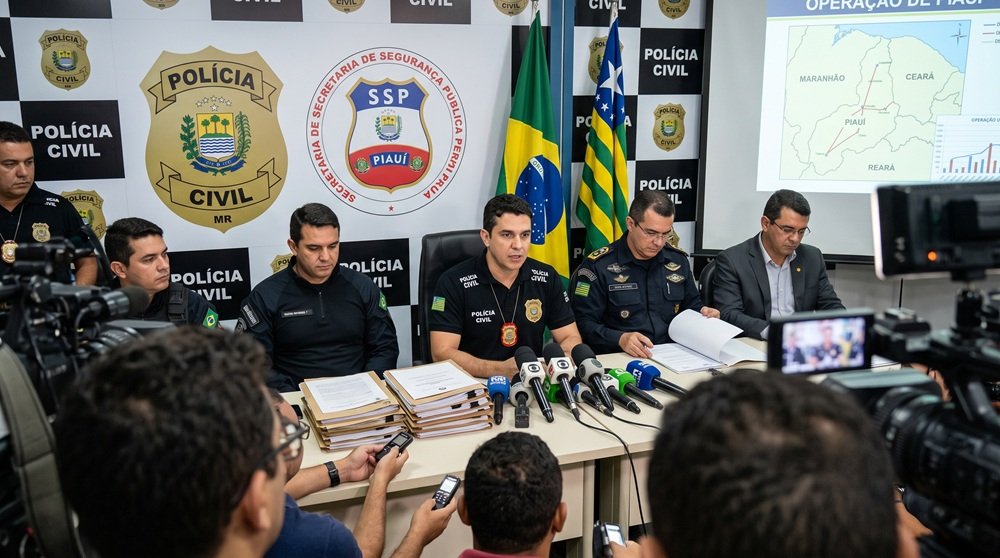
The Amaral Family, identified by security forces as a criminal structure operating in Piauí, Ceará, and Maranhão with ties to the Red Command (Comando Vermelho – CV), returned to the center of investigations following the discovery of a plot to assassinate two Civil Police Chiefs in Piauí. On Monday, September 28, the Secretariat of Public Security of Piauí (SSP-PI) launched an international-scope operation against ten suspects believed to be involved in an advanced plan by a criminal organization linked to the CV to assassinate delegates Charles Pessoa and Ayslan Magalhães. According to investigations, approximately R$ 1 million was set aside to hire hitmen from another state, as well as to supply weapons, vehicles, and a safe house. The case also highlights the expansion of the criminal organization’s connections beyond Brazilian borders.
This Content Is Only For Subscribers
To unlock this content, subscribe to INTERLIRA Reports.
Plot to Assassinate Delegates
One of the attacks was allegedly planned for Thursday, September 24, during a public event in the Mocambinho neighborhood, in the North Zone of the state capital, Teresina. However, intelligence services identified the plot in advance, and security forces acted to prevent its execution. Police also found that the suspects were tracking Charles Pessoa’s movements, including his routine at a gym and publicly announced commitments. The SSP-PI operation subsequently extended to Bolivia and Uruguay, with participation from Interpol, underscoring the international scale of the investigation.
Retaliation Against Anti-Drug Operations
Authorities are working under the hypothesis that the assassination plot was a retaliation for a series of police operations that caused significant financial losses to criminal groups in northern Piauí. Among the actions cited is an operation in Bom Princípio do Piauí, which resulted in the seizure of approximately one ton of drugs (primarily cocaine) hidden on a rural property. Ayslan Magalhães also stated that operations conducted since 2023 had been weakening criminal structures in the coastal region, and that an action carried out in December 2025 against a CV-linked cell caused an estimated R$ 60 million in losses to the factions.
The Amaral Family and the Expansion of the Red Command
The current investigation ties the latest plot to members of the Amaral family, a criminal network with a history of operations in Piauí, Ceará, and Maranhão, and links to the CV. Previous investigations identified family members as being involved in drug trafficking, illegal arms trading, robberies, and homicides. Authorities had previously described the organization as highly mobile, with members moving among the three states to evade police operations and sustain their criminal activities. The family network also demonstrated the ability to combine violent crime with organized financial operations to conceal illicit funds. In March 2026, four defendants linked to a CV core operating on the Piauí coast were sentenced to prison terms that combined exceeded 156 years for crimes including drug trafficking, money laundering, and membership in a criminal organization. Adriano do Amaral de Sousa, identified as the leader of the criminal core since 2019, received a sentence of over 73 years in prison.
Analysis
Investigations indicate that the criminal organization had moved past mere threats, structuring an operational plan to kill Charles Pessoa and Ayslan Magalhães. One of the key aspects identified is organized crime’s capacity to operate through family networks, command structures maintained from within the prison system, and transnational logistics. Authorities found evidence that orders continued to be relayed through intermediaries, while other members remained responsible for financing, logistics, and operational coordination. The investigation also uncovered potential ties to trafficking structures in Bolivia and Uruguay, which led to international cooperation measures involving Interpol. The combination of command from within prisons, interstate mobility, hiring external hitmen, substantial financial resources, and overseas connections demonstrates a resilient criminal structure, capable of maintaining operations even under heavy pressure.
Sources: GP1 [1], [2]; A10+; G1; Diário do Nordeste; 180 Graus; O Povo.

