


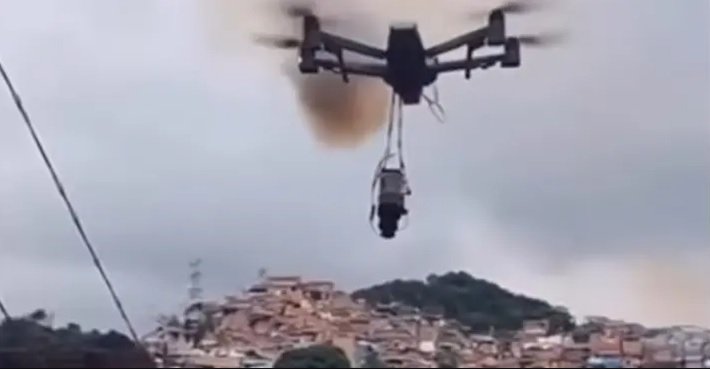
Police discovered that drug traffickers operating in the Complexo do Alemão, in Rio de Janeiro’s North Zone and controlled by the Red Command (CV), acquired large drones capable of transporting weapons and drugs between areas dominated by the faction. According to information from the Sub-Secretariat of Intelligence of the State Secretariat of Public Security, the aircraft can carry up to 80 kilograms of cargo — the equivalent of approximately 20 FAL or AR-15 rifles — and have an operational flight range of up to 12 kilometers.
This Content Is Only For Subscribers
To unlock this content, subscribe to INTERLIRA Reports.
Images
Images of training exercises involving one of the unmanned aerial vehicles were captured by cameras aboard a Military Police aircraft. The equipment, measuring approximately three meters in length, appears surrounded by at least ten individuals moments before takeoff. The flight reportedly took place in an open area with few nearby residences, although the exact date of the recording was not disclosed. According to investigators, the training sessions are conducted within areas of the Complexo do Alemão. The region, alongside the Complexo da Penha, is known for concentrating some of the main leaders of the CV who remain on the run.
Agricultural Models
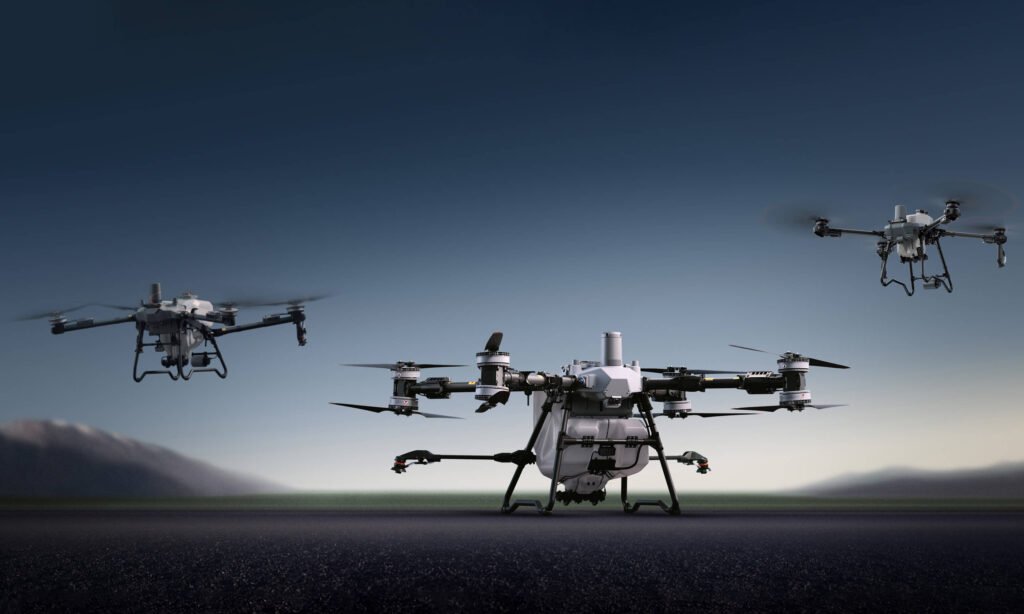
According to police investigations, the drones acquired by the faction are commercial models originally designed for agricultural spraying operations and cargo transport. Authorities estimate that each aircraft costs more than R$ 200,000. Investigators believe the autonomy of the equipment would allow traffickers to move weapons and narcotics between different territories controlled by the CV throughout Rio de Janeiro. From the Complexo do Alemão, the drones could reportedly reach communities such as Cidade de Deus, Jacarezinho, Complexo do Lins, and Complexo do Chapadão.
Rio das Pedras
The aircraft would also be capable of flying between the communities of Gardênia Azul, in Jacarepaguá, and Muzema, in Itanhangá — areas controlled by the faction and separated by approximately five kilometers. These territories are considered strategic because armed traffickers often depart from them in attempts to invade Rio das Pedras, a community historically regarded as one of the birthplaces of Rio’s militias and which remains under the control of paramilitary groups.
Use of Drones
This is not the first time that traffickers in Rio de Janeiro have used drones during criminal operations. In October 2025, during a police operation in the Complexo do Alemão and Complexo da Penha, criminals reportedly used smaller drones to monitor the movements of Civil Police and Military Police officers. According to authorities, the confrontation lasted approximately nine hours. The operation ended with 117 suspects and five police officers killed during the clashes.
Analysis:
The discovery that the Red Command is acquiring large cargo drones represents a significant evolution in the operational capacity of organized crime in Rio de Janeiro. Unlike the smaller drones previously used mainly for surveillance and monitoring police activity, these aircraft introduce the possibility of aerial logistical support for the transport of rifles, ammunition, and narcotics across multiple territories controlled by the faction. The ability to move up to 80 kilograms of cargo over distances of 12 kilometers creates a new security challenge because it reduces dependence on traditional ground routes, which are more vulnerable to police checkpoints and intelligence operations.

