


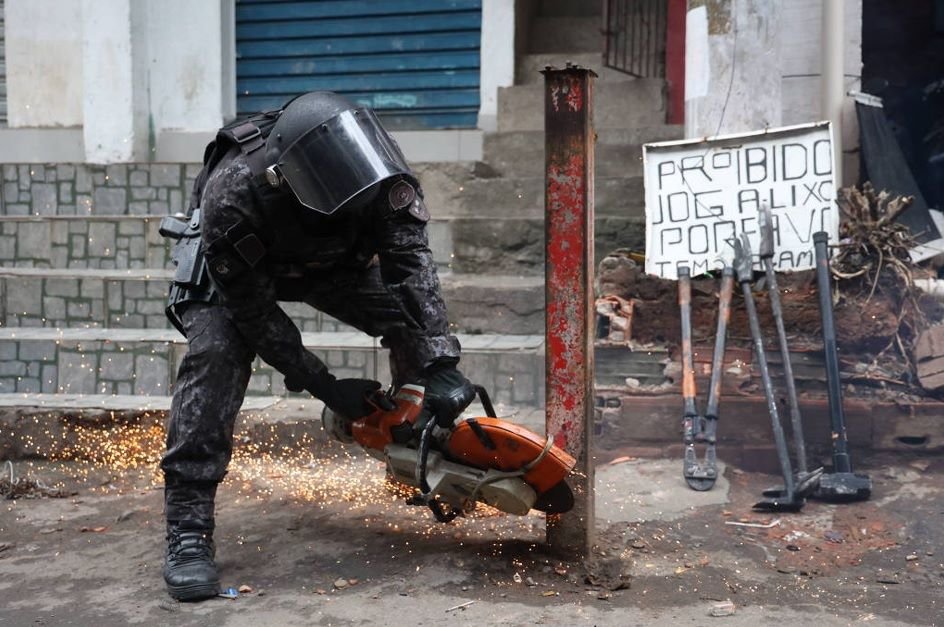
Escorted by military police officers, municipal workers began a new phase on Thursday (16/07) of removing barricades and speed bumps allegedly installed by criminals to restrict access to the Paraisópolis favela, in São Paulo’s South Zone. The operation is supported by teams from the 16th Metropolitan Military Police Battalion. According to the Military Police, the work is being carried out at locations where the structures were installed illegally and are obstructing vehicle traffic.
This Content Is Only For Subscribers
To unlock this content, subscribe to INTERLIRA Reports.
Clearing Roadways
The operation aims to clear the streets and ensure access for police vehicles, ambulances, fire department crews, and other public services, according to state police. During the operation, military police officers remained in the community to protect the removal teams and maintain order in the surrounding area. This is the second operation of its kind in Paraisópolis in less than a month. During the previous action in June, the state government stated that the structures had been placed in the streets to hinder operations against organized crime.
Weapons Seized
On the 7th, the Military Police reported finding an AK-47 rifle inside a building used by organized crime for drug production in Paraisópolis. The high-caliber weapon was fitted with a loaded drum magazine, which increases firing capacity, and was found alongside other loaded standard magazines. Inside the property, officers identified three areas—the police did not clarify whether they were individual rooms or entire apartments—used at different stages of the drug trafficking operation. The first area contained a refinery stocked with a “large quantity of cocaine” that had already been mixed and was ready for the final stages of preparation, as well as various tools used to process the narcotic, police said. In another area, officers seized bricks of cocaine base paste and various materials intended for packaging the drug. The AK-47 rifle was found in the third area, concealed inside the plaster ceiling.
Analysis:
The operation in Paraisópolis is significant because it reflects a form of criminal behavior that has traditionally been more characteristic of Rio de Janeiro than São Paulo. Unlike Rio’s major criminal factions, which frequently exercise territorial control through barricades, checkpoints, and restrictions on public access, the First Capital Command (PCC) has historically prioritized a more discreet operational model. Rather than openly controlling neighborhoods, the organization has generally focused on coordinating criminal activities through decentralized networks while seeking to avoid unnecessary confrontations that could attract sustained law enforcement attention. The installation of barricades to obstruct police access therefore represents a notable shift in the local security environment.
Sources: A Folha de SP.

