


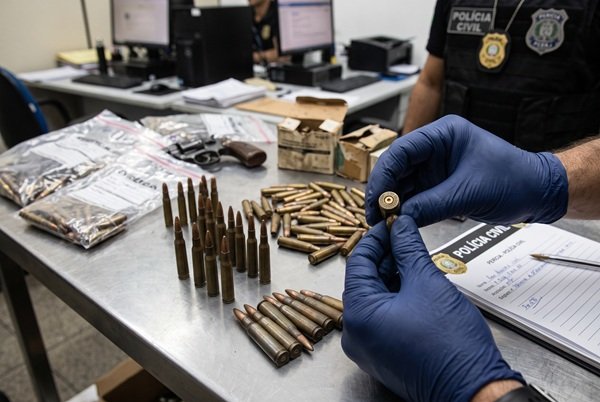
Recent police investigations and operations in Brazil have uncovered vulnerabilities in the control of firearms and ammunition, alongside suspicions of public security agents’ involvement with organized crime, particularly Red Command (Comando Vermelho – CV). On Sunday (10/11), the Sou da Paz Institute released a study showing that 40.9% of factory-original ammunition analyzed in seizures linked to CV was manufactured in Brazil, with a significant portion originally purchased by public security institutions or the Armed Forces. Two days later, on Tuesday (10/13), the Civil Police of Rio de Janeiro carried out an operation against a criminal organization suspected of supplying drugs, weapons, and ammunition to the faction, allegedly involving military police officers. These events, combined with a previous interstate investigation into gun registration fraud, highlight weaknesses in the oversight and tracking of legally acquired weaponry that ends up supplying criminal groups.
This Content Is Only For Subscribers
To unlock this content, subscribe to INTERLIRA Reports.
Brazilian Ammunition Found in Comando Vermelho’s Arsenal
On Sunday (10/11), the Sou da Paz Institute published a study analyzing 31,699 rifle cartridges linked to the Red Command, identified across 29 judicial cases between 2018 and 2025. Of the 29 cases analyzed, 10 involved ammunition in transit, 4 at storage locations, and 15 in active-use scenarios. Among the 31,205 factory-original rounds examined, 40.9% were produced in Brazil, followed by ammunition manufactured in Russia (28.1%) and the United States (14.1%). Of the domestic cartridges, 51.9% bore institutional traceability headstamps indicating they were originally purchased by the Armed Forces or public security institutions and, at some point, exited state control. However, out of the 119 headstamp codes identified, only 34 could be definitively traced back to the purchasing entities, exposing gaps in inventory management, documentation, and the tracking of diverted stock. The Sou da Paz Institute emphasized the urgent need to improve traceability mechanisms while broadening the production and transparency of public data on seized ammunition to prevent legally acquired stock from feeding criminal organizations.
Military Police Officers Investigated for Supplying Comando Vermelho
On Tuesday (10/13), the Civil Police of Rio de Janeiro, supported by the Military Police Internal Affairs Division (Corregedoria da Polícia Militar) and the Public Prosecutor’s Office of the State of Rio de Janeiro (Ministério Público do Estado do Rio de Janeiro – MPRJ), executed an operation targeting a criminal network suspected of supplying drugs, weapons, and ammunition to the Red Command, with alleged participation from military police officers. The Judiciary issued seven arrest warrants, executed at addresses in Del Castilho and Penha in Rio’s North Zone, Nova Iguaçu in the Baixada Fluminense, and Maricá in the Metropolitan Region. Three suspects were arrested, and officers seized a handgun, a radio communicator, and a stolen motorcycle. According to investigations, military police officers leveraged their positions to leak sensitive operational intelligence regarding police raids and participated in illicit arms and ammunition deals. The investigation began in October 2023 following the arrest of then-Sergeant Yuri Luiz Desiderati Ribeiro, who was later killed in July 2026 while transporting over 100 kilograms of cocaine along Avenida Brasil. Further inquiries revealed a structured network for purchasing, transporting, and distributing drugs and weapons to CV-controlled territories. Another military police officer, Eric da Silva Lobato, identified as a co-conspirator, remained a fugitive at the time of the operation.
Interstate Arms Diversion and Registration Fraud
A prior investigation on Monday (09/28) demonstrated how fraudulent documentation can be used to divert legally purchased firearms to criminal groups. During Operation Mercador, the Civil Police of Bahia executed over 25 search and seizure warrants across Bahia, Rio de Janeiro, Ceará, and Rio Grande do Sul, arresting eight suspects. Investigators found that the group acquired weaponry by fraudulently obtaining CAC (Collector, Sports Shooter, and Hunter) Registration Certificates using fraudulent psychological evaluations, proof of residence, and employment records. Rifles, carbines, and handguns of various calibers were ultimately recovered in the hands of major criminal syndicates, including Red Command (CV) and Bonde do Maluco (BDM). Police reported that the organization laundered money generated through illegal arms sales and that the diverted ammunition was used in drug trafficking operations and other violent crimes.
Analysis
These cases illustrate how organized crime in Brazil exploits internal vulnerabilities within firearm tracking and oversight mechanisms. The diversion of ammunition intended for security forces, the suspected involvement of police officers in criminal networks, and the use of fraudulent documents to procure legal firearms demonstrate how criminal groups leverage institutional weakness, corruption, and formal market channels to sustain their operations. Furthermore, the interstate nature of these networks highlights the logistics and financial coordination capabilities of these factions, allowing them to project power far beyond their core territories.
For the corporate sector, this scenario poses risks that extend well beyond localized armed violence in faction-controlled areas. The widespread availability of weaponry, paired with potential criminal infiltration in public institutions and private firms, increases the risk of violent confrontations, cargo theft, supply chain disruptions, and exposure of field personnel. The involvement of public agents also highlights the limits of security strategies that rely solely on reactive police interventions, as leaked intelligence and corruption can compromise law enforcement operations and ongoing investigations.
For businesses operating in affected areas, continuous monitoring of criminal activity, transit routes, police actions, and mobility disruptions remains essential.
Sources: CNN Brasil [1], [2]; G1; Sou da Paz; O Globo; Folha de SP; O Dia.

