


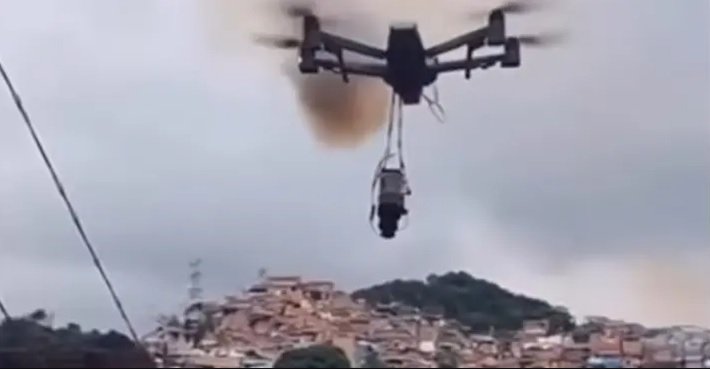
Teams from the Special Operations Battalion (BOPE), the Canine Action Battalion (BAC), and the 18th Military Police Battalion (Jacarepaguá) have been operating in Gardênia Azul, in the West Zone of Rio de Janeiro, since Monday (30/03). The objective is to locate suspects responsible for launching a drone carrying a homemade explosive device against police officers on Saturday (28). The attack occurred in the Vila Sapê community, in Curicica, within the same region, and did not result in injuries. According to residents, a house was struck by the device, causing structural damage to its walls. The area has been experiencing a series of violent disputes between rival groups, as criminals linked to militias attempt to regain control of territory currently dominated by the Red Command (CV).
This Content Is Only For Subscribers
To unlock this content, subscribe to INTERLIRA Reports.
Drone Launched Against Police Officers
The drone attack targeted officers from the 18th BPM who were conducting routine patrol operations in Vila Sapê. Investigations indicate that the individuals involved fled and sought refuge in Gardênia Azul, prompting the ongoing operation. In addition to capturing those responsible, police teams aim to seize illegal weapons, drugs, and recover stolen or cloned vehicles. At least gunfight has already occurred during the operation, resulting in the arrest of one suspect. Authorities also seized a rifle, a grenade, a pistol, ammunition, narcotics, magazines, a radio communication device, and an armored vehicle equipped with firing ports designed to support the use of long firearms.
Confrontation with one dead and four injured
The current operation follows another police action carried out on Sunday (29/03) in the same region. On that occasion, officers from the 18th BPM were patrolling Avenida Tenente-Coronel Muniz de Aragão when they were ambushed by armed individuals traveling in at least two vehicles. A shootout ensued, and five suspects—each reportedly with prior criminal records—were found injured. One of them died, while the others were taken for medical assistance. During the incident, police seized four rifles, three grenades, and two vehicles used by the suspects.
Use of Drones
The Civil Police have also expanded the use of drones in operations against organized crime in Rio de Janeiro. The equipment, imported from China, includes six different models equipped with advanced capabilities such as thermal sensors for detecting suspects in forested or hidden areas and night-vision imaging systems. These drones are operated by the recently created Coordination of Operations with Unmanned Aircraft (Coant). According to Civil Police Secretary Delmir Gouvea, the captured images are transmitted in real time to a monitoring center located at the City of Police complex, in the Jacaré neighborhood. The exact number of devices has not been disclosed for strategic reasons. Each drone model is designed for specific types of operations and is handled by trained personnel.
Facial and License Plate Recognition
Some of the drones acquired by the police are equipped with facial recognition and license plate reading systems, allowing integration with existing law enforcement databases used to identify wanted individuals and stolen vehicles. Another model is designed for stealth operations, enabling it to fly without being easily detected. These technologies are intended to enhance intelligence gathering and operational efficiency in high-risk areas.
Analysis:
The attempted drone attack against police forces in Gardênia Azul marks a significant escalation in the tactical repertoire of criminal groups operating in Rio de Janeiro. The use of improvised explosive devices delivered by drones suggests a shift toward methods more commonly associated with conflict zones, indicating a process of technological adaptation by organized crime. In areas such as Vila Sapê, where territorial disputes between militias and factions like the Red Command (CV) are ongoing, innovation in weaponry reflects both the intensity of competition and the need to counter increasingly sophisticated police operations.
At the same time, the expansion of drone use by law enforcement, combined with facial recognition and real-time data integration, points to a parallel process of modernization within the state apparatus. This technological convergence creates a new operational environment in which both criminals and authorities increasingly rely on surveillance, mobility, and data. The effectiveness of this approach will depend not only on equipment but also on intelligence integration, legal frameworks, and oversight mechanisms.

