


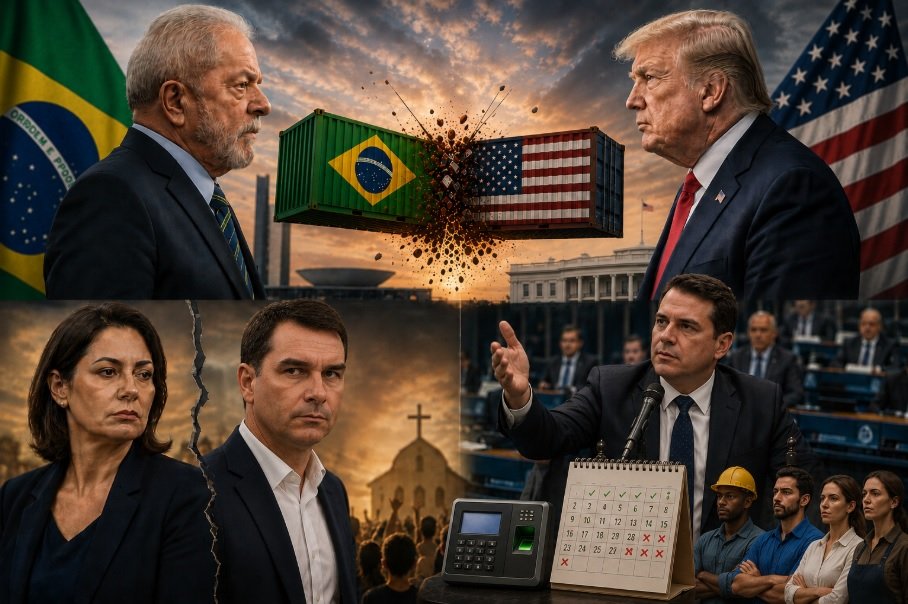
Brazil’s political and trade agenda enters a critical juncture this week as multiple fronts converge simultaneously. On the trade front, public hearings before the USTR are set to begin on Monday, opening the decisive phase of a U.S. investigation that could impose an additional 25% tariff on Brazilian goods ahead of a July 15 deadline — while Senator Flávio Bolsonaro made the unusual move of formally requesting a 180-day postponement of the tariffs from Washington, arguing that the measures have paradoxically strengthened Lula’s political standing rather than pressuring the Brazilian government. Within the opposition, the fallout from Michelle Bolsonaro’s public break with her stepson deepened further, as reports indicate she is now virtually certain not to support his presidential candidacy under any circumstances, dealing a significant blow to his strategy of expanding support among female and Evangelical voters. Meanwhile, in Congress, the debate over the PEC ending the 6×1 work schedule gained new momentum as Senate President Davi Alcolumbre advocated for scrapping the transition period approved by the Chamber of Deputies, reflecting ongoing tensions between business groups demanding more time to adapt and labor advocates pushing for swift implementation.
This Content Is Only For Subscribers
To unlock this content, subscribe to INTERLIRA Reports.
Tariffs
Public hearings organized by the Office of the United States Trade Representative (USTR) are scheduled to begin on Monday (06/07), marking a decisive stage in the U.S. trade investigation that could result in an additional 25% tariff on Brazilian products. Representatives from Brazilian industry and agribusiness are expected to participate, arguing that the proposed tariffs would negatively affect not only Brazilian exporters but also U.S. companies, consumers, and supply chains. At the same time, technical teams from both governments are expected to meet during the week to prepare for a final round of high-level negotiations before July 15, the deadline for Washington to decide whether to implement the proposed measures.
Postponement
Senator Flávio Bolsonaro (PL) submitted a formal request to the Office of the United States Trade Representative (USTR) seeking a 180-day postponement of the implementation of new U.S. tariffs on Brazilian exports. The request would delay the additional 25% tariffs until after Brazil’s presidential election. In the document, Flávio argues that the previous tariff increases imposed by the United States failed to produce the intended political results or alter the conduct of Brazilian authorities. According to the senator, the tariff measures have instead strengthened President Lula’s administration politically during an election year, allowing the government to portray the U.S. actions as attacks on Brazil’s national sovereignty.
No Support
Michelle Bolsonaro held a lengthy meeting with PL president Valdemar Costa Neto on Tuesday (30/06). According to individuals familiar with the discussion, there is virtually no possibility that she will support Flávio Bolsonaro’s presidential candidacy under any circumstances. However, she is still considering a possible Senate bid representing the Federal District. The public rift between Michelle and her stepson erupted a week earlier and has become an ongoing political challenge for Flávio, particularly as he seeks to improve his standing among female voters, especially within the Evangelical electorate.
6×1 Work Schedule
During a meeting with representatives of labor confederations on Wednesday (01/07), Senate President Davi Alcolumbre (União Brasil) defended eliminating the transition period established in the Proposed Constitutional Amendment (PEC) that would end the “6×1” work schedule—six consecutive working days followed by one day off—and reduce the legal workweek from 44 to 40 hours. The proposal, approved by the Chamber of Deputies in late May, provides that the new work schedule would take effect 60 days after the amendment is enacted. The transition period has become the central point of debate surrounding the proposal. Business associations and employer confederations have argued that companies need additional time to adapt, while the federal government, despite initially opposing a transition period, later agreed to a gradual implementation of the reduced workweek.
Analysis:
Brazil is entering a period in which foreign policy, trade, and domestic politics are becoming increasingly interconnected. The U.S. tariff investigation has evolved beyond a commercial dispute and now carries clear political implications for both governments. Senator Flávio Bolsonaro’s request to postpone the tariffs until after the presidential election reflects an acknowledgment that external economic pressure can influence domestic political dynamics in unintended ways. Rather than weakening the federal government, trade restrictions can generate a rally-around-the-flag effect, allowing the administration to frame itself as defending national economic interests.
Within the opposition, Michelle Bolsonaro’s refusal to support Flávio Bolsonaro represents a significant political setback because it affects one of the campaign’s main objectives: broadening its appeal beyond its traditional electoral base. Her influence among conservative women and Evangelical voters has made her one of the opposition’s most valuable political figures.

