


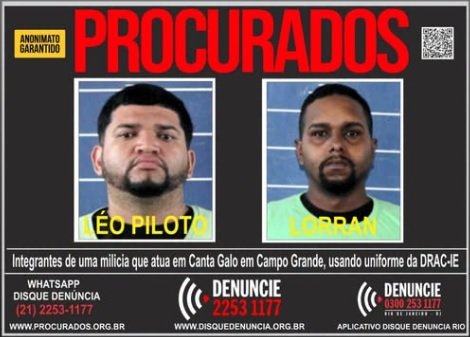
Agents from the Station for the Repression of Organized Criminal Actions and Special Inquiries (Draco/IE) launched an operation on Thursday (16/07) targeting a militia group that used counterfeit uniforms during armed patrols in the Magarça area of Campo Grande, in Rio de Janeiro’s West Zone. The operation seeks to arrest suspects and execute search and seizure warrants. The investigation began after videos circulated showing heavily armed men patrolling the streets during the early hours of July 4. In the footage, the suspects appear wearing tactical gear and displaying Draco insignia in an attempt to pose as Civil Police officers.
This Content Is Only For Subscribers
To unlock this content, subscribe to INTERLIRA Reports.
Identified
Based on an analysis of the footage and additional evidence gathered during the investigation, agents identified two of the suspects: Leonardo Torres Gomes, known as “Léo Piloto,” and Lorran Vasconcelos Martins. According to the Civil Police, both are members of the armed wing of the militia led by Paulo Roberto de Carvalho Martins, known as “PL.”
Advance of the Red Command
According to investigators, the armed patrols were intended to block the advance of drug traffickers from the Red Command, which has been attempting to seize control of the area. Police state that the operation was intended as a demonstration of the militia’s strength amid the ongoing territorial dispute between the criminal groups. The Civil Police also report that Léo Piloto and Lorran are responsible for securing the area under the militia’s control, helping preserve the organization’s dominance over the region. According to the investigation, residents and business owners are subjected to systematic extortion, threats, and other forms of violence carried out by the group.
Analysis:
The use of counterfeit police uniforms by organized criminal groups represents a significant escalation in operational sophistication because it allows offenders to exploit the authority and legitimacy associated with law enforcement. By presenting themselves as police officers, criminals can move more freely through contested areas, approach potential victims without immediately raising suspicion, and collect intelligence on rival groups or local residents. This tactic also complicates the work of legitimate security forces, as it becomes more difficult for civilians to distinguish between official operations and criminal activity, eroding public trust in law enforcement institutions.
Criminal organizations may also use counterfeit uniforms to establish fake checkpoints, kidnappings, extort businesses, transport weapons, or facilitate territorial control while reducing the likelihood of immediate resistance from the population. In areas already affected by disputes between militias and drug trafficking organizations, these tactics can further intensify instability and increase the complexity of police operations.

