


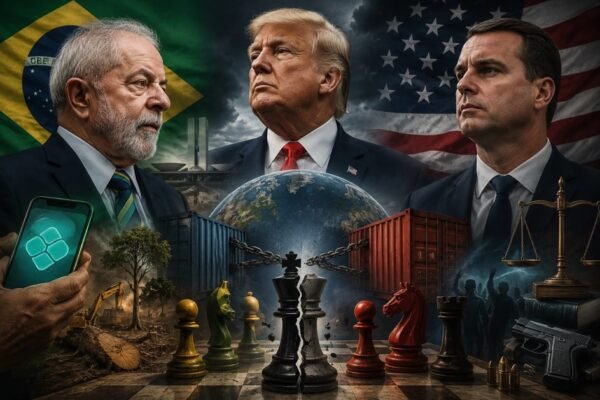
Brazil’s political and economic environment is growing increasingly contentious as the 2026 election season approaches, with tensions between Brasília and Washington taking center stage. The United States proposed a 25% tariff on a broad range of Brazilian exports following a trade investigation that cited concerns over PIX, deforestation, intellectual property, and anti-corruption enforcement — prompting a sharp response from President Lula, who accused Senator Flávio Bolsonaro of working against Brazil’s national interests after a meeting between the senator and U.S. Secretary of State Marco Rubio. On the domestic front, the Lula administration released a record R$16.1 billion in parliamentary amendment funds in May, seeking to build congressional support for the labor reform ending the 6×1 work schedule. Meanwhile, opposition lawmakers are pushing their own legislative agenda ahead of the elections, advancing bills on abortion restrictions, firearm regulations, and a proposed constitutional amendment to lower the age of criminal responsibility — measures closely aligned with Flávio Bolsonaro’s campaign platform.
This Content Is Only For Subscribers
To unlock this content, subscribe to INTERLIRA Reports.
New Tariff
The United States concluded on Monday (01/06) a trade investigation alleging that the Brazilian government maintains practices that “burden or restrict” commerce with the United States. Among the issues cited were Brazil’s PIX instant payment system, illegal deforestation, intellectual property violations, and alleged shortcomings in the enforcement of anti-corruption legislation. As a result of the investigation, the Office of the United States Trade Representative proposed the imposition of a 25% tariff on a range of Brazilian products. The agency, however, included a list of exemptions for goods considered strategically important to the U.S. economy, including meat, fruits, coffee, aircraft, rare earth minerals, and other selected products. After the U.S. Supreme Court ruled that a previous tariff imposed by President Donald Trump was unlawful, the investigation conducted under the Trade Act became one of Washington’s principal instruments for applying economic pressure on Brazil.
Lula’s Response
President Lula (PT) criticized the Trump administration’s proposal to impose a new 25% tariff on Brazilian exports and accused Senator Flávio Bolsonaro (PL), his likely opponent in the October election, of acting against Brazil’s national interests. During a public statement, Lula emphasized that his administration has been engaged in negotiations with the U.S. government since last year and argued that the proposal emerged only days after Flávio Bolsonaro met with Secretary of State Marco Rubio. The president subsequently referred to the Bolsonaro family as a “a family of criminals,” described the former president’s sons as “Bolsonaro’s boys,” and accused them of contributing to measures that could harm the country’s economic interests.
Payment of Amendments
The Lula administration accelerated the release of parliamentary amendment funds in May in an effort to secure congressional support for the proposal to end the 6×1 work schedule and to comply with a new budgetary rule requiring that most of these resources be transferred by midyear. In total, the federal government released R$16.1 billion in amendments during the month, allowing lawmakers to direct funds to projects in their political strongholds. The amount represents the largest monthly transfer of parliamentary amendment resources during Lula’s current term. According to government officials involved in congressional negotiations, the increase in payments was driven both by the new budget timetable and by the need to build sufficient support for the approval of labor reforms related to the end of the 6×1 work schedule.
Electoral Agendas
Opposition lawmakers are seeking to use the final legislative period before the 2026 elections to advance proposals that have become key priorities for the Brazilian right. In recent weeks, Congress has moved forward with a bill aimed at tightening abortion regulations and another proposal that would ease restrictions on the possession and carrying of firearms. There is also an expectation that the Constitution and Justice Committee (CCJ) of the Chamber of Deputies will examine a Proposed Constitutional Amendment next week that would lower the age of criminal responsibility from 18 to 16. The issue has become one of the themes promoted by Senator Flávio Bolsonaro (PL-RJ) as part of his presidential campaign platform.
Analysis:
The proposed U.S. tariffs represent more than a trade dispute; they have become part of Brazil’s domestic political debate as the presidential campaign approaches. By linking economic measures to issues such as digital payments, environmental policies, intellectual property, and governance standards, Washington has broadened the scope of bilateral tensions beyond traditional trade concerns. Lula’s decision to directly associate the tariff proposal with Flávio Bolsonaro’s contacts within the U.S. administration demonstrates how foreign policy is increasingly being incorporated into electoral narratives. As a result, relations with the United States may become a campaign issue in their own right, with both sides attempting to portray themselves as the true defenders of Brazil’s national interests.
Sources: O Globo [1], [2], [3], [4]; A Folha de SP [1], [2]; G1; CBN.

