


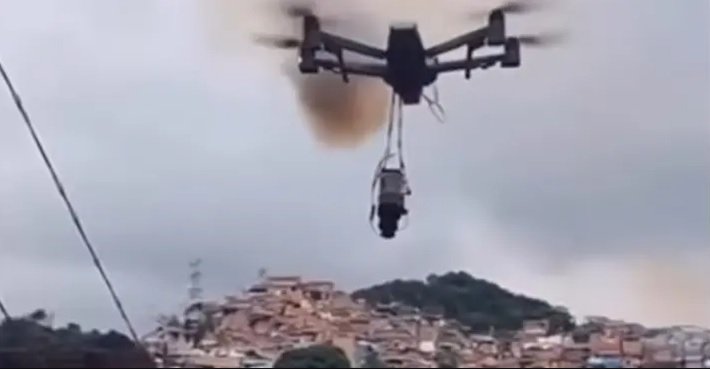
Clashes between rival criminal factions have found a new battlefield: the skies over Rio de Janeiro. Since March, at least seven incidents involving explosive devices dropped by drones have been recorded, either during criminal training exercises or in actual attacks. Most occurred over the past three months, a period marked by an intensification of territorial disputes. The most recent case took place on Saturday (01/08), when two people preparing amusement rides for a children’s street party were injured after a bomb was dropped from a drone in Favela dos Dourados, in the Cordovil neighborhood of Rio’s North Zone. Between Monday night (03/08) and the early hours of Tuesday (04/08), another confrontation involving drone-dropped explosives was recorded in the Complexo da Penha, also in the North Zone.
This Content Is Only For Subscribers
To unlock this content, subscribe to INTERLIRA Reports.
CV vs. TCP
The community, mostly controlled by the Red Command (CV), has been targeted by traffickers from the Third Pure Command (TCP) linked to Álvaro Malaquias Santa Rosa, known as “Peixão.” The faction leader controls neighboring favelas, including Parada de Lucas, Cidade Alta, Vigário Geral, Pica-Pau, and Cinco Bocas, an area he has called the “Complexo de Israel.”
Wind Postpones ‘Training Session’
Before the attack in Favela dos Dourados, a grenade exploded and struck a building in the Complexo da Penha during the early hours of the 31st, in what authorities suspect was a training exercise involving the use of drones for combat or for monitoring rival groups and police forces. Drug trafficking in this cluster of favelas is controlled by Edgar Alves de Andrade, known as “Doca” or “Urso.” According to the police, he is suspected of being part of the CV leadership and of ordering attacks against territories controlled by rival groups. Authorities are also investigating reports that a “training session” intended to teach criminals how to operate the equipment had been scheduled in the Complexo da Penha. The event was announced in a social media post published by an individual linked to a local drug trafficker. However, the drone operation class scheduled for July 17 did not take place. The cancellation was reportedly caused by unfavorable weather conditions, particularly strong winds.
Multiple Uses
A police officer investigating drug trafficking in the Complexo da Penha area stated that criminals not only use drones to drop grenades but also possess unmanned aircraft capable of detecting other devices of the same type. The equipment is also used for surveillance and reconnaissance. “The system functions like radar, indicating whether another drone is operating nearby and identifying the approximate location from which it is being controlled,” the investigator explained.
Morro da Caixa D’Água
The people injured in the explosion in Favela dos Dourados are not the only victims of this airborne threat. On May 29, a 15-year-old boy suffered a compound fracture to his leg while at Morro da Caixa D’Água, in Penha, after a drone allegedly dropped a grenade on the area. Nearly two months earlier, on March 30, another explosive device struck a building in Vila do Sapê, in Curicica, in Rio’s Southwest Zone. That incident occurred during an attack by CV traffickers against an area controlled by a militia. Additional incidents were recorded in June and July. Among the most notable were a building struck by an explosive in Parque Dois Irmãos, in Curicica, and a grenade found on the roof of a daycare center in Favela do Dique, in Jardim América, in the North Zone. In the latter case, the device was found intact and had to be safely detonated by the police bomb squad.
From Anti-Drone Rifles to Training for Drug Traffickers in Ukraine
Although drone-related incidents have become more frequent in recent months, state public security agencies have been investigating the use of such equipment by criminal organizations since 2017, when authorities discovered that Álvaro Malaquias Santa Rosa, known as “Peixão” and identified as a TCP leader, had acquired drones. As the drug trafficking boss of the Complexo de Israel, Peixão reportedly used the aircraft to monitor rivals, particularly members of the CV in Penha, as well as law enforcement personnel. Since then, the use of drones by criminal groups has expanded. In 2024, the Federal Police arrested a man in Nova Iguaçu, in the Baixada Fluminense region, as he received an anti-drone rifle through the postal service. That same year, the Civil Police investigated an individual who piloted a drone used to drop a homemade explosive on a community in Cordovil, in the North Zone. The following year, the Capital’s Narcotics Enforcement Division (DRE) opened an investigation into a Brazilian man linked to the CV who had volunteered to fight in the war between Russia and Ukraine. He had reportedly traveled to Eastern Europe with funding from the faction to improve his knowledge of guerrilla warfare tactics and later teach them to associates in Rio de Janeiro. A similar case involved another member of the group who, after returning from Ukraine, was spotted by a Military Police aircraft while conducting training with a drone measuring approximately three meters in the Complexo do Alemão.
Large-Scale Drones
The development does not end there. Federal Police investigations that resulted in the 2025 arrest of former state deputy Tiego Raimundo dos Santos Silva, known as “TH Jóias,” for alleged involvement with the CV revealed that he and an aide had negotiated the illegal purchase of anti-drone equipment for the faction. The intercepted conversations indicated that part of the R$ 750,000 transaction was settled through a payment of R$ 55,000 made in R$ 2 banknotes. Meanwhile, investigations conducted this year by the Intelligence Subsecretariat of Rio de Janeiro’s Department of Public Security found that traffickers in the Complexo do Alemão, an area controlled by the CV, had acquired large drones originally designed for agricultural operations and cargo transportation. These aircraft can carry loads of up to 80 kilograms, approximately the combined weight of 20 assault rifles, operate over distances of up to 12 kilometers, and cost more than R$ 200,000 each.
Analysis:
The increasing use of drones to conduct attacks represents a significant escalation in the operational capabilities of Rio de Janeiro’s criminal organizations. What was once primarily a tool for surveillance has evolved into a weapons platform capable of projecting violence beyond traditional territorial boundaries. By allowing explosive devices to be delivered remotely, drones reduce the direct exposure of attackers while creating new risks for rival gangs, security forces, and civilians. The recent incidents also indicate that criminal organizations are investing in technical training and adapting tactics observed in modern conflicts, demonstrating a willingness to incorporate commercially available technologies into their operational doctrine.
This trend reinforces the need for law enforcement to expand its focus beyond conventional policing. Counter-drone technologies, electronic detection systems, intelligence collection, and specialized training will become increasingly important components of public security strategies. At the same time, preventing criminal organizations from accessing advanced equipment through stronger oversight of imports, supply chains, and illicit markets will be just as important as responding to attacks after they occur.

